

Choosing a power bank line for resale or private label is not the same decision as choosing one for yourself. A retail buyer cares about weight and colour. A distributor has to live with the number for months: certification files that must match the exact model ordered, packaging that survives an airline’s inspection, a capacity claim that will not be challenged at retail, and a second order that costs the same as the first.
This guide walks through the five decisions that actually determine whether a power bank range works commercially — capacity band, form factor, port configuration, compliance paperwork, and freight mode — and the specific 2026 regulatory changes that are now affecting how these products are shipped and sold into the EU.
1. Start with the capacity band, not the individual model
Milliamp-hours is the most quoted and most misunderstood number on the specification sheet. Two things sit behind it: the nominal capacity printed on the cell, and the rated output capacity actually delivered at the end of discharge. Conversion losses mean the second is always lower — typically around 60–70% of nominal for a given power bank. When you brief a supplier, ask for both, and ask for the watt-hour figure as well, because air-freight classification and airline acceptance are calculated on Wh, not on mAh.
For most ranges, four bands cover the market:
- 1,000–5,000 mAh — pocket-size, emergency-use units. Low ticket price, high turnover, and the easiest range to keep in a retail display. See our 1000–5000mAh power banks.
- 5,001–10,000 mAh — the volume band. These are the units that sell on their own, without being bought as an accessory to something else. Our 5001–10000mAh range is the one most distributors start with.
- 10,001–20,000 mAh — where the buyer expects a laptop or tablet to charge. Bulkier, higher unit cost, and usually sold with a clear output specification. See 10001–20000mAh power banks.
- 20,000 mAh and above — a specialist range with a small number of models. Buyers in this band need the Wh figure, the cell configuration and the freight implications stated up front.
2. Match the form factor to the channel that sells it
The same capacity sells very differently depending on where it sits. The most useful question to ask is which shelf it will sit on.
- Compact and keychain sizes move through gift shops, convenience retail and accessory bundles. Our mini power banks and keychain power banks sit here.
- Slim and built-in-cable models are the travel and e-commerce range: fewer cables to lose, and the built-in cable becomes the reason a shopper picks your unit over a generic one. See built-in cable power banks.
- Display-equipped models — LED percentage displays and LCD status screens — are the easiest way to justify a price premium in retail, because the buyer can see remaining charge rather than guessing from four LEDs. See LED display power banks.
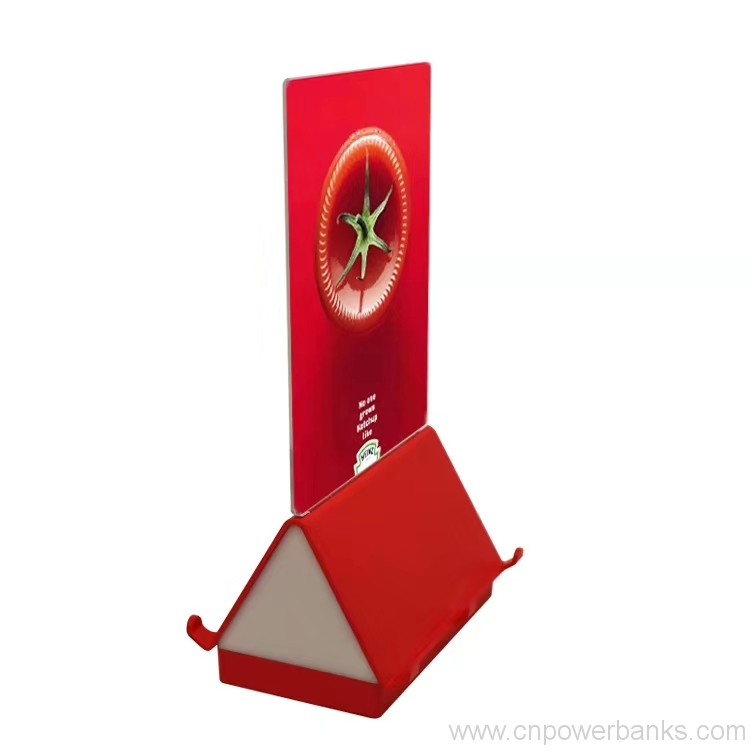
The display is also the easiest specification to verify before shipment: a working sample tells you in seconds whether the indicator is driven by the same cell that is actually being sold.
- Outdoor and solar models are a merchandising decision, not a performance one. Solar is a backup top-up, not a wall-socket replacement: a small built-in panel extends standby life a little, but it will not meaningfully charge a phone. Sell it on standby value and set expectations accordingly — buyers trust products that describe the limit honestly. See solar power banks and outdoor power banks.
- Car jump starters carry a different compliance profile again, because peak current and lead-acid content change both the shipping and the labelling position. Treat them as a separate range. See car jump starter power banks.
3. Get the port configuration right before you commit
Buyers increasingly expect USB-C on both sides, and expect the input and output ports to be usable at the same time. The specification questions that decide this are simple but frequently skipped: how many ports are available simultaneously, whether output power is shared across them, and whether USB Power Delivery is supported on output as well as input.
A multi-port unit that cannot charge a phone and a tablet at once is a different product from one that can, and retail listings rarely make that clear. Our multi-port power banks and single-port models are listed with their port counts for exactly this reason. If your range includes higher-capacity units, check the laptop power bank models separately — the output specification there is the specification that matters.
4. Compliance files: the part that decides whether your shipment clears
This is where most first-time importers get caught, and it is entirely avoidable. Four things to establish with any supplier before you place an order:
- UN 38.3 — the transport safety test series for lithium cells and batteries. The UN 38.3 test summary, not a marketing certificate, is the document carriers and customs will ask for, and it must identify the exact cell or battery model.
- CE and RoHS for the EU market, and FCC for the US. Under EU Battery Regulation (EU) 2023/1542, CE marking for batteries became mandatory on 18 August 2024.
- A safety data sheet (MSDS/SDS) for hazard communication. Worth being precise here: an SDS is not a transport document and does not replace a dangerous goods declaration or the test summary. It supports the paperwork; it does not substitute for it.
- Model correspondence. The single most common cause of a rejected consignment is a test report that does not match the model actually shipped. Ask for reports listing every model in your order, not a representative sample.
One change is already in force and will reach you during 2027 planning. From 18 August 2026, batteries placed on the EU market must carry a QR code giving access to key product, safety and recycling information. Portable batteries below 2 kWh — which covers every power bank in this catalogue — are excluded from the full digital battery passport obligation that follows in February 2027, but the QR code requirement still applies. If you are building a range for the EU now, ask your supplier how the QR code is generated and where it links to.
5. Air freight in 2026: the 30% state-of-charge rule is no longer a recommendation
Lithium battery air shipments are governed by the IATA Dangerous Goods Regulations, and the 67th edition, effective 1 January 2026, tightened several of the rules that buyers previously treated as guidance:
- Standalone lithium-ion batteries (UN3480, packing instruction PI 965) must be offered at 30% state of charge or less.
- From 1 January 2026, the same 30% limit applies to lithium-ion batteries packed with equipment under PI 966 where the cell or battery exceeds 2.7 Wh. This is the change that catches people out, because it extends a rule that many still associate only with standalone batteries.
- Batteries contained inside equipment (PI 967) remain under a strong recommendation rather than a universal mandate — 30% is advised, not required.
- UN 38.3 Revision 8 became globally mandatory on 1 January 2026 alongside the 67th edition. Reports issued to Revision 6 or 7 are no longer accepted for new consignments, so check that your supplier’s documentation was refreshed rather than carried forward.
- Sodium-ion batteries now have their own classification — UN 3551 standalone and UN 3552 packed with equipment — under packing instruction PI 978. Not relevant to a lithium range today, but relevant if you diversify later.
Labelling is where most rejections occur. The UN number must be legible at a minimum character size, the Class 9 lithium battery mark and the “keep away from heat” consignee mark are both required, and Section II packages must withstand a three-metre stack test. Sea freight is materially more forgiving: the IMDG Code, including Amendment 42-24 effective 1 January 2026, does not carry the air state-of-charge limits — though the UN number, packaging, marking and carrier acceptance still have to be checked for the specific configuration.
6. Verify the supplier before you place a first order
A factory that can produce is not the same as a factory that can document. Before committing, run three checks:
- Ask for documentation against your exact order list — model numbers, rated capacity, cell supplier. If the supplier is vague about which cell goes into which model, stop there.
- Confirm a sample matches the production specification, in writing, including the packaging you will be shipping in.
- Walk the production line. Our factory tour page shows the equipment and assembly steps we work with, and our company page sets out who we are and how we operate. A supplier who declines either is telling you something.
7. Five mistakes that cost buyers money
- Buying on mAh and ignoring Wh. Wh governs freight classification and airline acceptance; mAh alone tells you nothing useful for logistics planning.
- Accepting certificates that do not match the model. A valid report for a different cell is worth nothing at the border.
- Forgetting that labelling is a freight requirement, not packaging design. Non-compliant marks mean a refused or held consignment, and the cost lands on the shipment, not the supplier.
- Over-marketing the features that depend on conditions. A solar panel or a rugged shell is a selling point; it is not a claim about charging speed or water resistance certification.
- Not fixing the second-order terms before the first order. Unit price, tooling cost, sample fees and the MOQ at which quantities change should all be agreed in writing for the range, not negotiated per shipment.
If you have a target capacity, port configuration and destination market in mind, send us the specification and we will tell you which models we can supply against it and what documentation we can provide. Send your enquiry here — tell us the capacity band, the ports, the target country and any certification you need, and we will come back with a concrete answer rather than a catalogue.
Regulatory references in this article reflect requirements effective as of October 2026: IATA DGR 67th edition (1 January 2026), UN 38.3 Revision 8, IMDG Amendment 42-24, and EU Battery Regulation (EU) 2023/1542. Rules are amended annually — confirm the current edition with your forwarder before shipping.