

A campsite has no socket. It has a vehicle, and the vehicle has a 12 V socket that keeps working with the engine off. Two numbers follow from that, and they decide everything else: the pack has to take 12-14 V in, and it has to put 19 V out for the laptop. Capacity, weight and port count are the trade-offs you negotiate around those two numbers, not the other way round.
This guide works through one configuration that answers both requirements, the 16,000mAh multi-voltage pack in our laptop and tablet power bank for camping range, and then lists the checks that decide whether any model is worth putting into a group buy. It is written for the buyer who has to specify one model and defend the choice, so each section ends on something you can measure or ask for in writing.
What a Campsite Actually Asks For: 12 V In, 19 V Out
A pack for this job runs on two schedules. During the day it feeds the laptop at 19 V from a battery sitting in a daypack. At night it refills itself from whatever the vehicle can offer. Most consumer power banks solve only the first schedule: 5 V in through USB-C, 5 V out through USB-A. That is a phone pack with a large battery, and no amount of capacity fixes the missing input.
The failure is easy to spot on a spec sheet. If the input line reads 5V/2A or 5V/3A with nothing else, the pack cannot be refilled from a cigarette socket without an inverter, and an inverter that runs all night takes more space than the pack saves. What you want on the input line is a DC window, 12-14 V in the case of the unit here, because that is the range a vehicle electrical system actually produces: about 12.0-12.6 V with the engine off, and 13.8-14.4 V while running and charging.
The same window is also a boundary. A 24 V truck socket sits outside a 12-14 V input, so a lorry or a bus needs a 24-to-12 V dropper between socket and pack. Skipping the dropper is the fastest way to end a trip with a dead pack and a void warranty.
16,000mAh at 600 g: The Reserve You Carry for One Laptop Charge
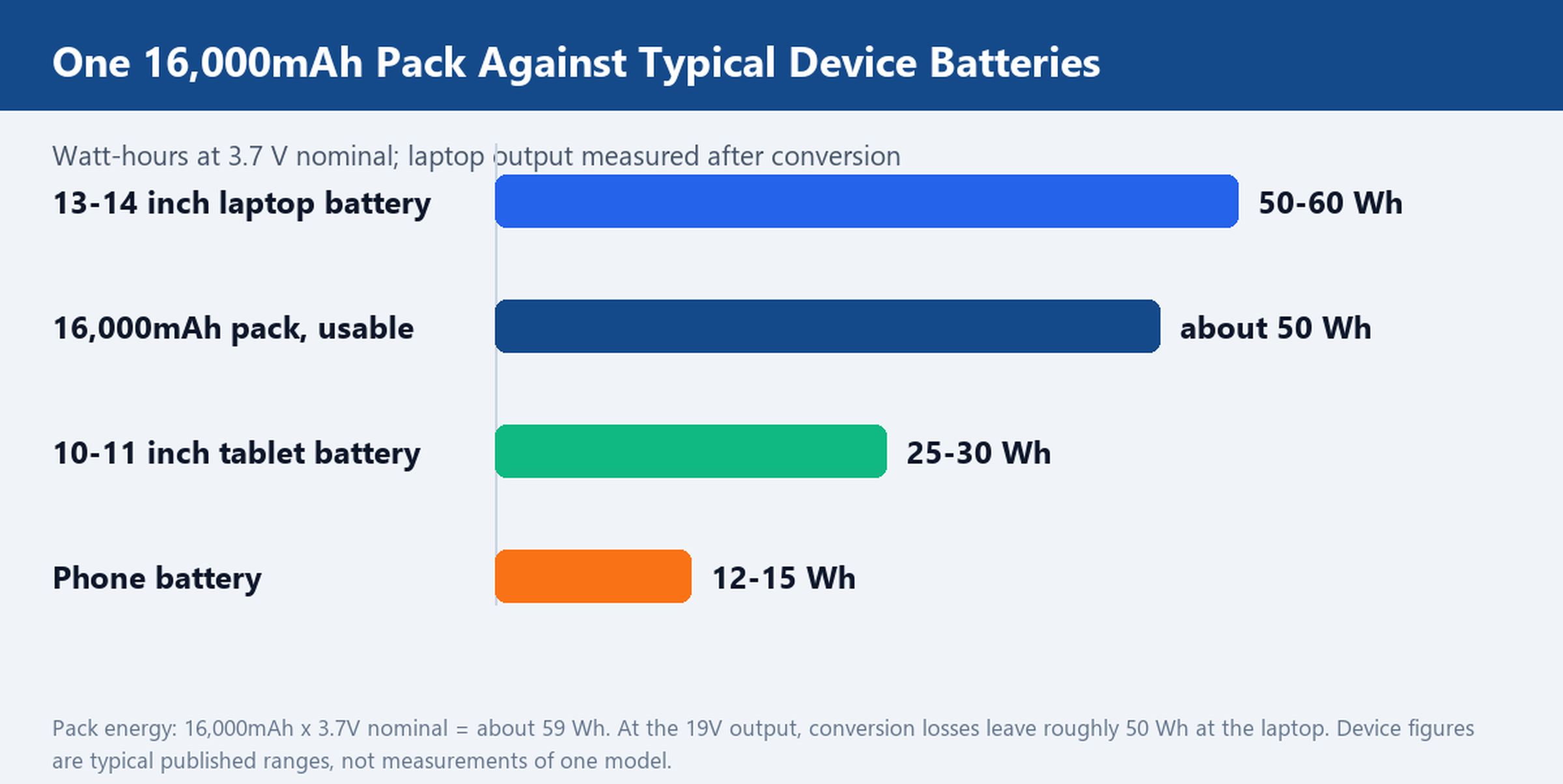
Capacity claims are quoted in milliamp-hours, which is a unit that hides the useful number. Convert first. At 3.7 V nominal, 16,000mAh is about 59 Wh. Send that through the 19 V output and conversion losses take roughly 10-15 percent, leaving about 50 Wh at the laptop connector. A 13-14 inch laptop battery holds 50-60 Wh. So the honest expectation is one working session per pack, and on a machine with a 60 Wh battery it is closer to 0.85 of a charge.
That is the trade the 600 g buys. If the itinerary needs two full laptop charges, a 20,000mAh-class unit is the answer, and it belongs in the heavier tier of the 10,001-20,000mAh range. If the itinerary is one afternoon of email and a client deck, the 16,000mAh pack stays in the daypack instead of the boot of the car, which is the weight figure that actually matters.
The body measures 180 x 110 x 24 mm, so it slides into the same sleeve as a 13-inch notebook. Energy density also settles the airline question: 59 Wh is below the 100 Wh carry-on threshold most carriers apply, so the pack flies in the cabin, never in checked baggage.
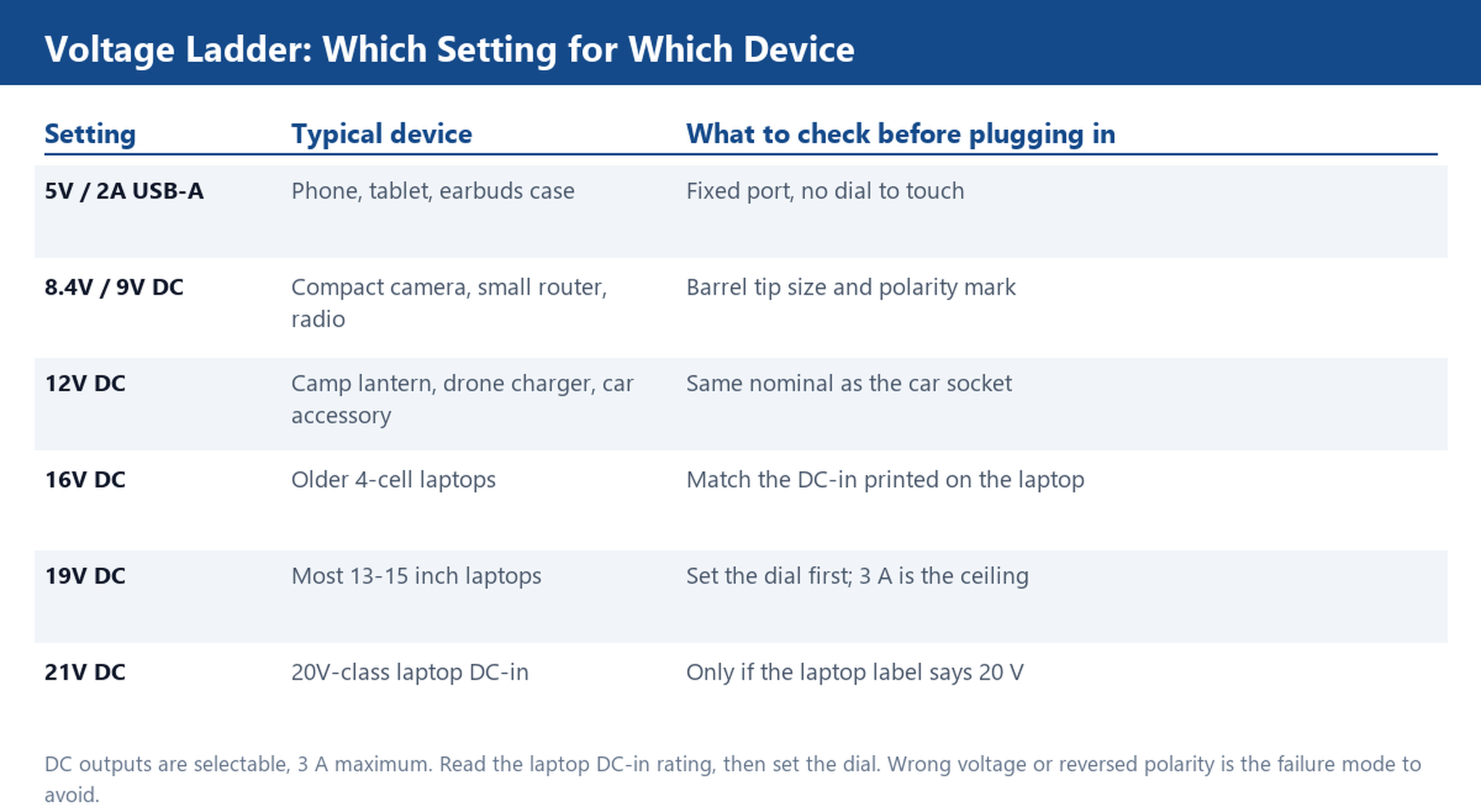
Capacity settled, the next question is which output feeds which device. The table below maps the settings to the hardware they serve, and the section after it explains where the current ceiling actually bites.
The 5-21 V Ladder: Which Port for the Laptop, Which for the Phone
The output side of this unit is a selector, not a single port: DC at 5V, 8.4V, 9V, 12V, 16V, 19V and 21V, with a 3 A ceiling, plus a fixed USB-A port at 5V/2A. The ladder exists because laptops do not share one input voltage, and the pack has to meet each machine where its label says it lives.
Set the dial before the plug goes in, every time. At 19 V and 3 A the ceiling is 57 W. Laptop adapters in this class are usually rated 45-65 W, so a 45 W ultrabook charges at full speed while a 65 W machine charges more slowly and may not hold its level under a render or a compile. That is a limit of the ladder, not a defect, and it is worth stating plainly to anyone who expects a workstation to run at full draw from a 600 g pack.
The 5V/2A USB-A port delivers 10 W, which is slow for a modern phone but entirely adequate overnight. Phones and tablets belong on that port; the DC ladder belongs to the laptop and to the accessories that expect a barrel plug.
Topping Up Overnight From a 12 V Car Socket
Refilling from the vehicle is the part buyers underestimate. The pack takes 12-14 V in, which is exactly what the socket supplies, so no adapter is involved: a DC cable from socket to pack input is the whole circuit. What is not obvious is the habit that makes it work.
Charge while driving, not while parked. Two or three hours on the road covers the refill from the alternator at no cost to the starter battery. Leaving a vehicle in accessory mode overnight to feed a pack pulls the same battery that has to crank the engine in the morning, and a cold campsite is a poor place to discover that. If the vehicle is stationary for days, a folding solar panel is the alternative, and our outdoor power bank line carries solar models for exactly that case, though a panel only earns its space when the vehicle is not moving.
Do not accept a charge-time promise without the input current. The arithmetic is simple: 59 Wh divided by the input power, plus about 20 percent for losses. A supplier who quotes a charge time but cannot state the input current in amps is quoting a number they have not measured. Related: the socket circuit is fused, commonly at 10-15 A, and a pack input draws far below that, so the fuse is never the constraint. The pack input is.
For buyers who want the campsite format rather than the travel format, the 20,000mAh LCD campsite pack covers the 16,000-24,000mAh tier on request and adds a display, at the cost of the DC ladder.
What to Confirm on the Spec Sheet Before a Group Buy
A purchase order for a few hundred units stands or falls on six lines. Ask for each in writing, and treat a vague answer as a gap rather than a detail.
First, the capacity tier as a range, not a slogan: 16,000mAh class with 14,000-20,000 available on request is a number a factory can commit to. Second, the full output ladder with the maximum current at 19 V specifically, since a single 3 A figure across seven settings hides where the limit bites. Third, the input window and the input current. Fourth, cell grade and cycle life; 500 or more charge cycles is the figure to hold a supplier to, and it should appear in the specification rather than in a sales email.
Fifth, the safety file. Certification names are the starting point, CE, RoHS and FCC in this case, and the test reports are what you actually keep on file. Sixth, commercial terms: a 12-month warranty, sampling in 5-7 days, FOB Shenzhen. Add one more check that never appears on a spec sheet: confirm which connector tips ship in the box and whether polarity is marked, because a reversed tip turns a working pack into scrap in one connection.
Then test one sample on the exact laptop model you plan to deploy. A pack that charges a 13-inch ultrabook at 45 W may refuse a 15-inch machine that expects 65 W, and that difference is invisible until the sample reaches the person who will carry it. One sample, one afternoon, one spreadsheet of results is cheaper than a pallet of returns.
Send the Laptop List, Get the Voltage Setting
The fastest way to close this is to send us the laptop models, the DC-in voltage printed on each label and the quantity your group needs. We will confirm the matching dial settings, the connector tip list for each model, and quote with one sample unit so the test above happens before the order, not after it.
If you are still comparing tiers, start from the laptop and tablet power bank category, or pair the pack with a car charger for the vehicles in the fleet. Sampling runs 5-7 days, FOB Shenzhen, and every configuration is confirmed with you before the order is locked.