

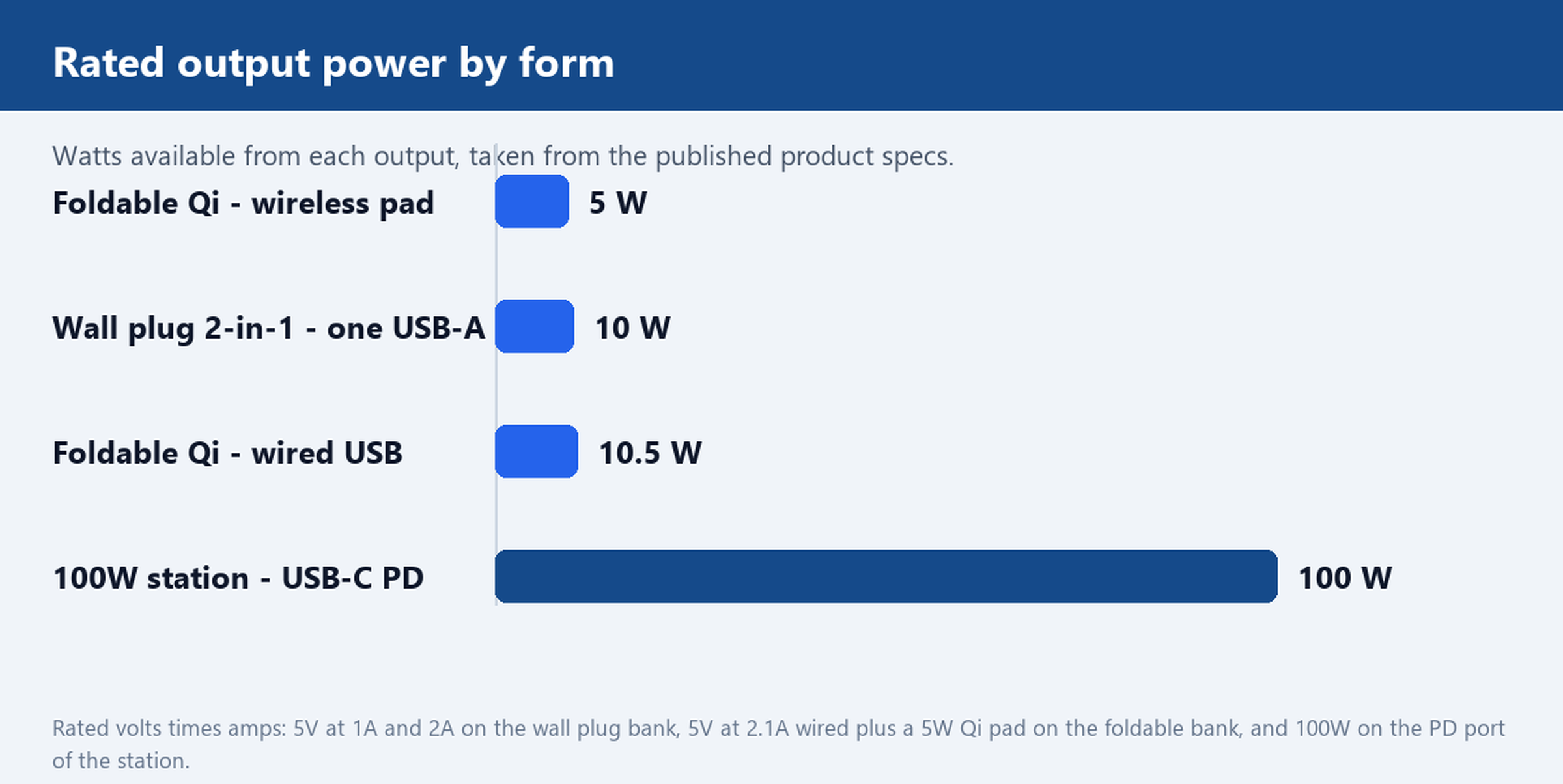
Pick the form before the capacity. Three multi-function power banks can land within a few dollars of each other on a quote sheet and still differ by a factor of twenty in what they deliver: a 5W wireless pad at one end, a 100W USB-C port at the other. The shape tells you which side the second capability sits on, input or output, and that decides which buyer the unit belongs to. Below are the three forms with the numbers from their published specifications, the port arithmetic that decides whether an order comes back, and the order in which to confirm specs before you ask for a sample.
What multi-function means on a catalog shelf
The label gets attached to any bank with a second capability, and those capabilities are not interchangeable. Two of them change how the unit takes energy in. One changes what it can put out.
The fold-out AC plug works on the input side: the bank refills from a wall socket with no charger and no cable, which is why it sells into hotel amenities and travel retail. The Qi pad works on the output side, but at 5W, so it removes the cable rather than the wait. The 100W PD port also works on the output side, and at twenty times the wattage of the pad, so it changes what the product can actually run: a laptop, a camera battery, a small power tool.
The question is how to choose multi-function power bank form, not how to choose the largest battery, so apply one criterion first: ask which side the second function sits on. If it is the input side, the gain is logistics: one item to pack instead of two, nothing to lose. If it is the output side, read the wattage before anything else, because a 5W pad and a 100W port are not the same product even when both carry the multi-function label. A well-built unit can carry both, which is what the station form does.
Start with the output budget, not the mAh label
Capacity decides how many refills a bank gives. Ports decide whether a device charges at all, and buyers confuse the two constantly because capacity is the number printed largest on the box.
Work from the device list. A phone pulls roughly 10W to 18W over USB. A tablet asks for 18W to 30W. A laptop asks for 45W or 65W, and a 10W port will not charge it: the machine reports a connection, then drains slowly under load. Add up the wattage of everything that must run at the same time, then look at how the bank splits its output across ports. If two devices must charge together, add watts, not port count.
Once the wattage is settled, capacity follows from the day you need to cover, and the multi-function power bank range is grouped so that the capacity bands sit next to the form rather than in a separate list.
Type 1: the 2-in-1 wall plug bank
The published configuration is 5,000mAh, with 2,500mAh to 10,000mAh available on request. Output is two USB-A ports at 5V and 1A or more each, with a single port rated at 2A. AC input covers 110V to 240V at 47Hz to 63Hz, so one build serves both plug standards. The shell weighs 80g, and the Li-polymer cells are rated for 500 cycles or more. CE, RoHS and FCC are the certification names to request.
Where it wins is compendium-style selling: the bank is also the charger, so a hotel or an airline amenity kit ships one item instead of a bank plus an adapter. For corporate gifts the same logic applies, because the recipient never has to look for a cable to top the unit up.
The failure mode to guard against is a two-port assumption. Two ports do not mean double the output: with both in use, each port sits at 1A, which is 5W per phone. Two phones are fine. A tablet on one of those ports is not. If the order needs tablet charging, the single-port 2A rating is the number to write into the spec, and the second port should be treated as a convenience.
Confirm two details at sampling on the 2-in-1 wall charger power bank: the plug standard for the destination market, and whether the prongs fold flat enough for the packaging you plan to use.
Type 2: the foldable Qi bank
The sample configuration is 5,000mAh, real 5,400mAh, with 5,000mAh to 10,000mAh on request. It measures 139 x 63.5 x 30.5mm and weighs 305g. The Qi pad runs at 5W, the wired USB port at 5V and 2.1A, and the input at 5V and 2A. Overcharge, overheat and short-circuit protection are stated in the spec.
The fold is the product. Opened on a desk it works as a charging stand that props the phone at a viewing angle. Folded, it goes into a bag as a bank. That makes it a fit for hotel nightstands, front desks and desk retail, where the phone is expected to sit upright while it charges rather than lie flat on a counter.
Set expectations on speed before the order, because this is the slowest output in the guide. The 5W pad moves energy at roughly half the rate of the same bank on its wired port at 5V and 2.1A, so the same top-up takes about twice as long. Sold as overnight or desk charging it performs exactly as promised. Sold as fast wireless charging it comes back as a return.
Two checks belong in the sampling brief for the foldable Qi wireless charger power bank. First, coil alignment: the pad center has to line up with where the phone sits when propped, and a thick case will push the coil out of range. Second, weight: at 305g it is close to four times the 80g wall plug bank, which puts it in a different freight band if you ship by the kilogram.
Type 3: the 100W PD station
The published spec is 50,000mAh, 100W PD over USB-C, a 15W magnetic wireless pad, and simultaneous charging for up to five devices. A digital display reads the remaining charge, an LED lamp extends from one end for use after dark, and an integrated handle lets the unit be carried between a vehicle and a work area.
Do the energy arithmetic before quoting it, because it changes where the product can be sold. At a 3.7V cell nominal, 50,000mAh works out to about 185Wh. Most airlines cap carry-on lithium batteries at 100Wh without prior approval, so this unit travels as freight rather than in the cabin, and that belongs in the listing copy. The same figure, measured against the 18.5Wh of a 5,000mAh bank, is ten times the stored energy before conversion losses: ten refills of a phone-class device from one charge of the station.
The 100W port is the reason to buy it, and the port is only as good as the cable. A 100W PD link needs a cable rated for 5A with an E-Marker chip; a charge-only cable will cap the run far below the port rating and the buyer will blame the bank. Order the cable with the unit from the USB cable range. The 15W pad is for a phone left on the top surface overnight, not for a laptop.
The 50,000mAh power station with 100W PD page does not publish a weight, so ask for the shipping weight before you plan retail freight rather than assuming it matches a smaller bank.
Port math, then the order you place
The arithmetic repeats across all three forms. Two USB-A ports at 5V and 1A are 10W shared, and one port at 2A is 10W on its own. A second phone does not add watts to that bank, it splits them. On a multi-port bank the same rule applies, which is why any quote should state shared wattage per port instead of a single total, and why the multi-port power bank range is worth reading port by port.
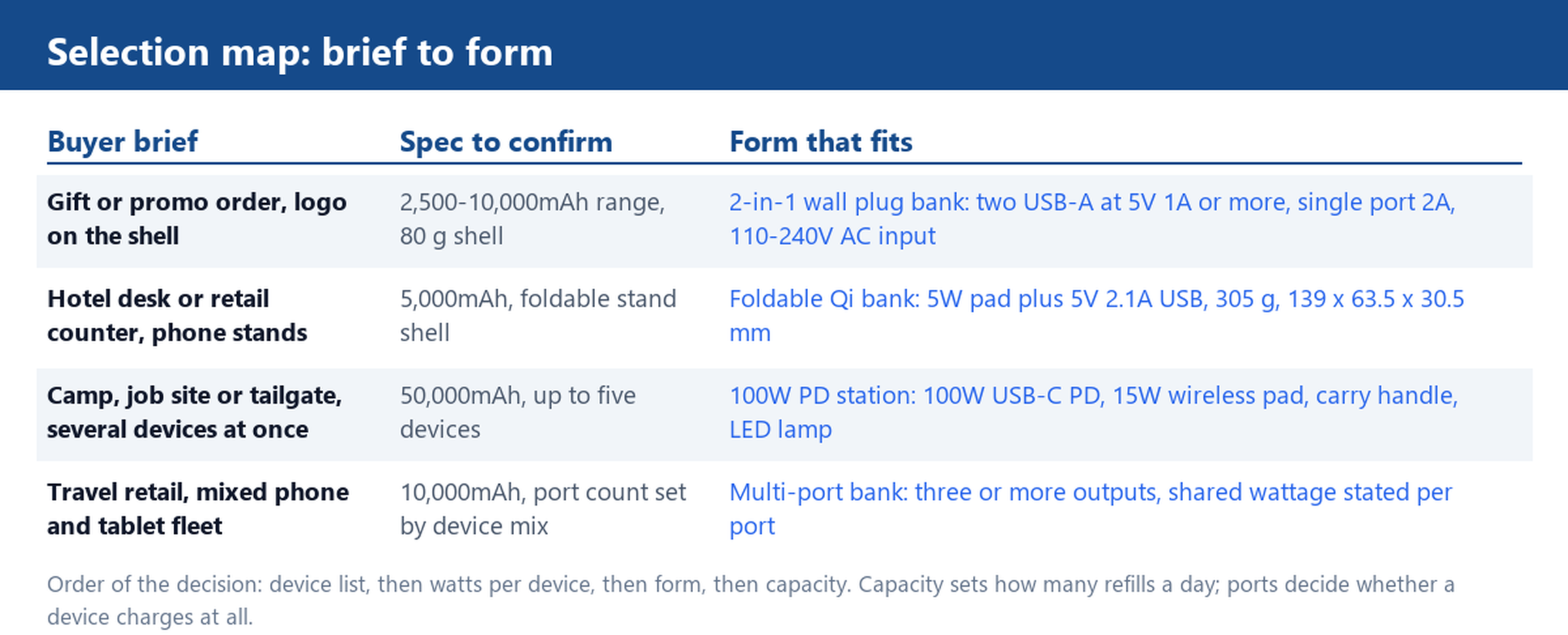
Sequence the decision in five steps: device list first, then watts per device, then the form determined by whether the second capability sits on the input or the output side, then the capacity band that covers the day, and last the plug standard, logo placement and packaging. Deciding capacity first is what produces a 20,000mAh bank that cannot charge the laptop it was bought for.
Tell us the retail channel, the target capacity, and whether the unit needs a foldable AC plug or a Qi pad, and we will quote a matching sample with your logo printed on the shell. The customization options for shells, printing and retail packaging are set out on the customize page.