

A buyer assembling a thirty-unit laptop deployment will usually collect two quotes that differ by a wide margin, and the gap rarely sits in the cell. It sits in three lines of the specification sheet: how many DC steps the output board carries, how many connector tips leave the factory inside the box, and what happens to the shell. Those are also the three lines a supplier can quietly change between the sample and the production run. This guide walks the decisions that have to be closed and written down before a custom laptop power bank quote means anything, using the 16,000mAh tier we build as the worked example.
The 7-Step DC Ladder: 5V, 8.4V, 9V, 12V, 16V, 19V and 21V
The ladder is not a marketing figure. Each step is a separate tap on the DC-DC converter, with its own feedback network, its own calibration pass and its own marking on the shell. Adding a step adds cost on every unit and adds one more way for a user to select the wrong setting.
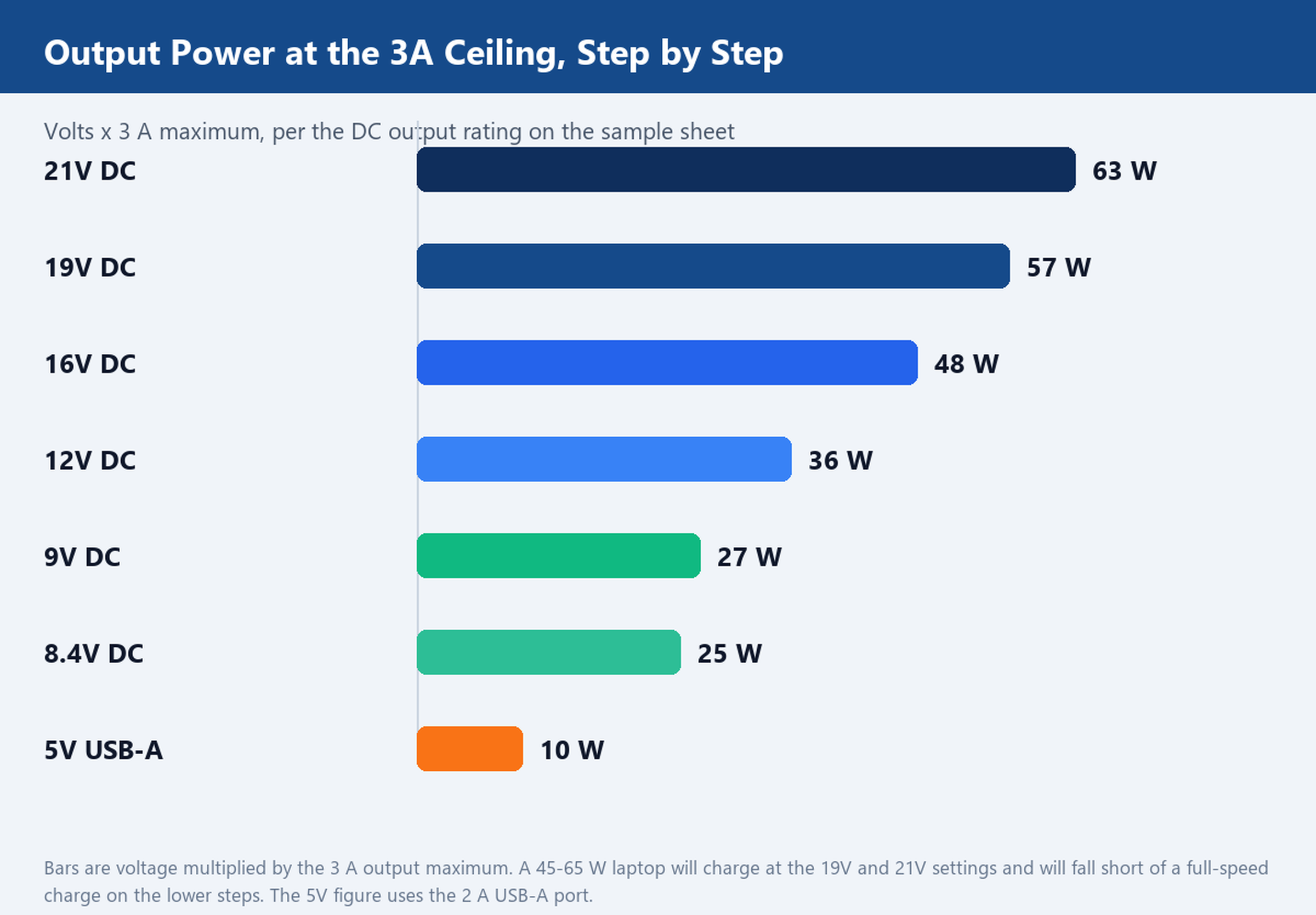
Read the seven steps as a mapping rather than a ranking. The 5V position is the USB-A port at 2A, for phones and earbud cases. The 8.4V and 9V positions cover compact routers, cameras and small field radios. The 12V position matches the nominal figure of a car socket, which is why it is the one used for dash accessories and portable monitors. The 16V position serves older four-cell machines. The 19V position is the mainstream setting for 13 to 15 inch business laptops. The 21V position exists for machines with a 20V-class DC input, where a 19V setting will still run the laptop but pulls the charge rate back.
The judgement call is printed on the laptop, not on the brand. A label reading 19V at 3.42A tells you two things at once: the step you need, and the fact that a 3A ceiling will sit slightly under the draw at full load. If the deployment mixes 19V and 20V machines, carry both steps. If every unit in the fleet is a 12V tablet and a router, the upper steps are dead weight that the buyer pays for on every unit.
Switching method deserves as much attention as the ladder itself. A rotary dial is fast and readable from arm length, but it gets knocked inside a bag. A key plus LED readout cannot move by accident, at the cost of a second press before every charge. For corporate issue, ask for the variant where the selected step holds until it is deliberately changed, then have the sample tested by someone who has not read the manual.
The full range of multi-voltage units sits under laptop and tablet power banks, and the specifications on each page are the ones to hold a supplier to.
Building the Laptop Tip Kit Before the Quote Is Fixed
The connector kit is the first line of the quote, not an accessory added at the end, because it drives three other decisions: the moulded tray inside the shell, the packaging insert and the inspection step at the end of the line. A kit agreed after the tooling is cut is a kit that gets renegotiated badly.
Barrel connectors are named by outer diameter and inner pin diameter, and the common sizes in laptop service are 5.5 x 2.5 mm, 5.5 x 2.1 mm, 4.0 x 1.7 mm, 3.0 x 1.1 mm and the larger 7.4 x 5.0 mm plug used on older business models. Two connectors can look identical at a glance and differ by half a millimetre on the pin, which is why the kit has to be built from the deployment list rather than from a generic assortment.
Work from the bottom up. List every laptop model in the fleet, read the DC-in barrel size and the polarity mark off the label, then collapse the list into distinct connector types. Ten models frequently resolve to four or five tips, because a generation of business laptops shares one barrel. Order one tip per distinct type, plus a spare set, and decide early whether the spare set ships in the box or stays in the after-sales kit; that single choice moves the packaging cost and the replacement process more than the connector price does.
Polarity is the failure mode to design out. Centre-positive is the near-universal convention on laptop barrels, and the small number of centre-negative devices is exactly why the sample should be checked with a meter rather than assumed. A reversed tip will not always destroy a machine on the first plug, which makes it worse: the failure arrives weeks later, in the hands of a user, with no clear cause.
The body size sets the physical limit. A 180 x 110 x 24 mm shell has room for a moulded row of tips and a short output cable, and each tip added beyond that row needs its own slot, its own gate in the mould and its own position in the tray. Ask for a photograph of the open tray with the agreed kit fitted before the tooling is signed off.
3A Output Against a 16,000mAh Class Cell: What One Charge Covers
The 3A figure is a limit on the output path, set by the boost stage, the DC cable and the connector, not by the cell. What reaches the laptop is voltage multiplied by current, which is why the same pack behaves very differently at each step: 19V at 3A is 57W, and 21V at 3A is 63W, while a 12V setting at the same current gives 36W.
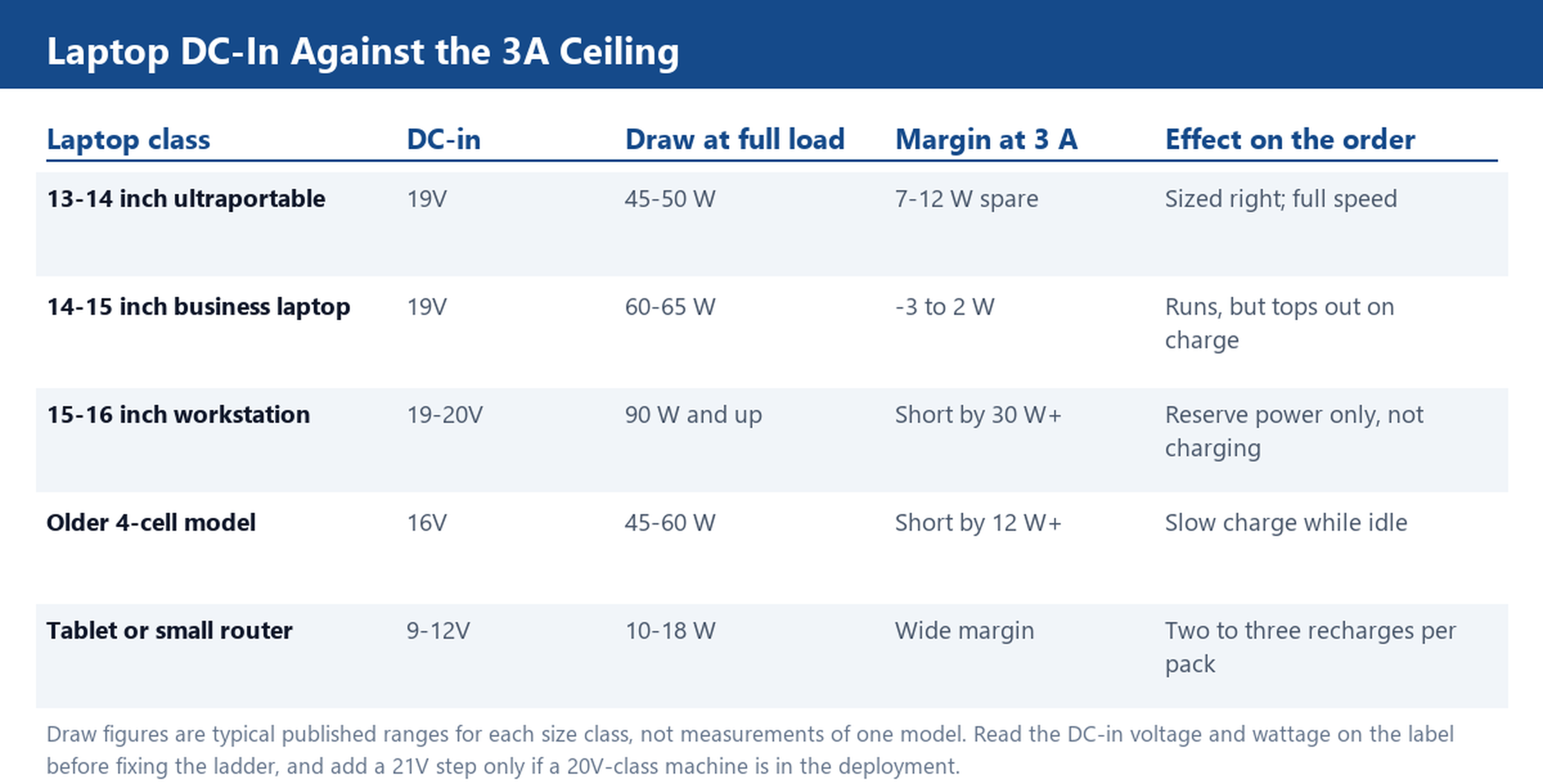
That arithmetic sorts laptops into three groups. A 13 or 14 inch ultraportable that draws 45 to 50W at full load sits comfortably inside the 19V step and charges at full speed. A 14 or 15 inch business laptop drawing 60 to 65W sits right at the edge: it runs and it charges, but the pack cannot hold the machine at full load, so a long compile or a video call will flatten the internal battery slowly while the pack is connected. A 15 or 16 inch workstation drawing 90W and up is outside the envelope at any step, and the honest framing for that fleet is reserve power for a meeting, not a charge cycle.
Capacity should be read in watt-hours, not milliamp-hours. A 16,000mAh cell at 3.7V nominal carries about 59Wh, and conversion losses across the boost stage leave roughly 50Wh at the laptop output. Against a 50 to 60Wh laptop battery that is about one charge, closer to eighty percent of one on a machine at the top of that range. Against a 25 to 30Wh tablet it is two charges, and against a 12 to 15Wh phone it is three or more.
The capacity tier itself is a customisation line. The 16,000mAh configuration ships in the 10,001 to 20,000mAh band, the same platform is quoted anywhere from 14,000 to 20,000mAh on request, and fleets that need a longer reserve move up to a 20,000mAh workstation unit with an LCD readout. The 16,000mAh multi-voltage model is the reference build for everything described here, rated at 500 or more charge cycles.
DC 12-14V Input and the Adapter That Ships With It
The input is DC 12 to 14V, which is a different charging path from a USB-C PD input and changes how the unit gets refilled in the field. It means a 12V wall adapter at the desk and a 12V car lead on the road, and it means the buyer has to decide what goes in the box rather than assuming the user already owns the right brick.
Three details belong on the quote. The first is the plug format for the destination market: a European deployment needs the round two-pin plug, a North American one needs the flat blade, and a program that ships to several markets needs either a fixed plug per SKU or a interchangeable-head adapter with the heads packed per carton. The second is the input current rating, which sets the recharge time and should be stated on the sample sheet rather than inferred. The third is whether a car lead is included, because a 12V input port without a car lead is a feature the buyer cannot demonstrate to a user.
Compliance runs alongside those choices. A mains adapter sold into the European Union carries its own declaration obligations on top of the pack, so the paperwork has to cover the adapter, not just the battery. Our units are built to CE, RoHS and FCC requirements, and the file that ships with a sample order is the one to compare against the certificate your own importer will need.
Adapters, car leads and output cables are listed under chargers and accessories. Fixing the adapter specification at the same time as the tip kit avoids the common outcome where a program arrives with a pack that nobody in the office can plug in.
Housing, Logo Engraving and the Sampling-to-Mass-Production Sequence
At 180 x 110 x 24 mm and 600 g, the body has a broad flat face and a narrower edge band, and the two surfaces take branding differently. The flat face suits a full-colour mark; the edge band suits a short wordmark that survives handling. Deciding which one carries the brand is a design question with a cost attached, because the method follows the artwork.
Screen printing is the low-cost route for flat colours and handles several colours in one pass. Laser engraving gives a single-colour mark that does not wear off and reads well on a dark shell, and it is the usual choice for a serial number or a corporate asset tag. UV printing holds gradients and photographic artwork but adds a step and a cure time. The practical test is the artwork itself: fine lines and hairlines belong on laser, gradients belong on UV, and anything that wraps over a curved edge needs to be pulled back onto the flat before the plate is made.
The sequence that keeps a program on schedule runs in one direction. Close the tip list and the voltage ladder first, because both change the mould and the board. Then approve the shell colour and logo process on a physical sample, not on a digital proof. Only then confirm the cell grade and the protection board, and release the production batch. Sampling on the reference build runs five to seven days, with final configuration confirmed before the order is placed, and units ship FOB Shenzhen with a twelve-month warranty.
The customisation process covers what can be changed on the shell, the ports and the packaging, which is the list to read before assuming a change is free.
The Quote Sheet Fields That Decide the Price
Most requests for a custom laptop and tablet power bank OEM program arrive as a one-line email with a laptop model and a quantity, and that email cannot be quoted accurately. Seven fields do most of the work in the reply, and each one is cheaper to settle before the sample than after it.
Capacity tier sets the cell count and the body volume, and moving from 16,000mAh to 20,000mAh changes both. Number of DC steps sets the converter taps, the calibration time and the marking on the shell. Tip kit composition sets the tray, the packaging insert and the inspection step. Input adapter specification sets the plug format, the heads per carton and the compliance file. Shell finish and logo process sets the tooling, the plate and the reject rate on the print line. Certification scope sets which documents travel with the shipment and whether the adapter is covered. Packaging and spare set sets the carton, the insert and the after-sales stock the buyer has to hold.
A quote that answers all seven can be compared line by line against another. A quote that answers three of them is a number, not an offer, and the missing four will surface as a change order once the tooling is cut. That is the whole reason the voltage ladder and the tip list belong in the first email rather than the third.
Send us the laptop models you need to cover and the connector tips already in your kit, and we will quote a 16,000mAh sample with that DC voltage ladder, the right input adapter and your logo on the shell.