

The laptop and tablet power bank certification requirement that changes the paperwork is a 100 Wh energy line, and it is not printed on the label. What the label usually shows is capacity in mAh at cell voltage, so a pack advertised at 30,000 mAh is about 111 Wh at 3.7 V nominal, and it has already crossed into the band where an airline needs to approve it before it boards. Get that conversion wrong at the quotation stage and the mistake surfaces at an airport counter or a port inspection, where the cost is not a component but a whole shipment.
Why laptop-class packs sit in a different compliance band
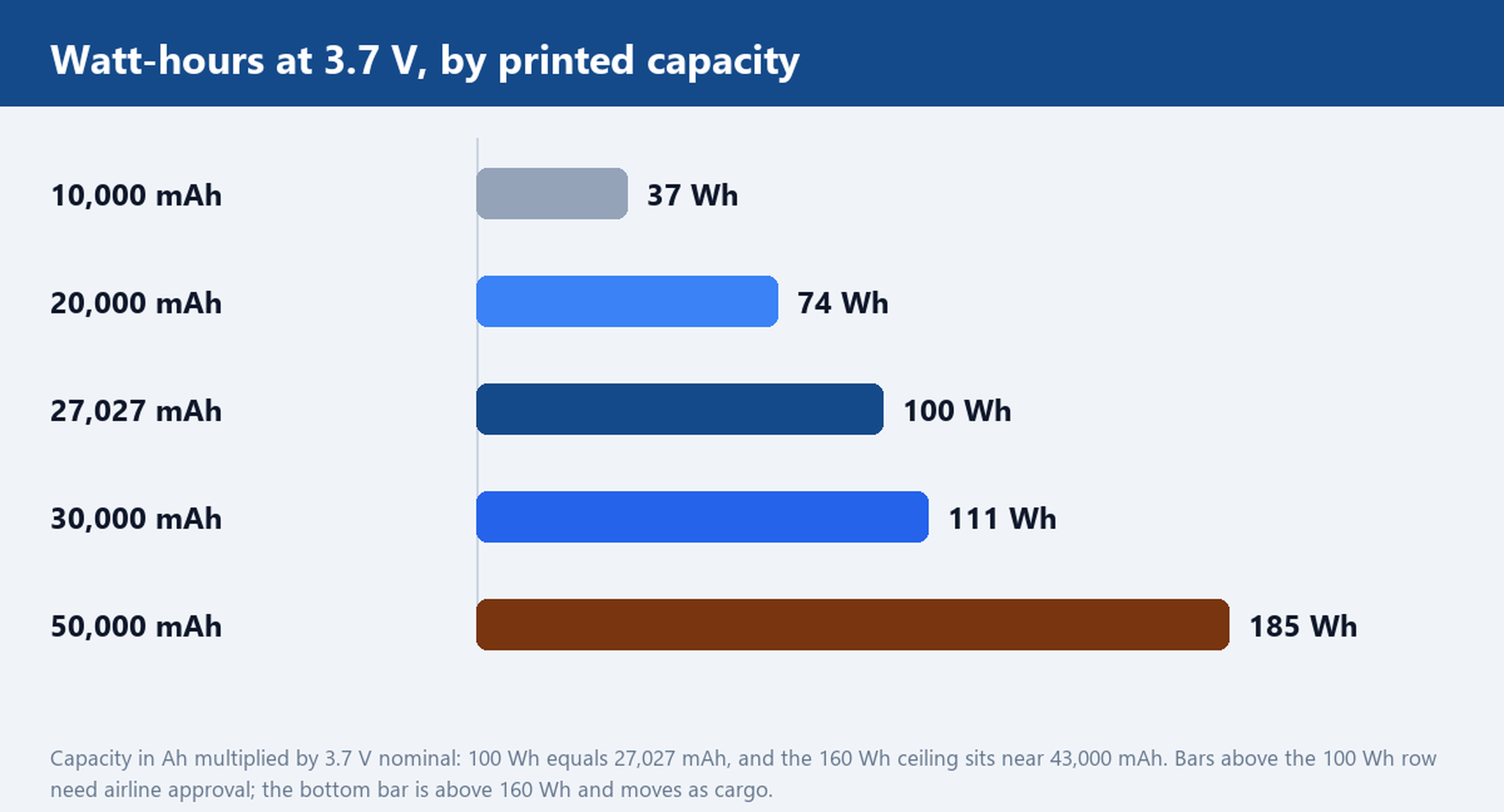
Energy is the number the regulations use, and energy is capacity multiplied by nominal voltage. For lithium-ion cells at 3.7 V nominal, 20,000 mAh works out to 74 Wh, 27,027 mAh to exactly 100 Wh, and 30,000 mAh to 111 Wh. A laptop pack that outputs 20 V through a DC barrel or USB PD still stores its energy in cells at cell voltage, so quoting the output voltage in a capacity discussion only confuses the number that has to be declared.
The air transport rules divide packs into three bands. Below 100 Wh a pack may travel in the cabin without prior approval from the airline. Between 100 and 160 Wh it needs that approval, arranged before the flight rather than at the gate. Above 160 Wh it is not accepted in passenger baggage at all and has to move as cargo. At 3.7 V nominal the 160 Wh ceiling lands near 43,000 mAh, which is why a 50,000 mAh class pack is a freight product rather than a carry-on one, whatever the marketing copy suggests.
Carriers also tighten their own acceptance rules from time to time, sometimes with little notice, so the airline approval is a step to confirm with the carrier on the route rather than a permanent entitlement. The safe planning assumption is that the band limits hold and that the carrier may add conditions on top.
UN38.3 and MSDS: what the report has to cover
UN38.3 is the transport test series for lithium cells and batteries, and it has eight tests: altitude simulation, thermal cycling, vibration, shock, external short circuit, impact or crush, overcharge, and forced discharge. A report that lists fewer than the full set, or that covers a cell but not the assembled pack, does not describe the product being shipped.
Two details decide whether the report is usable. The first is traceability: the pack report has to name the cell model and maker that were inside the tested samples, because the pack result depends on those cells. The second is the issuing laboratory, since a report without a named lab, a report number and a test date cannot be checked by a customs officer or a forwarder, and therefore does not function as a document.
The MSDS is a separate file, not a summary of the report. It runs to sixteen sections under the GHS format and has to match the actual chemistry, nominal voltage and Wh of the pack. A generic MSDS downloaded for lithium-ion cells in general will be spotted quickly, because the declared energy does not match the product on the invoice.
Two equipment standards sit alongside these. IEC 62133-2 covers the safety of the cell and the battery pack, and IEC 62368-1 covers the pack as an item of electronic equipment. For North American retail, pack-level safety standards are commonly requested on top. Which of these a buyer needs depends on the destination, but the transport pair, UN38.3 and MSDS, is needed on every route.
Cell-level documents buyers ask for beyond the pack report
A pack report is only as good as the cells it was issued against, so the file set usually includes the cell spec sheet and the cell UN38.3 report as well. The spec sheet should give nominal capacity, the voltage window, the maximum continuous charge and discharge current, and the cycle condition the capacity was measured under. Those figures are what tell you whether a 111 Wh pack can actually deliver the 60 W or 100 W its port advertises.
Ask for the cell maker and model in writing, then write a change-control clause into the purchase order: any substitution of cell, protection board or charger IC requires a new pack report before the next shipment. Without that clause, the report stays valid on paper while the production lot drifts to a cheaper cell, and the mismatch is invisible until a shipment is stopped.
The physical tests are worth requesting for laptop-class packs specifically, because the failure mode is different from a phone pack. A 1.2 m drop test on the pack, and a check that the output port and the DC cable strain relief survive it, catches housing and solder problems that the electrical tests do not. The laptop and tablet power bank range is where those documents apply, and the power banks by type index shows how the DC-output and PD-only versions are split.
Air, sea or courier: matching the paperwork to the route
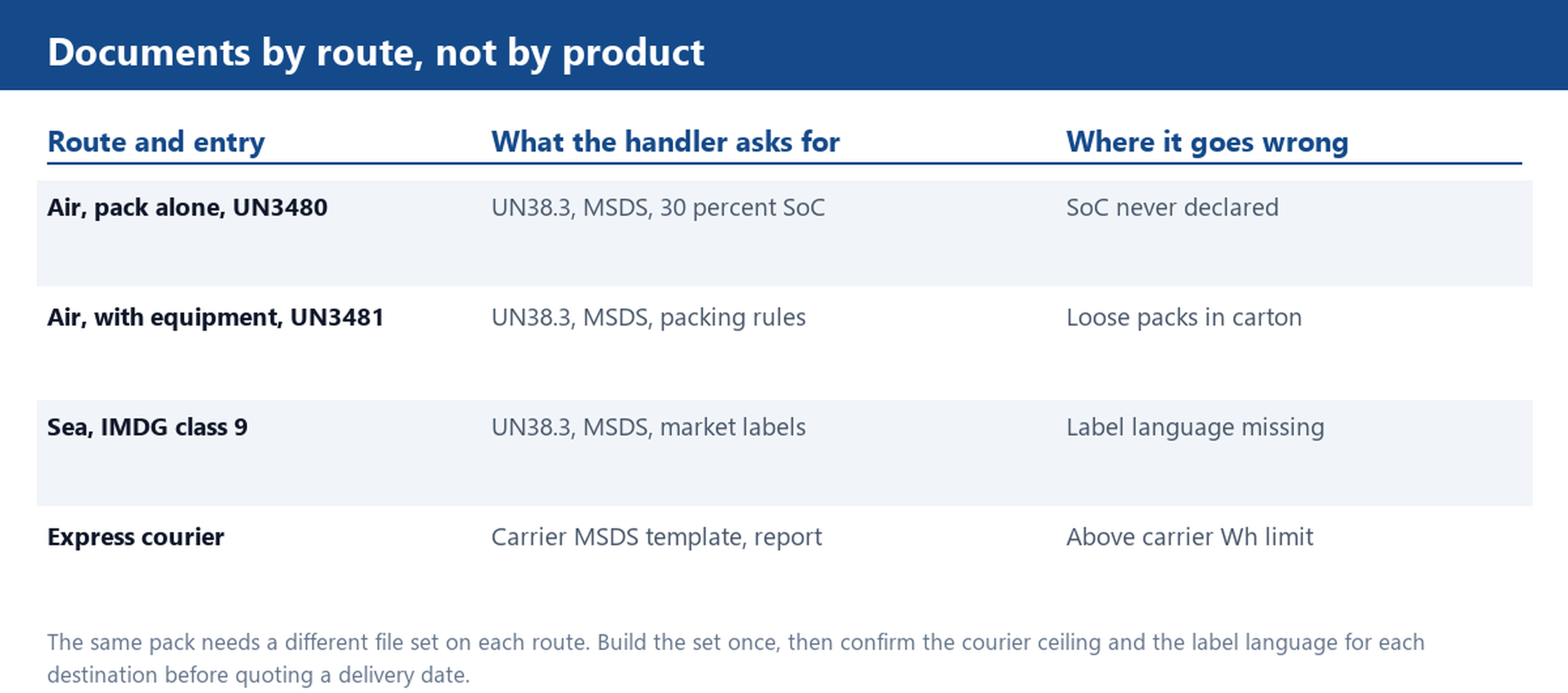
Air freight splits into two entries. Batteries shipped on their own are UN3480; batteries packed with equipment or contained in equipment are UN3481. The difference matters because the packing rules and the state-of-charge requirement differ. Lithium-ion packs moving under UN3480 by air are required to be at a state of charge of no more than 30 percent, and that has to be declared, not assumed. A forwarder who receives a carton at full charge will hold it.
Sea freight moves the same class 9 goods under the IMDG code. The state-of-charge rule does not apply the same way, but transit time and container temperature do, and a pack that sits for six weeks in a hot container is a different risk from one that flies in a day. The documentation set stays close to the air set, with labels and language requirements set by the destination market.
Express couriers run their own acceptance rules on top of the regulatory ones. Many apply a Wh ceiling below the airline limits, and most require the MSDS in their own template rather than the generic sixteen-section file. Confirm the ceiling for the specific service before quoting a delivery promise, because a pack that is legal to fly is not automatically accepted by every express account.
Building the file set before the first shipment
Assemble the pack once and keep it current. The minimum set: pack UN38.3 report naming the cell model with a lab, number and date; cell UN38.3 report; cell spec sheet; MSDS matching the declared Wh; IEC 62133-2 for cell and pack; drop test report; a state-of-charge declaration for air; and the change-control clause in the purchase order. Add destination-specific marking and language requirements on top, since those are staged and a file assembled years ago is not automatically current.
Then check the set against the invoice before the deposit, not after the container reaches the port. Four things go wrong most often: the declared Wh does not match the label, the report covers a different cell, the MSDS is a generic file, and the state of charge was never declared. Each is cheap to fix at the factory and expensive to fix at a border. If the order also spans smaller packs, the 10,001 to 20,000 mAh range stays under the 100 Wh line and needs a simpler file, while a laptop charger pack with an LCD or a multi-voltage 16,000 mAh build lands in the band where the approval step applies.
Send us the capacity in mAh and the cell voltage, the output wattage and the destination country. We will convert it to Wh, place it in the correct band and list the document set that route requires before you pay a deposit.