

Buying a flashlight power bank for workshop use is not a brightness decision. The question a workshop, a site or a security desk actually asks is whether one unit gets a phone and a radio through a shift with the light left on, and how much of that capacity is still there after a year of daily charging. Sizing it takes about five minutes of arithmetic, and the arithmetic usually moves the answer up one capacity tier.
Short version: a 10,000 mAh unit covers one phone, one handheld radio and four hours of torch time with a few watt hours spare; an 8,000 mAh unit lands just under that demand; a 6,000 mAh unit covers the phone or the radio, not both. The rest of this page is that calculation and the three specifications it depends on.
Shift Math First: 6,000, 8,000 and 10,000 mAh Against One Phone and One Radio
Convert capacity to watt hours before comparing anything. Multiply milliamp hours by the nominal cell voltage of 3.7 V and divide by 1,000: 6,000 mAh is 22.2 Wh, 8,000 mAh is 29.6 Wh and 10,000 mAh is 37 Wh. The output side runs at 5 V, and a conversion stage at roughly 85 percent leaves about 18.9 Wh, 25.2 Wh and 31.5 Wh of usable energy at the port.
That is why a 10,000 mAh bank does not deliver 10,000 mAh at 5 V. In 5 V terms the figure lands near 6,000 mAh, and any listing that quotes the cell figure as a charge count is quoting the wrong number.
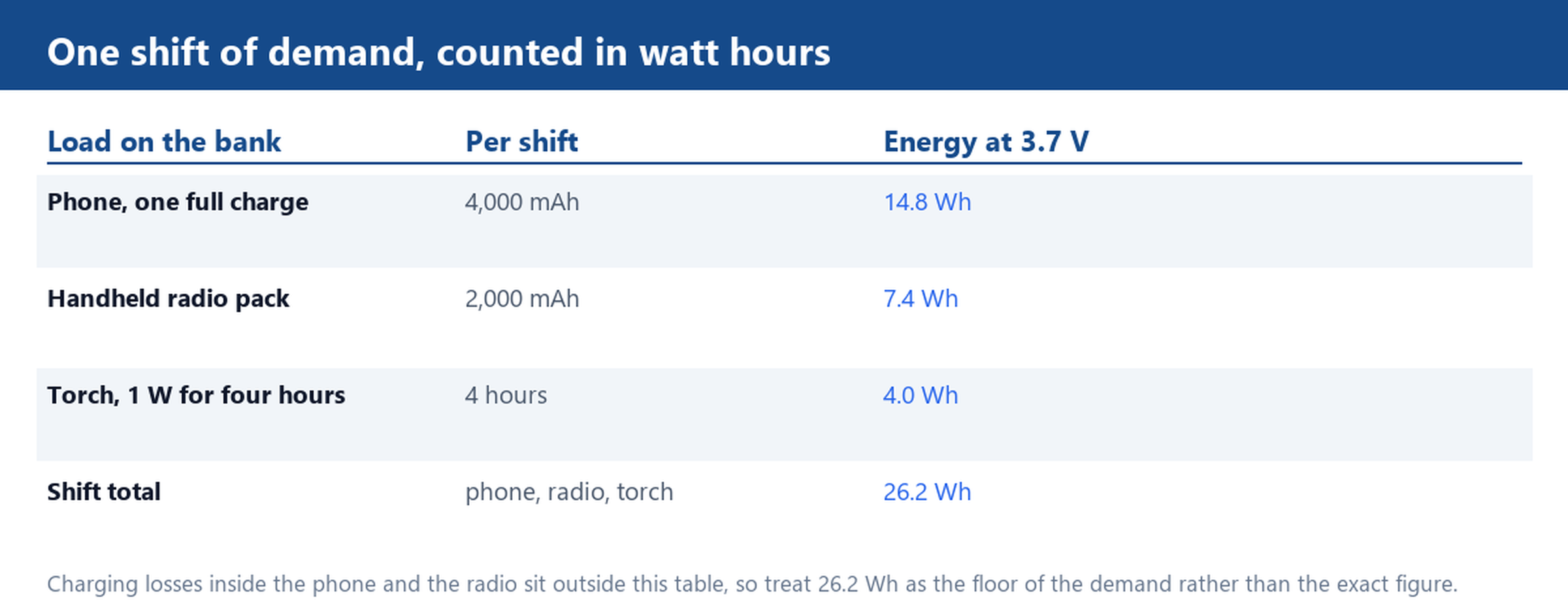
Now the demand side, per shift. A typical 4,000 mAh phone battery is 14.8 Wh. A handheld radio pack around 2,000 mAh is 7.4 Wh. A 1 W torch running four hours is 4 Wh. That is 26.2 Wh for the shift, before any loss in the phone or radio charging circuit.
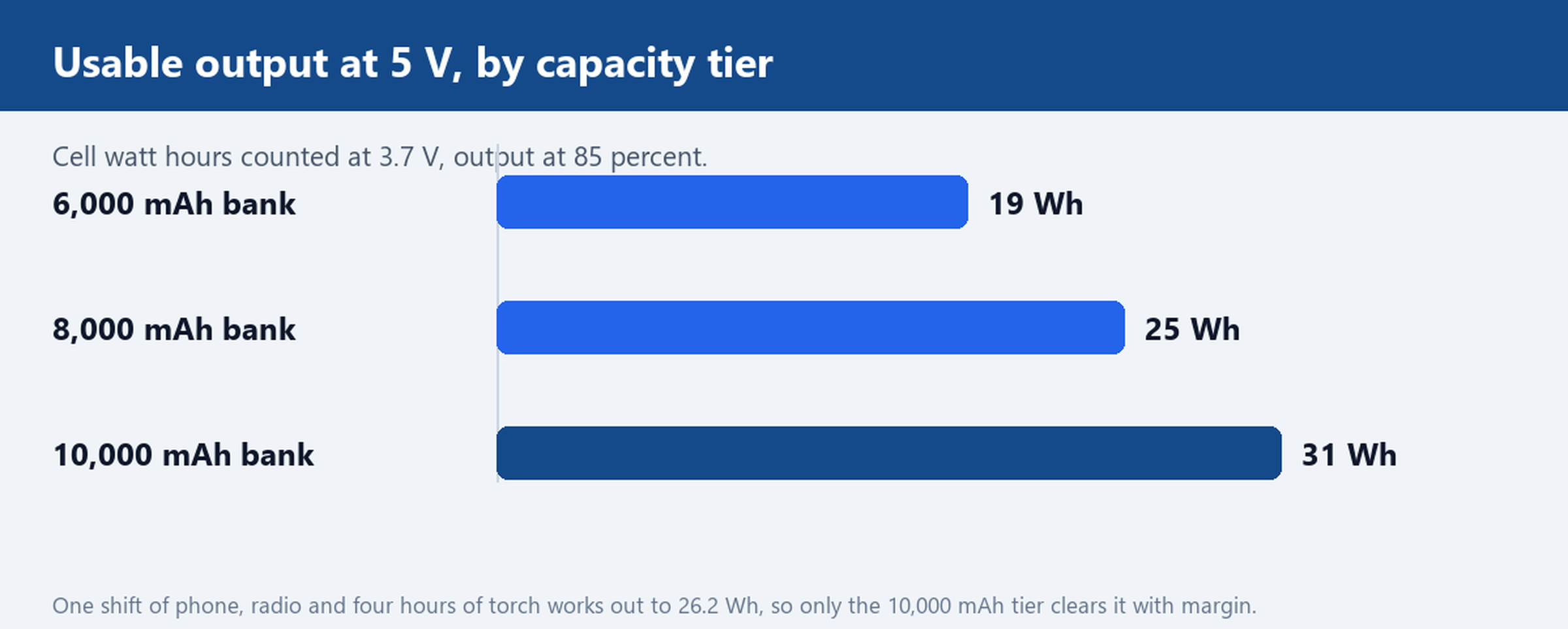
Against that demand the tiers separate cleanly. The 10,000 mAh unit holds the whole shift with roughly 5 Wh left. The 8,000 mAh unit sits just below the total and will need the torch rationed or the radio charged every other day. The 6,000 mAh unit covers the phone and the light, or the radio and the light, but not all three.
5V/2.1A Output, and What a Second Port Does to the First
The dual USB model states dual USB output at 5V/2.1A with 5V/2A input, and the 10,000 mAh light-and-charge unit lists two USB-A outputs at 5V/2.1A and 5V/1A. Those are per-port figures, and two ports on one regulator do not add up to 3.1 A. Ask for the total output current before ordering, because that number decides what happens when both ports are in use.
At 2.1 A the port delivers about 10.5 W, which is enough for a phone that accepts 2 A and comfortable for a radio drawing well under an amp. Run both at once and the regulator splits its total between them, so the phone charges slower and the radio charges slower, and a workshop that plugs both in at the same time should expect the longer of the two charge times, not the shorter.
Input matters as much as output on a shift pattern. A 37 Wh bank recharging at 5V/2A takes roughly four hours from empty including conversion loss, which fits an overnight charge and does not fit a lunch break. If the unit is shared between shifts, either buy two or pick a tier with headroom rather than planning to top it up mid-shift.
Cycle Life: 500-Plus Cycle Cells and the Charge Count Claim
The cell grade behind these units is quoted as grade-A with 500-plus cycles, and that number is where the shift math quietly changes. Five hundred cycles at one cycle per working day is about two years of use, which sounds comfortable until the retained capacity is added to the sentence: at the end of that count the cell is typically near 80 percent of its original capacity, not at 100 percent.
That matters because the 10,000 mAh unit cleared the 26.2 Wh shift with about 5 Wh spare. Twenty percent of 31.5 Wh is 6.3 Wh, so by the end of the cycle count the same unit no longer holds the shift with margin, and the 8,000 mAh tier would have fallen short long before that.
Put three things in the purchase order instead of accepting the headline: the cell grade, the depth of discharge the cycle count was measured at, and the retained capacity threshold. A supplier who can answer all three is telling you the cells were tested rather than described.
Body, Carry and the Torch as a Load
Treat the light as a load with a wattage, not a feature. One watt for four hours is 4 Wh, the figure used above. A light left on for a whole eight-hour shift at 3 W is 24 Wh, which is most of a 10,000 mAh budget and more than a 6,000 mAh unit can give. Ask for the light wattage and the runtime at that wattage; lumen figures describe the beam and say nothing about the drain.
Carry follows the cell format. The slim 10,000 mAh emergency-lighting model uses an 18650 core in a flat shell, which sits in a tool bag or on a shelf edge without rolling; the drawer-style 8,000 mAh unit is built to be borrowed and put back, which is a real requirement on a shared bench and a bad one for a unit that must stay charged.
The multi-function range covers both shapes, and the same capacity tier appears in each. Pick the shell by where the unit lives, then size the capacity by the shift math, in that order, because the reverse order is how workshops end up with a drawer of partly charged units.
Paperwork for a Trade Channel
Three items belong in the order file. The RoHS declaration for the platform, not a copy for a different model in the same family. Carton marks that match the capacity printed on the shell, since a mismatch is the first thing a customs broker or a retail buyer checks. And a sample with the shift test run on it: charge a real phone and a real radio from the unit in one sitting, with the torch on, and record the watt hours in and out.
That test takes an afternoon and settles the tier question better than any data sheet, because it measures the conversion loss of the actual unit rather than the 85 percent assumed here. If the measured figure comes in well under the calculation, the tier is wrong for the shift, not the other way round.
Send your shift pattern and device list for a sample unit and a quote.