

Ask ten buyers what separates a single-port power bank vs multi-port power bank design and most will answer with capacity first. That is the wrong starting point. The deciding question is how many devices need to charge at the same time, and what happens to the 5V/2A output budget once two or three cables are plugged in. A 5,200mAh single-port unit at about 122 grams is the right shape for a race-day kit, a staff handout or a retail impulse buy. A 10,000mAh triple-port pack is the right shape for a family table or an event desk where several phones charge together. This guide works through the output math, the weight and capacity trade, the cell format choice and the specification lines to fix before a volume order. 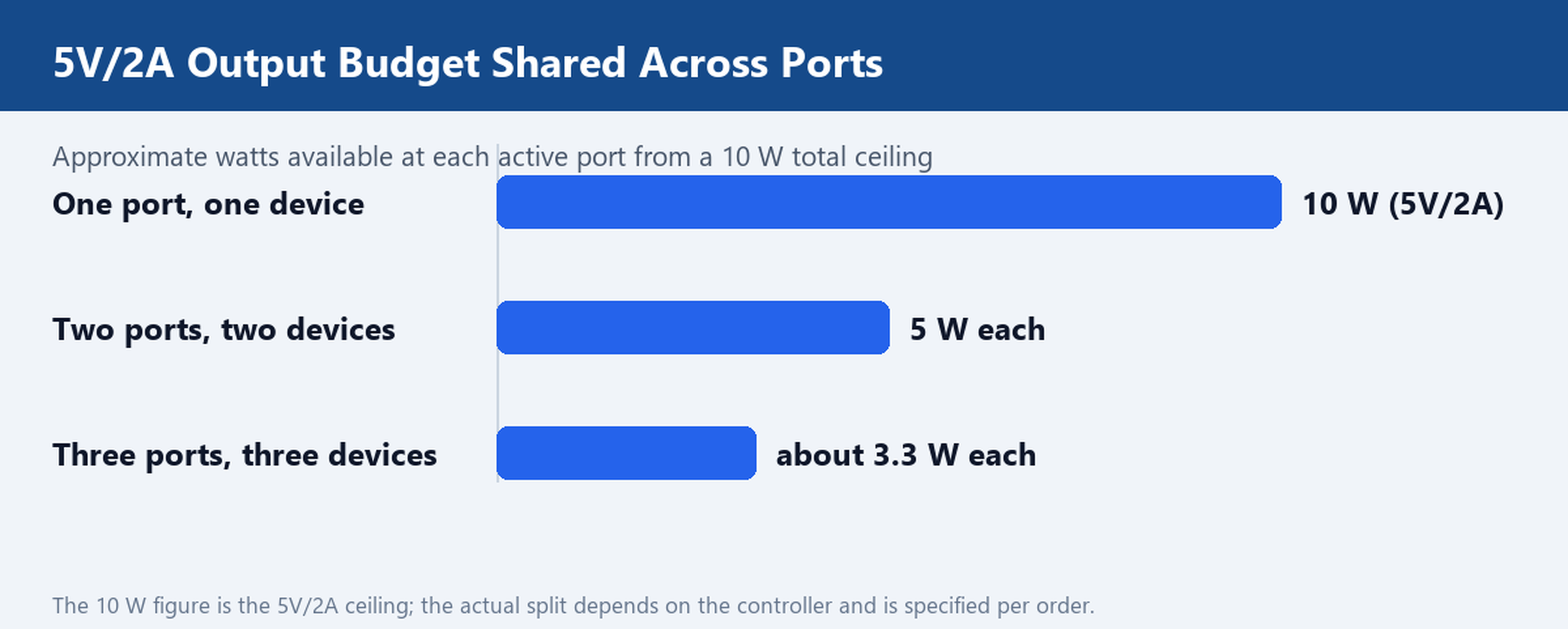
What 5V/2A means once three ports are filled
The 5V/2A figure printed on a box is a total budget, not a promise made separately to every port. Multiply the two and the ceiling is 10 watts at the battery output. With one device connected, that device can draw the full 2 amps. Add a second device and the controller has to divide the same 10 watts between two cables; add a third and the same ceiling is shared three ways. A phone that expects 2 amps but receives a fraction of that will still charge, just far more slowly, and the buyer rarely connects the slow charge to the number of occupied ports.
How the split happens depends on the controller. Some designs hold one priority port at the full 2 amps and give the remaining current to the others; others share more evenly across all occupied ports. The exact allocation has to be confirmed in the spec sheet or measured on the bench with all ports loaded at once. It cannot be inferred from the peak number on the packaging. This is the first criterion to settle when comparing a single-port unit with a three-port unit, because it decides whether the extra ports are genuinely useful or merely convenient sockets that slow every device down.
There is a practical consequence for product selection. If the end user charges one phone at a time, a single port delivers the entire 10 watts on every occasion, and a three-port unit offers no speed benefit at all. If the end user charges a phone, a pair of wireless earbuds and a smartwatch together, three ports let all three charge overnight from one adapter-free brick, even though each one receives less current. Port count is therefore a question about charging behaviour, not a question about which unit is more powerful.
Single-port: 5,200mAh at 122 grams and one cable in the bag
The case for a single port is weight, simplicity and cost per unit. A 5,200mAh cell at 3.7 volts nominal stores about 19.2 watt-hours; after the boost converter and cable losses, roughly 16 watt-hours reach a phone, which is enough for a substantial top-up rather than a full multi-day charge. A body built around one output and one small cell can come in at around 122 grams, light enough to disappear into a race-day belt or a conference tote. There is only one cable to pack and one port to explain on the retail card.
That simplicity also removes a class of support problems. There is no sharing behaviour to document, no second or third socket to fail, and no confusion about which port is the fast one. For a giveaway, a membership pack or a single-device promotional item, a light single-port unit is easier to price and easier to brief. Our mini power bank range is where most of these light builds sit, and the 1,000 to 5,000mAh category covers the lower tiers when the brief calls for an even smaller body. The trade is deliberate: the buyer gives up simultaneous charging and accepts one top-up, in exchange for grams and a clean story.
Triple-port: sharing 10,000mAh across three devices
A 10,000mAh pack stores about 37 watt-hours at the cell, or roughly 31 watt-hours after conversion. That is close to twice the usable energy of the 5,200mAh single-port unit, and the larger cell is what makes three occupied ports practical: there is enough stored energy to keep all three devices charging for a meaningful period even when each one receives a reduced share of the 10-watt ceiling. The shape suits a household charging station, a shared desk at an event, or a travel bag that serves a phone, earbuds and a watch at once. 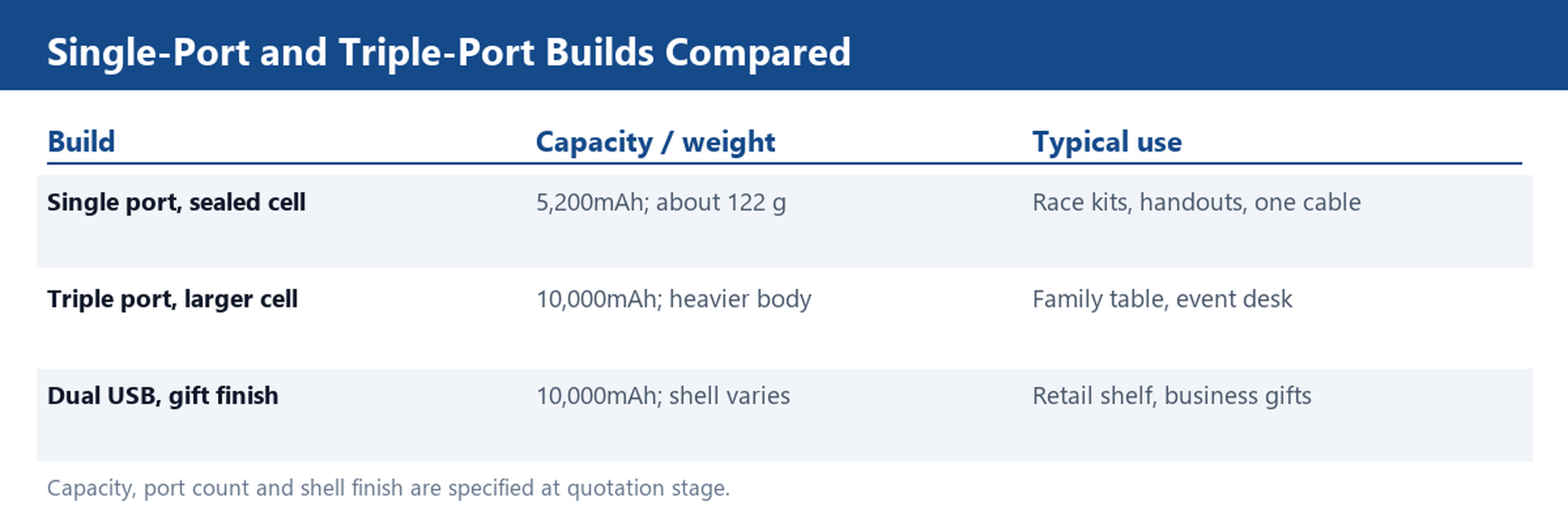
The extra sockets do add bulk. A three-port body has a larger cell, a more complex board and more internal space between the sockets, so it will not match the 122-gram single-port case. Buyers who specify three ports for a single-device use case end up paying for weight and board complexity they never use. Buyers who specify one port for a three-device use case end up with a queue of people waiting for the cable. Match the port count to the observed charging behaviour before comparing prices.
Several of the units on this site illustrate the middle ground. The marble-pattern slim 10,000mAh model and the large LCD 10,000mAh model show how a larger cell is packaged for different finishes, while the dedicated multi-port power bank category collects the builds intended for charging more than one device. Use the category and product pages to fix real dimensions and port layouts rather than assuming that every 10,000mAh unit offers the same sockets.
Swappable 18650 cells or a sealed cell
Port count is only half the specification. The other half is what sits inside the case. A build using removable 18650 cells lets the end user or the service desk replace a cell without scrapping the whole unit, which matters for field equipment and for programs where a long service life is expected. The trade is a larger body, a cell holder and the need to match cells so that capacity and internal resistance stay consistent across a pack. A sealed lithium-polymer cell, by contrast, can be made thinner and lighter, gives a cleaner surface for logo printing, and removes the user-serviceable parts entirely.
Neither format is inherently better; they serve different customers. A sealed cell suits a light single-port giveaway where the unit is replaced rather than repaired. A swappable 18650 format suits a three-port workbench or fleet unit where downtime costs more than a slightly heavier shell. Because the two formats drive different tooling, the choice has to be made before a quotation is requested, not after a sample has been approved. State the cell format, the pack configuration and whether the end user is expected to open the case, and the factory can propose the correct board and enclosure.
Specification lines to fix before a volume order
Write the following into the purchase order and the comparison becomes objective. First, the number of ports and the output allocation with every port loaded, not the peak figure with one port occupied. Second, the cell capacity and format, with the nominal voltage used for any watt-hour claim. Third, the weight of the finished unit including the case, because a 122-gram single-port case and a three-port case belong in different product categories. Fourth, the charging behaviour the end user is expected to have: one device at a time, or several together. Fifth, the documentation pack that travels with the battery, so a shipment is not held up at a border.
Once those five lines are fixed, the single-port versus three-port decision stops being a matter of opinion. Tell us how many devices charge at once and we will quote a single-port and a triple-port sample side by side.