

Ask how to choose outdoor power bank stock and most guides answer with watt-hours or solar panel size. That is the wrong starting point for a buyer who actually carries the unit on a van floor, a belt loop or a shared campsite table. The first decision is mechanical: how the bank leaves the van, and whether it is clipped, sealed or held by a handle. This guide reads three carry formats sold into the outdoor and worksite retail channel: a 5,000 mAh shock-bone body with a carabiner, a sealed 10,000 mAh shell measured at 170 × 88 × 19 mm and 265 g, and a 10,000 mAh unit with a grab handle for a group table. Output, cycle life and certification form the common floor across all three. Every figure below is a stated nameplate rating or a printed dimension, never a promise about how long a particular device will run. Keep a short list of who carries the bank and where it rides, and the rest of the specification falls into place. 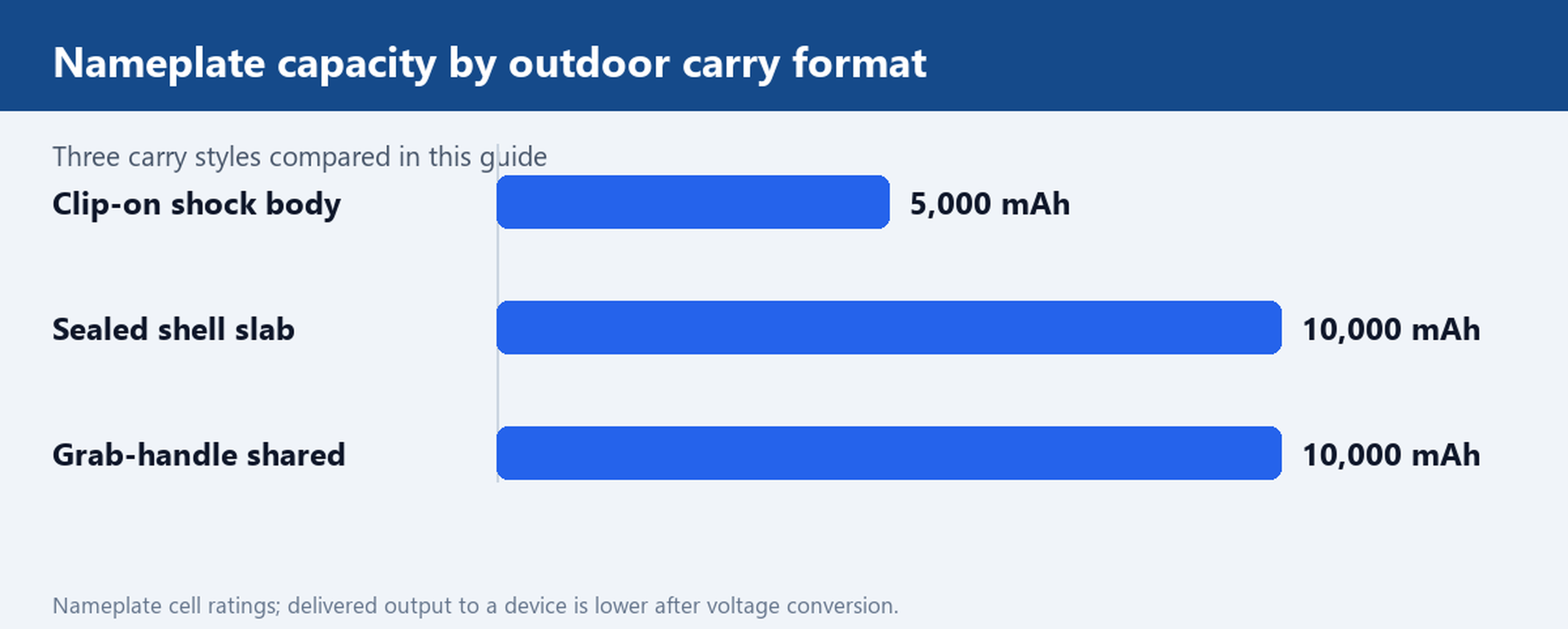
Start With How It Leaves the Van
Before comparing capacities, decide where the bank lives between uses. A bank that stays in a glove box is a different product from one that hangs off a backpack strap during a full day on a trail or a job site. Write down the carry style first: clipped to a belt or bag, sealed inside a pocket or crate, or set down on a table for several people to share. That choice sets the shell construction, the fittings and the reasonable capacity range. A clipped unit has to stay small and light, so the 5,000 mAh class dominates. A sealed unit can be heavier because the case protects it, which is where 10,000 mAh slabs sit. A handled unit is deliberately bulky because it is meant to be passed around, not worn. Buyers who skip this step end up with a high-capacity bank that never leaves the drawer because it is awkward to carry, when a smaller unit in a pocket would have been used every day. Treat carry style as the first filter and capacity as the second.
Sealed Shell and Shock Bones: The 5,000mAh Tier
Take the 5,000 mAh class first. In an outdoor build this capacity is usually wrapped in a shock-bone shell, a rubberised frame that absorbs a knock when the bank is clipped to a bag and swings against a hard surface. The carabiner is not decoration; it is the part that decides whether the unit is used or left behind. Look for a closed loop or a spring gate that can be opened one-handed, and check that the clip is anchored into the shell rather than glued to a seam. Capacity at 5,000 mAh is enough for one phone through a demanding day or a top-up for a headset and a phone together, without the weight that discourages daily carry. Output on this class commonly sits at 5 V / 2 A, rising to about 2.1 A on some single-port designs, which is a realistic charging rate for a standard phone input rather than a fast-charge claim. For a buyer stocking a clip-on impulse item, this tier is the volume choice. Browse the 1,000-5,000mAh range to see how the shells and clips vary before fixing a specification.
The 170 × 88 × 19 mm Slab at 265 g
The middle format is the sealed shell. A representative 10,000 mAh outdoor unit measures 170 × 88 × 19 mm and weighs 265 g, dimensions that matter more than the capacity number once the bank shares a pocket with keys and a phone. A sealed shell means the seams are closed against dust and splashes, so the unit survives a wet bag or a dusty crate; it is not a submersion rating, and the spec sheet should be read for what it actually says. At 19 mm thick, this is a slab rather than a stick, which suits a jacket pocket or a gear bag but not a trouser pocket. The 10,000 mAh rating roughly doubles the rescue capacity of the 5,000 mAh tier, so it covers a phone through a long day plus a second device or a second full charge. Output again settles around 5 V / 2 A to 2.1 A on these sealed builds, and cycle life is commonly stated at 500+ charges before useful capacity falls away. The 5,001-10,000mAh category shows how much the sealed shells vary in thickness and finish.
Grab Handle: 10,000mAh for a Shared Table
The third format is built for a group. A grab-handle unit is also typically 10,000 mAh, but the handle changes the use case: the bank is placed on a table and passed around a campsite, a trade-show booth or a work break, rather than worn by one person. The handle must be moulded into the shell and sized to clear a gloved hand, and the body needs a wide, stable base so it does not tip when a cable is pulled. Because several people share it, output may be split across more than one port, and a buyer should check that two devices can charge together at a sensible rate instead of one fast port and one token port. LED charge indicators are useful here: on a shared bank, a four-light gauge tells the group when to recharge before a dead unit strands everyone. The table below sets the three carry styles side by side. 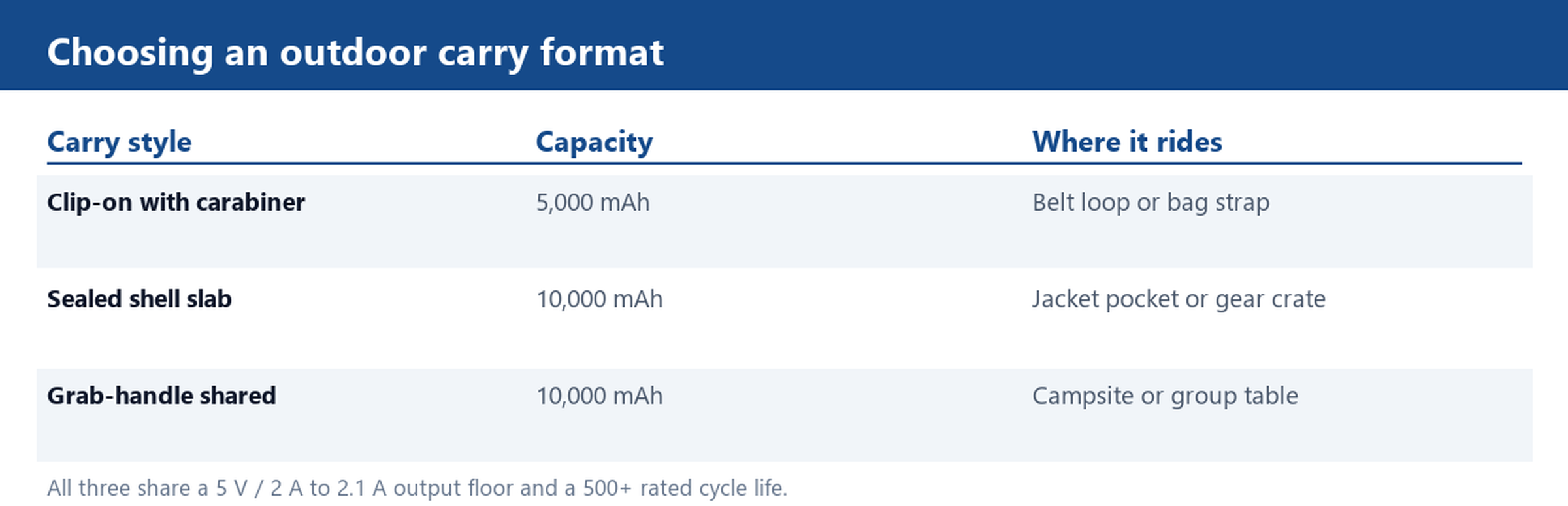
Solar as a Top-Up, Not a Charging Plan
Outdoor banks often carry a solar panel, and this is where expectations drift. A small panel on a 10,000 mAh shell is a top-up source for a sunny day on a trail, not a charging plan for a work week; it slows the drain from the bank when a mains outlet is unavailable. Treat solar as a feature that extends time away from power, not as a replacement for a wall charger, and say so plainly in any listing to avoid returns. What every one of these formats shares is the electrical floor: 5 V / 2 A up to about 2.1 A output, 500+ charge cycles, and the CE, RoHS and FCC marks as the compliance documents a buyer should ask to see. Certification belongs here once, on the shared floor, not repeated in every section. For a retailer building an outdoor assortment, the practical move is to stock one clip-on 5,000 mAh unit, one sealed 10,000 mAh slab and one handled 10,000 mAh bank, then let the carry style do the selling. Send us the carry style and target capacity, and we will quote the shell, carabiner colour and silkscreen logo with a 5-7 day sample.