

A battery case is a moulded shell with a cell inside, and the mould is cut for one handset body. That single fact reorganises the purchase order. An iPhone 6 shell does not accept an iPhone 7 Plus, an R9 body does not share a tool with an R9 Plus, and no capacity figure makes two shells interchangeable. Buyers serving refurbishment channels and accessory wholesalers usually learn this after a model-mixed lot arrives with lines that cannot be sold against the handset list they were bought for. The order that avoids it is written in three layers: handset geometry first, capacity tier second, charge path third, with the tool list confirmed before the quantity is split.
Why the Shell, Not the Capacity, Decides the Order
Three things inside a battery case are bought separately even though they ship as one part. The shell is a moulding with a camera cutout, button reliefs, a port tunnel and a snap lip, and every one of those features is cut to a handset body. The cell is a commodity in a fixed set of sizes. The board is where the charge path lives. Only the first of the three is expensive to change, which is why it is the one to fix before anything else is discussed.
Two handsets that read as the same size on a spec sheet can still differ by a fraction of a millimetre in width or by the position of the camera, and a shell that is 0.3 mm tight will crack at the snap lip on the second or third removal. The customer experiences that as a bad batch, not as a bad model, and the return comes back without the handset attached.
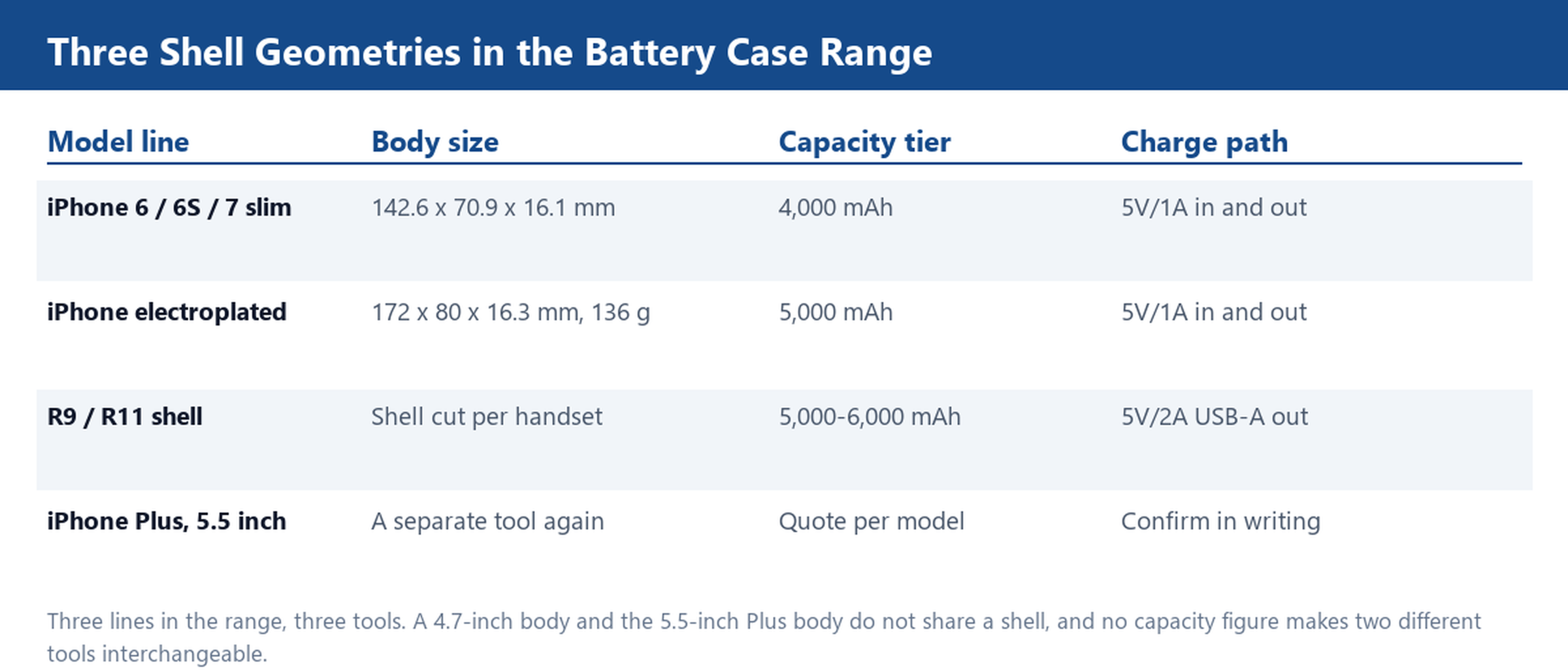
So ask for the tool list rather than the model list. A supplier who knows the moulds can tell you which handset models genuinely share one tool and which merely look close. In our own range the answer is visible from the published dimensions: a slim shell cut at 142.6 x 70.9 x 16.1 mm for the 4.7-inch iPhone bodies, an electroplated shell at 172 x 80 x 16.3 mm and 136 g, and a separate shell for the R9 and R11 bodies. Three lines, three tools, and no shared mould anywhere between them.
Three Geometries, Three Tools, One Purchase Order
The 4.7-inch and 5.5-inch bodies in the same iPhone generation are the classic trap. They share a connector, a camera layout and a marketing name, and they do not share a shell: the 5.5-inch Plus body is wider and longer, so a Plus case is a different tool with a different snap lip. A lot split 60/40 between the two sizes, quoted from one unit price, is a lot where one size is priced against a mould that does not exist.
Model strings matter as much as screen sizes. iPhone 6 and 6S share a body dimension, and the 7 and 8 add a camera change that a shell either accommodates or does not. Writing iPhone 6 to 8 as one line is how a batch ends up fitted to two models out of three. Put the exact model on each line, with the quantity per model beside it.
On the Android side the geometry question is sharper because the refurbishment channel keeps older handsets alive longer. The R9 and R11 bodies are sold through refurbishers, and the R9 Plus is a longer body that takes a different shell again. Our mobile phone battery case listing is organised by handset for that reason, and it is worth reading the model line before the capacity column.
The buying action is one sample per model, not one sample per family. A fit sample that arrives for the 4.7-inch body proves nothing about the 5.5-inch shell, and the difference shows up at the point where the snap lip meets the frame, which is exactly the part a photograph cannot show.
Capacity Tiers in Practice: 4,000 mAh at 16.1 mm Against 5,000 to 6,000 mAh
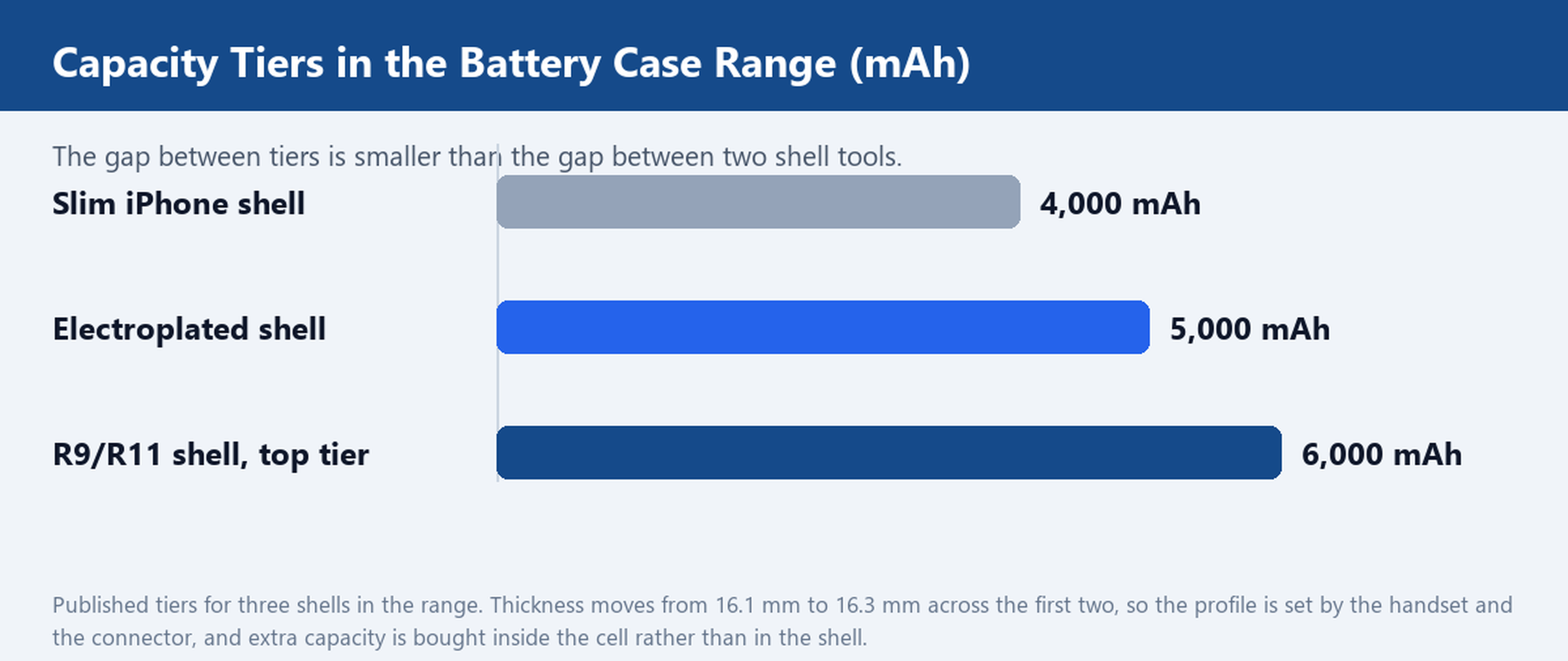
Capacity is the second decision, and in this product it is a smaller spread than buyers expect. The slim shell publishes 4,000 mAh, with 2,500 to 5,000 mAh available on request. The electroplated shell publishes 5,000 mAh. The R9 and R11 shell publishes 5,000 to 6,000 mAh per project. That is a range of roughly 25 to 50 percent between the bottom and the top tier, carried in a body that grows by 0.2 mm in thickness between the first two.
That small thickness change is the useful signal. The profile of a battery case is set by the handset, the connector and the snap lip, so a designer has very little room to trade thickness for capacity. The extra milliamp-hours are bought inside the cell, not in the shell, which is why a buyer who asks for a thicker case to get more capacity is asking for a new tool rather than a bigger battery.
Choose the tier by what the phone does in a day. A slim 4,000 mAh shell is a pocket product for a 4.7-inch handset and adds one useful charge without changing how the phone sits in a hand. A 5,000 to 6,000 mAh shell is a shift-length product, and it belongs with the handsets that are used as a work tool rather than as a phone. Keep the tiers as separate SKUs even when they share a tool, because they are separate boxes, separate returns and separate price points, and merging them on a purchase order produces a lot that cannot be invoiced against either line.
Charge Path: 5V/1A Against 5V/2A and What the Customer Complains About
The charge path decides which complaint you receive. A 5V/1A input and output fills a phone slowly and keeps the shell close to ambient temperature. A 5V/2A USB-A output fills faster and puts more heat into the same sealed volume, which is heat the user feels through the back of the case. Neither is wrong. Selling the second as if it were the first is what produces a one-star review that says the case gets hot, and selling the first as if it were the second produces a review that says the case is slow.
Three lines belong on the order: the input connector, the output current, and whether pass-through charging is supported. The input connector is a SKU dimension in its own right, since a micro-USB input and a Lightning-class input are different shells with different port tunnels, and a buyer who assumes one gets the other at the sample stage. The output current is a board property, so a 2A rating on a board built for 1A is a heat complaint with a date on it.
Ask for the charge test rather than the label: input at 5 V with a known load, measure the current the phone actually draws and the case temperature after thirty minutes. A published 5V/1A line and a measured 5V/1A line are the same number only when somebody measured it, and that measurement is the difference between a quote and a specification.
Where a customer needs the case to charge two things, the answer is usually a different product rather than a modified board. The multi-port power bank range exists for that case, and forcing a second output into a battery case shell tends to cost the thickness margin the shell does not have.
Cell Grade and the Clause That Protects a Reorder
The catalogue line for this product family is Grade-A lithium-polymer with a 500-plus cycle claim on the R9 and R11 shell. What a buyer has to add is the clause, because the grade is a supplier assertion and a substitution is invisible in a photograph. Write the cell chemistry, the capacity tolerance you will accept, and a sentence that no change of cell maker, cell grade or protection circuit is allowed without written approval and a new sample.
Then ask for one incoming test per lot: discharge a sample at a stated current, report the watt-hours that come out, and compare that against the watt-hours the pack should hold. A 5,000 mAh pack at 3.7 V nominal is 18.5 Wh, and a lot that delivers 15 Wh is a lot of lower-grade cells wearing the right label. That check costs an hour and settles the question before the cartons are opened.
Certification belongs on the same line but not in more detail than the buyer needs: CE, RoHS and FCC are the marks the channel asks for, and the paperwork should travel with the lot. Cycle life itself is a longer subject than a purchase order can carry, and the honest version of it is a test protocol agreed with the supplier rather than a number repeated from a listing.
Lot Structure for Refurbishers: Model Mix, Logo Neutrality and Sampling
A refurbishment buyer orders a model mix, not a model. That makes the ratio the first commercial decision: the quantity per handset model, in units, tied to the handset list the channel actually holds. A mix built from last season numbers arrives with the models nobody wants and none of the one that turns. Ask for the ratio to be quoted per model and for the tool sharing to be confirmed in the same reply, so that a change in the mix does not silently become a change in tooling cost.
Logo neutrality is the second. A shell with a printed logo is committed to one channel, and a refurbisher selling through several storefronts usually wants a clean shell with the logo applied later or not at all. Say which one you are buying, and if the answer is a printed logo, approve it on the actual shell rather than on artwork, since silk print on a curved electroplated surface reads differently from the flat proof.
Sampling and the production window close the order. One fit sample per model and one charge test per tier is the minimum that has ever caught the two faults that matter, which are a snap lip that is too tight and a board that runs hot. Agree the mass production window per model rather than for the lot as a whole, and split the shipment so the slowest model does not hold the fastest one in a warehouse. Where the whole programme is being built around a new handset, the same conversation belongs in the custom power bank brief, because the shell and the cell are specified together.
The slim power bank and power bank for mobile phones ranges follow the same three-layer order, so a buyer who has written one brief for this category can reuse it across the accessory programme without rewriting the clauses.
Send us your handset model list with the quantity per model, and we will confirm which shells share a tool and quote a model-mixed lot with a sample case for fit testing.