

Most car charger orders fail on the vehicle, not on the electronics. Knowing how to choose car charger stock for a fleet or a retail channel comes down to three numbers and one physical check: the input voltage range the vehicle actually supplies, the current each port is rated at, and whether the body fits the socket without hitting the flap. Capacity in mAh does not enter into it, which is why this product is priced and specified differently from a power bank.
12-24 V Input First: The Truck That Kills a 12 V Unit
A charger rated for 12 V only is a 12 V car accessory. Put it in a light truck or a van with a 24 V system and the input stage sees double the voltage it was designed for. Some units survive for a while because the converter has margin; most fail at the input capacitor, and they fail hot.
So the first line of the specification to read is the input range, not the output. A wide-input unit marked 12-24 V covers both a passenger car and a truck, which matters for any fleet that mixes light vans with heavier vehicles and for a distributor selling into repair shops that see both. Two practical checks:
- Ask for the input range in writing. A data sheet that says 12 V to 24 V is different from one that says 12 V, and the difference is visible on the label of the sample.
- Ask about the protection circuit. Over-voltage and reverse polarity protection should be listed as features of the input stage, not as a general claim about safety.
A 12 V only unit still has a place: a promotional item for a car dealership that only sells passenger cars, where the cost difference matters more than the coverage. Just do not mix it into a fleet order without a label that says so.
1 A, 2.1 A Dual and 2.4 A Class: Matching Amps to the Device in the Socket
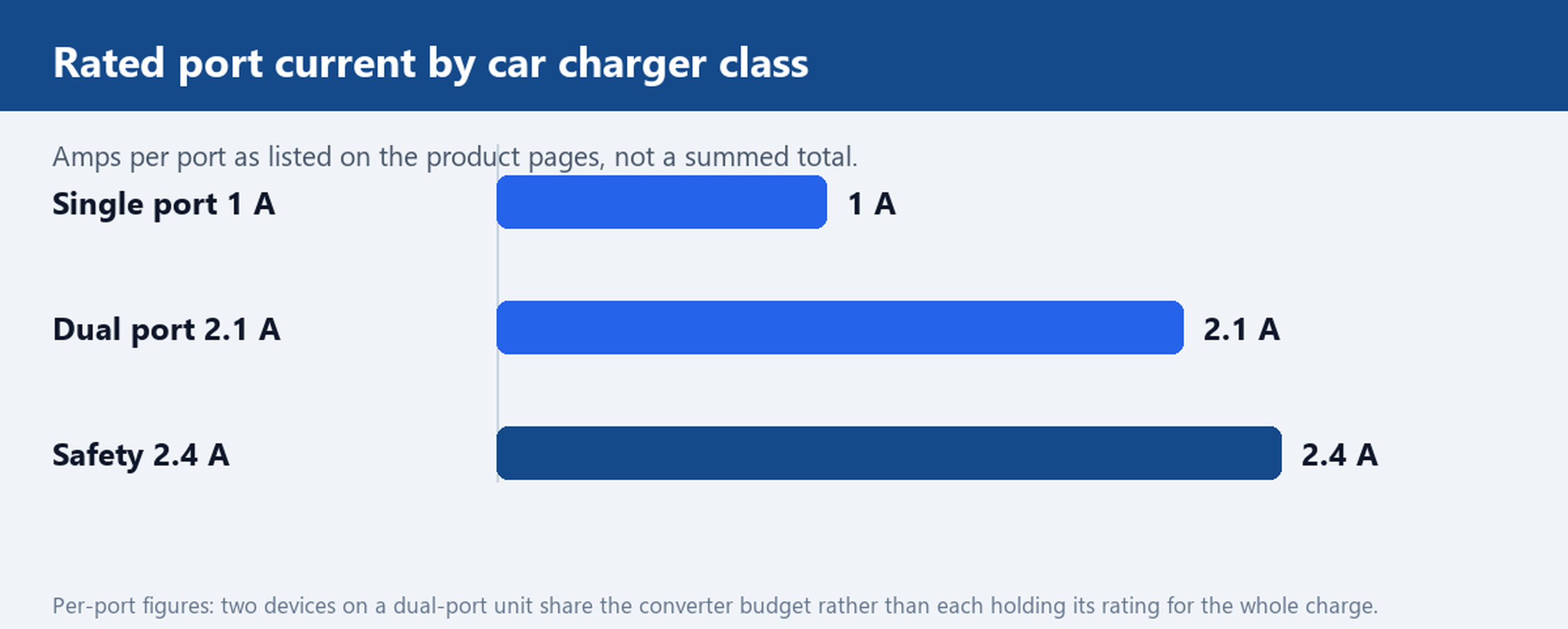
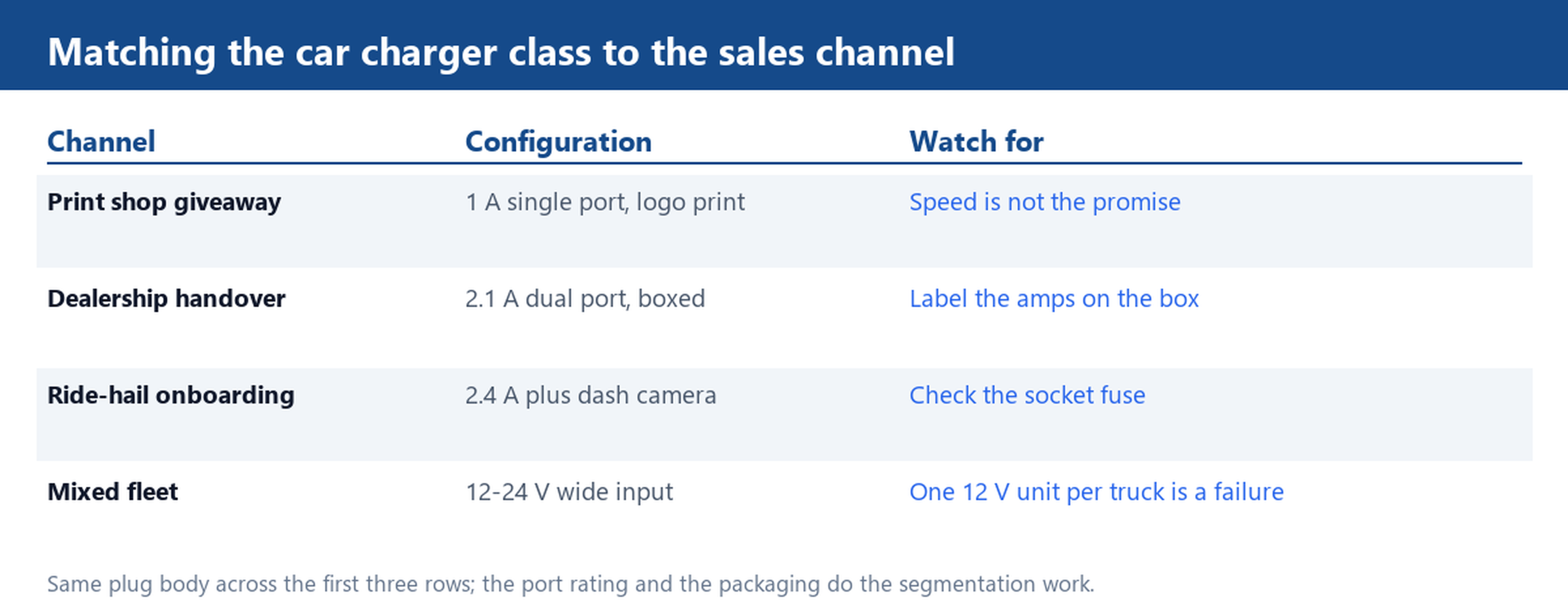
Current rating is where the channel decides the specification. The chargers and accessories category splits the range along exactly these three classes.
- 1 A single port. About 5 W at 5 V, enough to hold a phone at its current level while it is idle. This is the print-shop and event giveaway class, where the promise is a logo on a usable object rather than fast charging. The single-port 1 A mini charger is built for that job.
- 2.1 A dual port. The dealership handover class. Each port carries 2.1 A, so a driver can run navigation on one port and charge a second device on the other. The dual-port 2.1 A charger is the version most fleets standardise on.
- 2.4 A class. Higher single-port output for a phone plus a dash camera, which is the ride-hail and delivery driver case. The 2.4 A safety charger sits in this class.
Two engineering notes before the quantities are fixed. First, the port ratings are per port, but the converter inside has a total budget: two devices charging at once on a dual-port unit will usually share the available current rather than each holding its rating. Second, check the vehicle fuse for the socket circuit before promising a three-port unit to a fleet, because a plug that draws more than the circuit allows turns a convenience item into a warranty claim.
Socket Fit: Mini Bodies, Grip Rings and Dashes With No Room
The third number is body length, and it is the one that gets ignored until the first return. A 12 V socket sits in three very different places: exposed on the console, under a lid with a spring flap, or tucked behind the handbrake console where nothing protrudes.
For a socket under a flap, a short body is the whole specification. Measure the depth from the socket rim to the flap in the closed position, then compare it with the body length plus the cable bend of the sample. A long body with a straight cable entry holds the flap open, and on some cars that is also where the socket illumination sits, so the driver notices it every night.
A grip ring or a knurled collar looks like a cosmetic detail and is not: a mini body seated deep in a socket is hard to pull out with two fingers, and drivers pull on the cable instead, which is how the connector and the socket both get damaged.
Safety Tools Built Into the Plug: Hammer, Belt Blade and LED
The built-in tool version sells on perceived value and it earns that value in specific channels: insurance and roadside assistance programmes, corporate safety kits, and taxi or ride-hail onboarding packs. A plug that also carries a window hammer, a belt cutter and a small LED is easier to justify in a safety budget than a plain charger, and it stays in the socket where it can be found.
Two constraints come with the format. The blade makes the item a restricted article for some air freight routes and for some retail categories, so confirm the shipping mode and the local rule before the artwork is printed. And the tool end is the part that gets abused: specify a metal body around the hammer point if the item is going into a rental fleet, because a plastic shell at that stress point cracks.
CE, RoHS, FCC and the Sampling-to-Production Calendar for a Fleet Order
For a fleet or a retail chain, the paperwork is part of the product. Ask for the test reports that match the exact model and the exact plug, not a generic file set for the product family, and check that the model code on the report matches the code on the sample label. CE and RoHS cover the European channel, FCC the United States; a distributor selling into both needs both files before the first purchase order.
The sampling sequence that avoids most problems is short. Approve a physical sample, then lock the label artwork and the packaging in the same approval, then ask for a production unit from the first run to compare against the approved sample. Colour and logo are the two things that drift between a sample and a production run, and both are visible without a tester.
Finally, put the vehicle mix and the channel on the purchase order rather than in an email thread: 12-24 V wide input for the mixed fleet, dual 2.1 A for handover, 1 A mini for the giveaway, and short bodies wherever the socket has a flap. That single line is the difference between one order and a repeat order.
Tell us the vehicle mix and the sales channel and we will send three car charger samples with the certification file set.