

A carton of samples arrives, the label says 20000 mAh, and the first unit discharges 11800 mAh into a load at 5 V. Nothing is broken. That gap is conversion loss, and telling normal from a warning means measuring it against the right number. This is the bench routine for the three readings that decide a power bank shipment: delivered energy, the PD handshake the port actually performs, and case temperature under sustained load. How to test power bank stock properly starts with accepting that the label and the meter measure two different things.
Three Numbers to Verify: Rated Capacity, Output Wattage, Surface Temperature
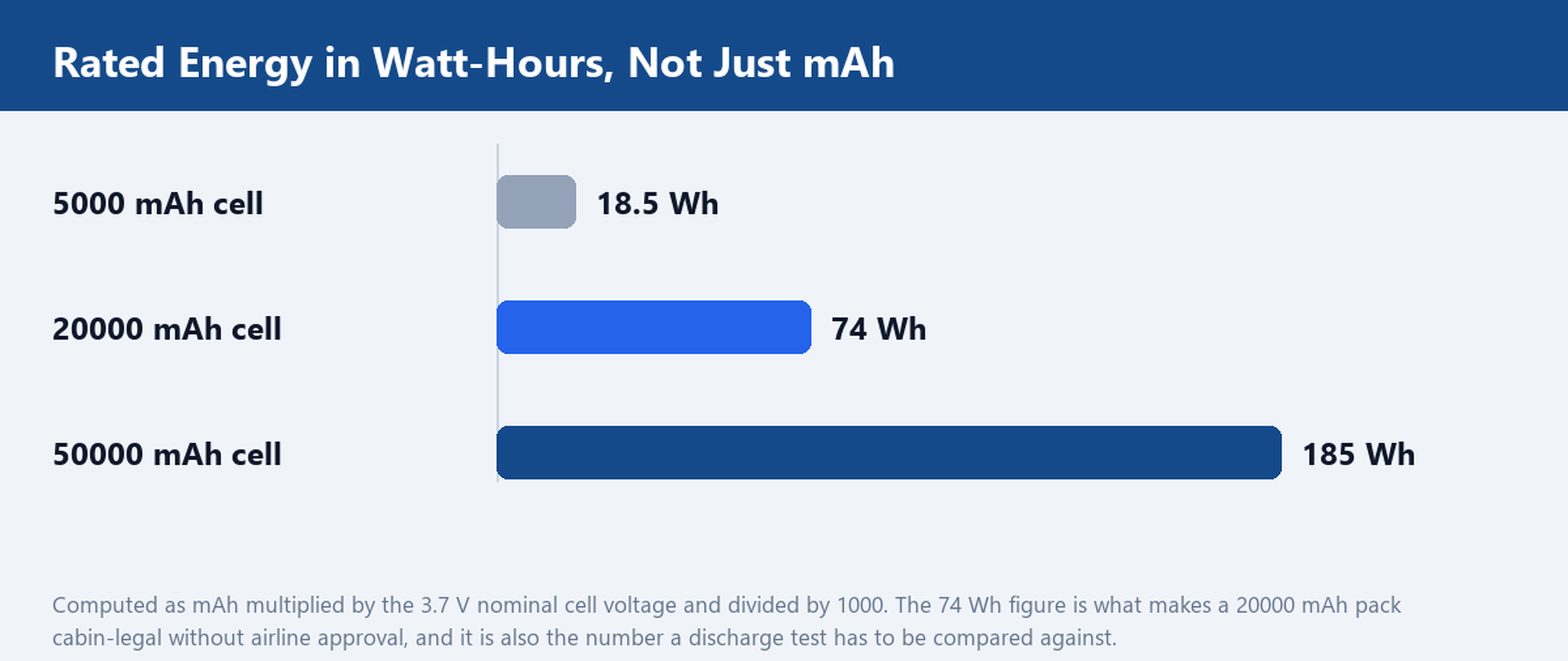
Rated capacity is cell capacity, measured at the nominal cell voltage of 3.7 V, before any conversion. Output happens at 5 V, 9 V, 12 V, 15 V or 20 V through a boost converter that loses energy as heat. Convert first: milliamp-hours multiplied by 3.7 and divided by 1000 gives watt-hours. A 5000 mAh pack holds 18.5 Wh, a 20000 mAh pack holds 74 Wh, and a 50000 mAh pack holds 185 Wh. Those are the numbers a discharge test is compared against, and the 74 Wh figure is also what keeps a 20000 mAh pack inside the cabin allowance that most airlines apply without a separate approval.
Wattage on the output side is a negotiation result, not a property of the battery. A port rated 45 W or 100 W is capable of advertising certain voltage and current pairs; what the phone or laptop actually receives depends on what it asks for and on the cable in between. Two units with the same cell and the same claimed wattage can negotiate completely differently, which is why the handshake test exists separately from the discharge test.
Surface temperature is the third number, and it is the one no listing prints. It matters twice: lithium cells age faster when they run hot, and a case that becomes uncomfortable to hold is a customer complaint regardless of what the meter says. None of the three readings can be inferred from the other two.
Running a Discharge Test and Reading What Comes Out
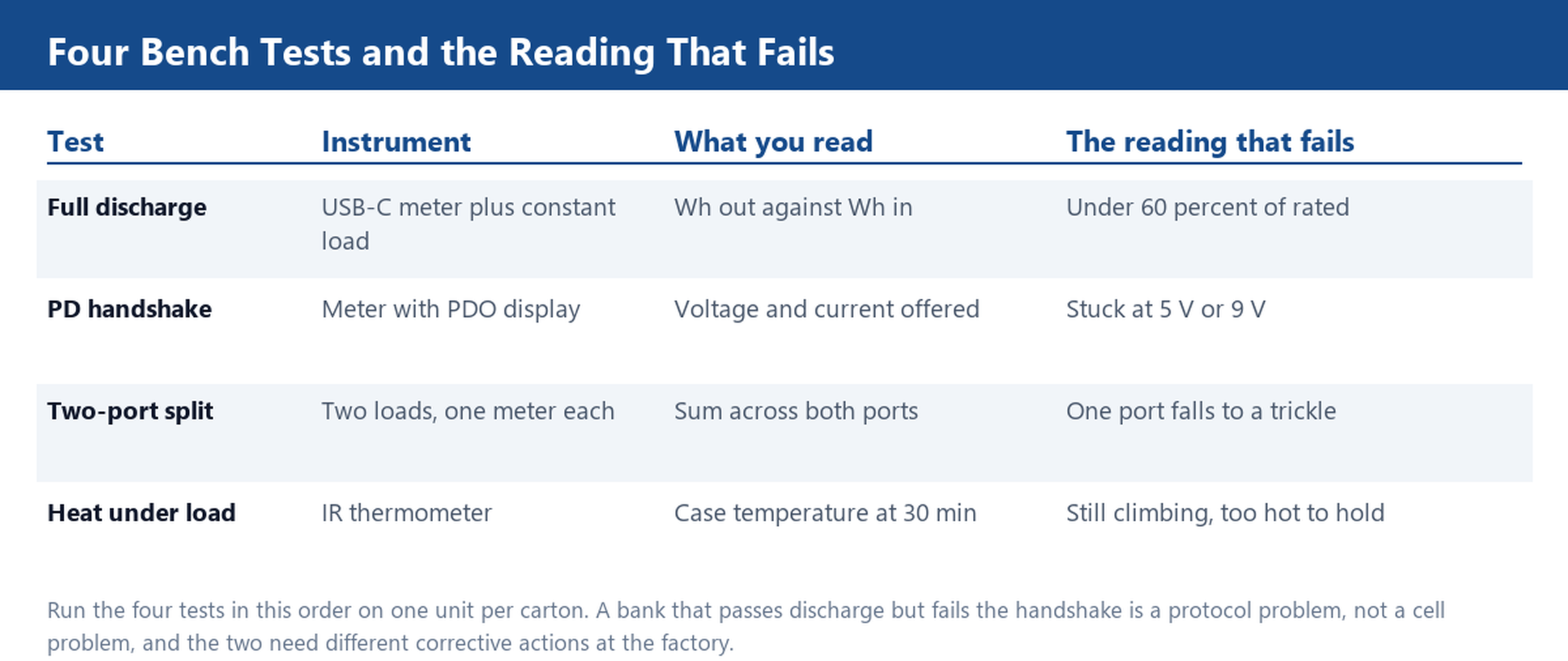
Put a USB-C meter inline between the bank and a constant load, run at 5 V, and record watt-hours until the bank cuts off. Divide delivered watt-hours by the rated watt-hours from the calculation above. A healthy pack lands somewhere between 60 and 70 percent of its rated milliamp-hour figure when measured at 5 V, because boost conversion, standby draw and the cutoff voltage all take a share. Below 60 percent, either the cells are undersized for the label or they are not new.
Ignore the percentage display while the test runs. On most units that figure comes from a fuel gauge estimating remaining energy from voltage, and it is common to see a pack fall from 20 percent to shutdown without warning. The meter is the record; the display is an estimate. Log the meter output with the time, the ambient temperature and the load current, because a discharge run without those three is not repeatable.
Repeat the run at the output level the product will actually be sold on. A pack rated 45 W delivers less total energy at 45 W than at 5 V, since higher current through the same cell resistance burns more of the stored energy internally. For a 20000 mAh 45 W unit that difference is small but measurable; for a 50000 mAh 100 W station running several devices it is the difference between the published runtime and the one a customer experiences.
Checking the PD Handshake Instead of Trusting the Label
Power Delivery works by negotiation: the source advertises a list of voltage and current pairs, and the sink requests one from that list. A meter that displays the active power object shows exactly which pair was agreed. A 45 W port should offer something like 15 V at 3 A or 20 V at 2.25 A. A 100 W port needs 20 V at 5 A to reach its rating. If the meter sits at 5 V and 3 A, the link is at 15 W, and no amount of waiting will move it.
Two causes account for most of those failures, and separating them takes one extra cable. First, the port may not advertise the high-voltage objects at all, which is a firmware or hardware fault in the bank. Second, the cable may lack the electronics that tell the source it can carry 5 A; a 3 A cable caps a 100 W bank at 60 W and no display will explain why. Test with the cable you plan to ship, then swap in a known good 5 A cable. If the handshake improves, the fault is in the accessory, not the bank.
Check the full advertised list rather than one successful negotiation, and keep the list with the sample. If a batch offers fewer power objects than the approved sample, the port controller or its firmware has changed, and that is a production change nobody told the buyer about.
Load Sharing When Two Ports Are Used at Once
The converter inside a power bank has a total output budget, and every port draws from it. Plugging a second device does not add capacity; it divides the same envelope. On a multi-device unit the label should state the split, and the split should be measured rather than assumed: two meters, two loads, then add the wattage from both ports and compare the sum with the single-port figure.
What often surprises buyers is the shape of the split rather than the total. Many designs drop a secondary port to a trickle when a high-power device is connected, so a phone that charged at 18 W alone falls to a slow charge the moment a laptop is plugged in. That is a design choice, not a defect, but it has to be documented, because the customer will report it as a fault and the support desk will have no answer. The multi-port range is where those tables belong in the specification.
Wireless charging is a load too. A 15 W pad on top of the case draws from the same budget, so the port figures taken with the pad idle do not describe the unit in use. Measure with the pad active and with a phone on it.
A Sampling Routine That Catches a Bad Batch Before Payment
One unit per carton, four tests, in this order: full discharge, PD handshake, two-port split, heat under load. Thirty minutes at rated output with an infrared thermometer on the case gives the temperature reading, and the useful judgement is the trend rather than the absolute number: a case that stabilises is behaving, a case that is still climbing at the half-hour mark is heading somewhere worse. If the unit is too hot to hold comfortably at that point, the design has no thermal headroom and the batch will generate returns in summer.
Record every reading and compare against the approved sample instead of against the label. Variance is the signal. Ten units that discharge within a few percent of each other are a controlled process; three of ten that handshake differently are a firmware or connector problem, and that will not improve in the next carton.
Then write the acceptance criteria into the purchase order: minimum delivered watt-hours as a percentage of rated, the required list of power objects, the port split table, and a surface temperature ceiling measured under a stated load. Those four lines turn a verbal promise into something a QC bench can reject. Capacity, port count and enclosure changes run through the custom power bank programme, and the power bank range by type is where the format decision starts.
Tell us the capacity and wattage you are ordering, and we will send a unit with its discharge log so the same test can be run on arrival and the numbers compared line by line, rather than a label against a meter.