

The most common complaint about an outdoor solar power bank is that a full day in the sun adds one bar of charge. That is not a fault. It is what a panel of that size can do to a cell of that size, and the arithmetic is simple enough to run before an order instead of after a shipment. Read the panel as a backup input that keeps a pack from going flat on a long trip, and the rest of the specification falls into place: capacity, port split, shell and the parts you cannot change later.
How to Choose Solar Power Bank Output Before Panel Wattage
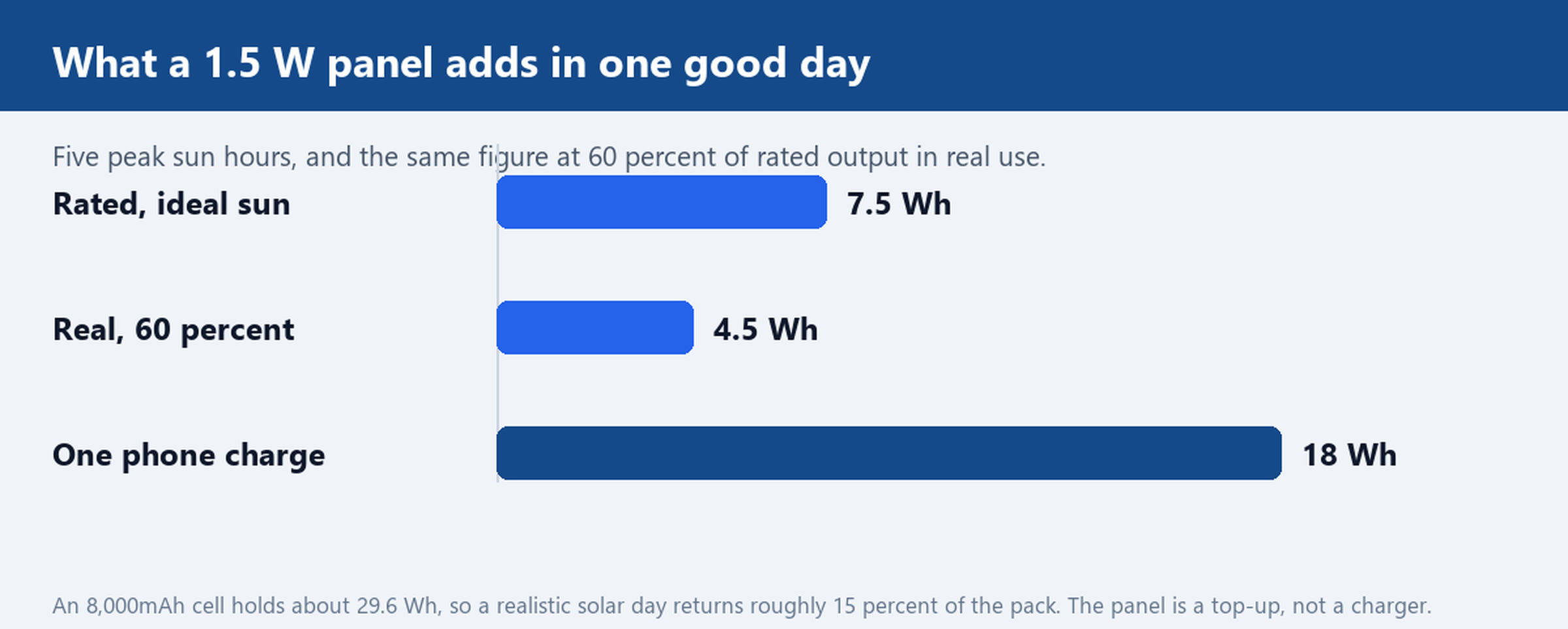
Start with the number nobody prints in large type: the panel wattage. A 1.5 W face is typical on a carabiner-sized unit. Under five peak sun hours, which is a good day in most temperate markets, that is 7.5 Wh of energy at rated output. Real panels on a curved, partly shaded shell return closer to 60 percent of rated, so budget about 4.5 Wh per day. Against an 8,000mAh cell, which holds roughly 29.6 Wh at 3.7 V nominal, that is about 15 percent of the pack per good day.
Put that next to a phone. A full charge from empty takes roughly 18 Wh drawn from the pack once conversion losses are counted. So four good days of sun is about one phone charge. The panel is doing exactly what it should be doing on a trail: buying time in an emergency, slowing the drain while the phone is off, and keeping the pack from reaching zero. It is not replacing the wall charger, and a product page that implies otherwise is the reason returns happen.
10,000mAh at 265 g or 8,000mAh With Two Outputs: Picking by Load
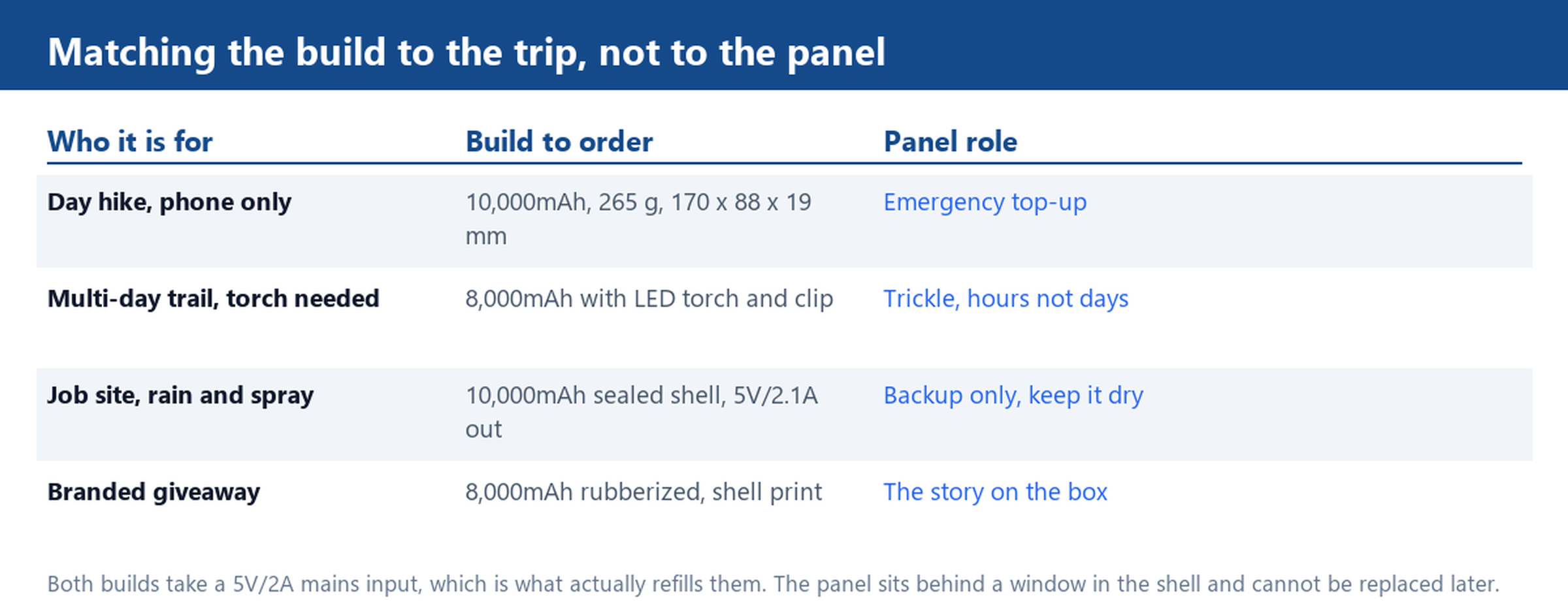
Once the panel is understood as a top-up, capacity becomes a question about days off-grid and what has to charge. The 10,000mAh waterproof solar power bank is the day-hike and job-site build: 170 x 88 x 19 mm at 265 g, 5V/2.1A output, 5V/2A input plus the panel, grade-A Li-polymer cells, and a capacity tier that can be ordered anywhere from 8,000 to 20,000mAh. The 8,000mAh carabiner solar charger is the multi-day trail build: 1.5 W panel, 5V/2A USB-A output, optional USB-C in and out, an LED torch, cells rated at 500-plus cycles, and a rubberized shell that hangs off a pack.
The choice is rarely about the milliamp-hour figure alone. The 10,000mAh unit weighs 265 g, which a hiker feels after a full day; the 8,000mAh unit trades 2,000mAh for a torch, a clip and a smaller footprint. If the device mix is a phone and a headlamp, the smaller pack with the torch is the better order. If it is a phone, a tablet and a site radio, the 10,000mAh build with the 2.1A port is the one that finishes the job.
Output Split: 5V/1A for a Headlamp, 5V/2.1A for the Phone
Ports are where a specification sheet becomes a support email. A 5V/1A port delivers 5 W, which is fine for a headlamp, a bike light, a small camera battery or a Bluetooth speaker, and slow for a modern phone that will happily pull 10 W or more. A 5V/2.1A port delivers 10.5 W, which covers a phone at a normal charging rate but still sits below the fast-charge standards that phones negotiate over USB-C.
So order the split to match the intended use rather than the highest number on the page. One 2.1A port plus one 1A port suits a two-device trip: the phone on the fast port overnight, the headlamp on the slow one. Two 1A ports suit a promotional build where the users charge small accessories. A single port keeps the bill of materials smallest but forces the queue, which is the arrangement most likely to generate a complaint from a two-phone household.
Input matters just as much. A 5V/2A input refills a 10,000mAh pack in a bit over five hours at ideal current, which is an overnight charge. A 5V/1A input doubles that, and buyers notice. If a quotation offers a 1A input to save cost, it is worth knowing before the packaging says fast recharge.
Shell, Water Resistance and a Panel That Cannot Be Replaced
The panel sits behind a window sealed into the shell, so it is not a serviceable part. A crack, a delamination or a scratched face means the whole unit is scrap, and there is no field repair. That single fact argues for a shell that survives a drop rather than one that survives a photograph: rubberized paint over a rigid frame, a raised lip around the panel window, and a port cover that closes with a positive click.
On water, the honest wording is rain and spray. A sealed housing with a covered port meets that. Immersion is a different claim and needs a different design, and a supplier who answers yes to both without a test report is telling you something about the documentation, not the product. Ask what test the housing passed, and ask for the report with the sample.
Heat is the other shell question. A dark pack left on a rock in direct sun gets hot, and a Li-polymer cell charged at high temperature ages faster than the cycle count on the datasheet suggests. This is one more reason the panel is a top-up: the pack should spend the day in shade or on a pack, not baking on a dashboard.
Order Notes: Configuration, Marking and What to Confirm Before the Run
Five items belong in the confirmation before tooling, and each one is cheaper to settle now than after the cartons are printed:
- Capacity tier, stated in mAh with the nominal voltage, since the 10,000mAh build can be ordered from 8,000 to 20,000mAh and the weight changes with it.
- Port configuration, written port by port: how many outputs, at which current, and whether USB-C is input only or input and output.
- Panel wattage, with the number on the quotation rather than a description of the panel as a feature.
- Housing finish and logo method, plus whether the panel window is flush or recessed, because that decides how the print wraps.
- Sampling and production timing, which on this range runs 5 to 7 days for a sample and 15 to 25 days for mass production depending on quantity.
Certification is the sixth item if the destination market needs it: the 10,000mAh build is quoted with CE, RoHS and FCC, and the file should travel with the sample rather than arrive after the order.
Tell us how many days off-grid and which devices must charge, and we will match the 8,000mAh or 10,000mAh build and send a sample with the panel spec written into the quote. If the order is branded, the power banks by use pages show the shells that print well for outdoor, marine and job-site programmes.