

The capacity on the box is not the number that decides a power bank for travel. Watt-hours are, because cabin rules are written in watt-hours and the arithmetic behind them is fixed: milliamp-hours times 3.7, divided by 1,000. A 10,000mAh pack is 37Wh and boards without a question. A 50,000mAh station is 185Wh, nearly twice the usual cabin ceiling, and no amount of retail packaging changes that. The useful travel kit is therefore built around what can fly, and the station belongs to the van, the site trailer and the event table.
The Carry-On Line: Where 10,000mAh, 20,000mAh and 50,000mAh Land
The common cabin ceiling is 100Wh per battery, with some carriers allowing 100 to 160Wh only with approval at check-in, and lithium cells barred from checked baggage in most markets. Convert the capacities on your quotation into watt-hours before anything else, because the tier a buyer thinks they are ordering and the tier the airline sees are often different.
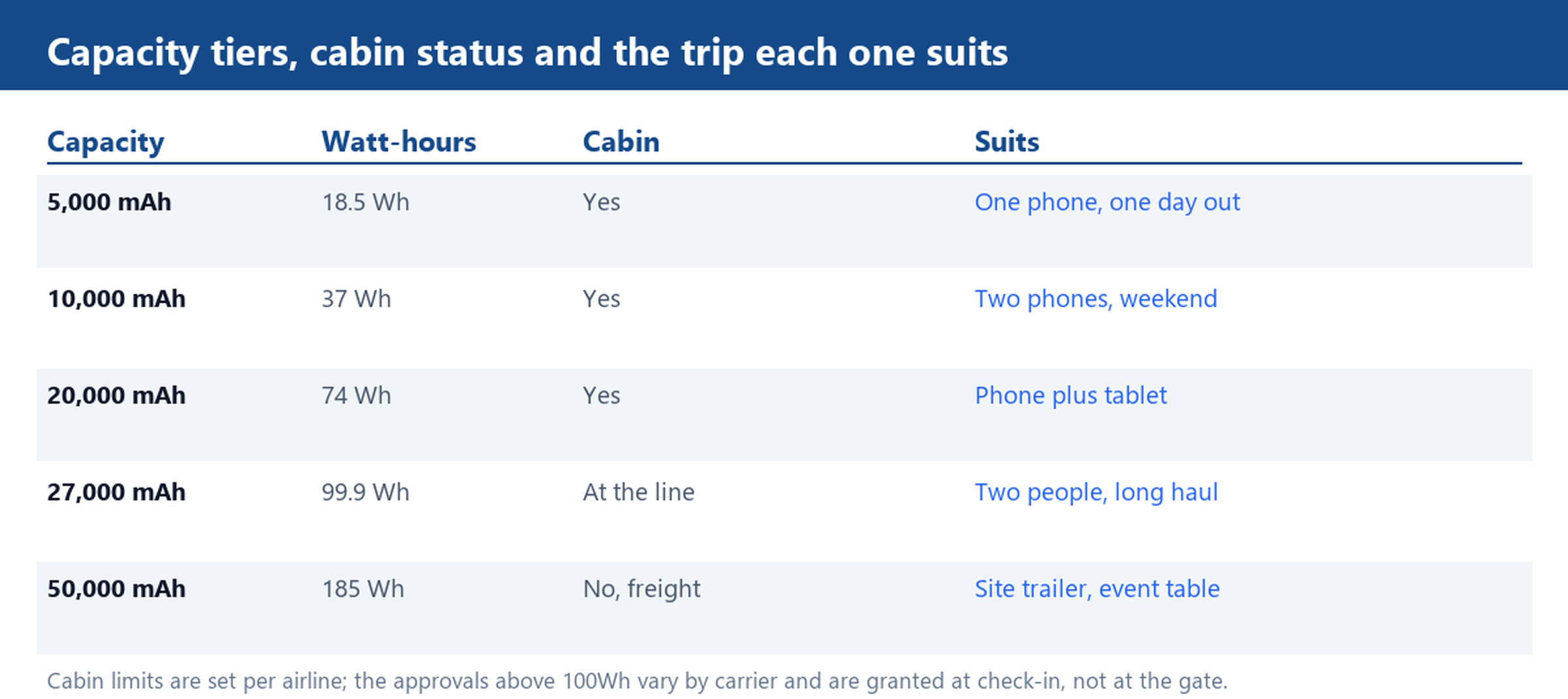
A 5,000mAh pack is 18.5Wh and reads as a phone top-up. A 10,000mAh pack is 37Wh, still less than half the ceiling, which is why it is the volume travel size. A 20,000mAh pack is 74Wh and remains cabin-legal while carrying roughly two full phone charges plus a tablet. A 27,000mAh pack lands at 99.9Wh, which is legal and also the last row that is: it sits at the line, so any cell variation upward pushes it into the approval zone. A 50,000mAh station at 185Wh is freight, full stop.
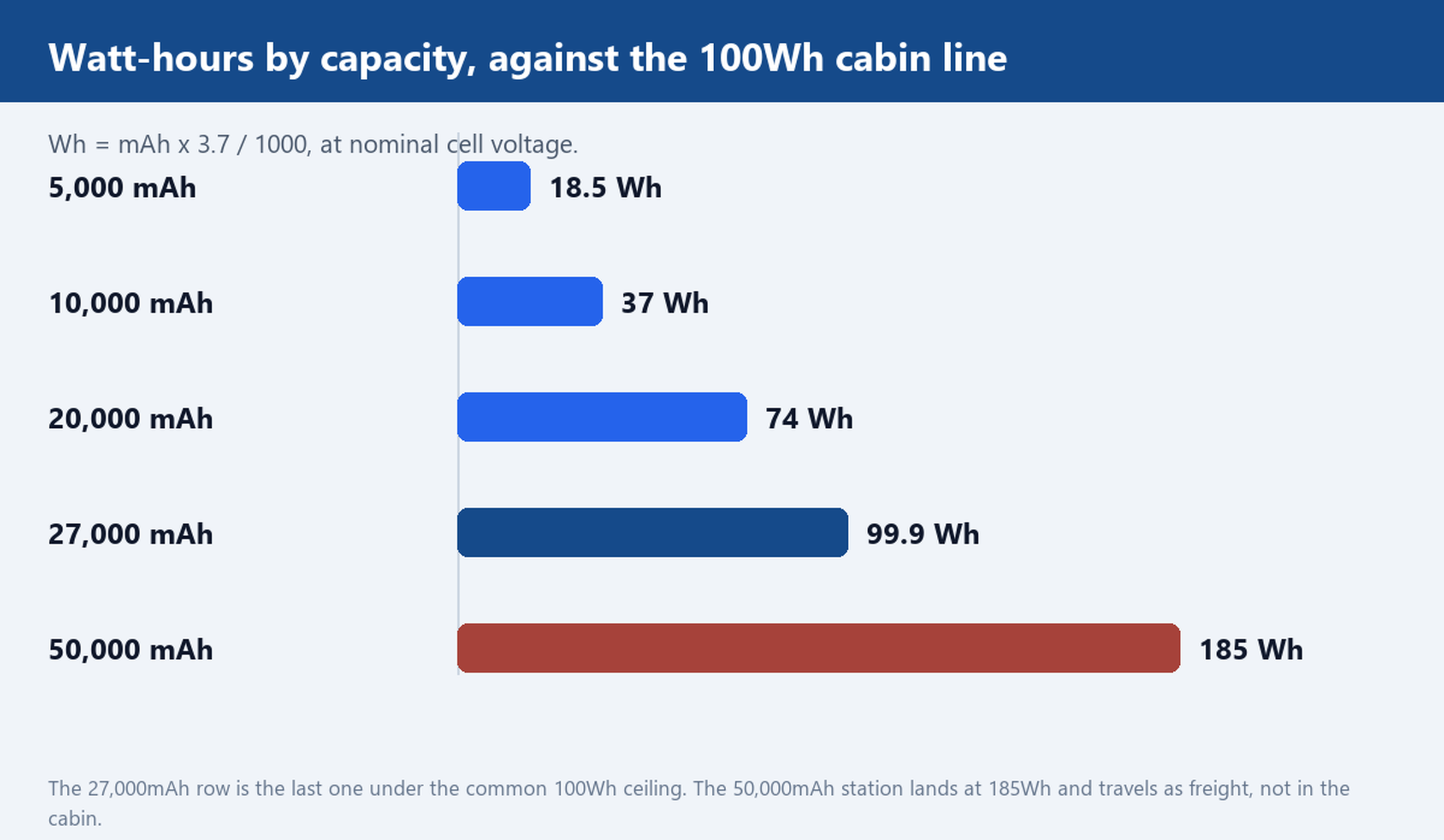
That single table explains the two-product travel line better than any capacity comparison. Two 10,000mAh packs give 74Wh of usable cabin capacity across two bags and two travellers, and neither one is confiscated at a gate. One 50,000mAh station gives five times the energy and cannot make the flight.
Multi-Port Kits: Phone, Tablet and Earbuds From One Pack
On the road, port count matters more than capacity once the pack is above about 10,000mAh, because the queue is the problem, not the joules. Two travellers with three devices each do not want to rotate a single cable at a gate. A dual-output pack such as the dual USB unit with LED display covers a phone and a tablet at the same time, and the display removes the guessing that turns a 30 percent pack into a search for a socket.
The port budget is where the specification has to be read carefully. Two USB-A outputs on the same 5 V rail share one converter, so the quoted single-port current is not the sum available with both loaded: plug in a tablet and a phone and the pack arbitrates, usually giving the tablet the larger share and holding the phone at a trickle. That is normal behaviour, and it becomes a complaint only when the retail copy implied two full-rate ports. Write the per-port figures on the carton, not the total.
Earbuds and watches are the other half of the kit and the easiest to get wrong. Their cases draw a small current for a long time, and some packs shut off when the draw falls under their standby threshold, so the case stops charging overnight without any indication. If the travel kit is being sold to a market where earbuds travel with the phone, test that behaviour on the sample: charge an empty case from the pack overnight and see whether both are full in the morning.
Port count only helps inside a tier that can fly, so the same arithmetic is worth reading in travel terms before the port table is drawn:
Self-Recharge on the Move: Wall Plug, USB-C In and Hotel Outlets
Recharge is the part of travel that buyers underestimate. A 10,000mAh pack holds 37Wh; refilling it from a 5 V 2 A charger means about 10 W into the pack, so the arithmetic runs to roughly four hours of ideal transfer and closer to five hours once conversion losses are counted. A 20,000mAh pack doubles that. On a two-night trip with one hotel socket, a pack that needs five hours is fine overnight and useless on a day move.
The fold-out plug format solves the socket problem directly. The 2-in-1 wall charger power bank carries 110 to 240 V input prongs in the body, so it refills from any wall socket with no cable to pack, and the same prongs fold away for the bag. On a hotel desk with one free outlet, that also frees the outlet for a laptop, which is the argument that closes the sale with frequent flyers.
Pass-through charging is the detail to confirm. A pack that can charge itself and a phone from one socket is a different product from one that cannot, and the difference only shows on the second night of a trip. Ask for it in writing, and test it on the sample with the phone at 20 percent, because some units pass through at reduced current and take twice as long on both sides.
Sharing 100W Across Five Devices: What Each Port Drops
A station rated at 100 W is describing the total output of one converter, not five simultaneous 100 W ports. The budget is shared, and the sharing rules are what a buyer needs on paper. If a laptop pulls 60 W from the high-power port, 40 W remains for everything else, which is enough for two phones at 18 W and leaves almost nothing for the fourth and fifth device.
The drop is not linear and it is not transparent to the user. Most multi-port boards allocate in a fixed priority: the high-power port keeps its profile while the remaining ports fall back in steps, so a phone that was charging at 18 W can drop to 7.5 W the moment a third device is plugged in. The user sees a slower percentage, not an error. That is why the port table belongs in the datasheet with each port rated separately, alongside a line stating what happens when all ports are loaded.
For a travel kit the practical rule is one high-power port for a laptop or tablet, two standard ports for phones, and a low-current port for accessories. Above that, the pack is doing the work of a desk charger and the honest product is a station used from a fixed socket, not a pocket pack.
What to Confirm in the Datasheet and With the Airline Before Shipping
Four lines have to be on the datasheet before a bulk order ships into an air-travel market. The watt-hour figure, printed on the case as well as in the document, because a security officer reads the case and not the carton. The per-port voltage and current table, including the all-ports-loaded row. The pass-through behaviour, stated as supported or not supported. And the cell chemistry and cycle rating, which for the polymer cells used across this range is quoted at 500 or more cycles for daily cycling.
Then check the carrier, not the country. Cabin limits, approval thresholds above 100Wh and the rules on carrying packs in the hold are set per airline and change without much notice, so a kit validated for one route can fail on another. The power banks by use range is organised around exactly this split, with the cabin sizes and the station sizes in separate tiers, and the multi-port range carries the port counts discussed above.
Tell us the trip length, device count and airline, and we will shortlist capacities with the Wh figure and port split written out.