

A usb charger for office desks is a port-count decision before it is a wattage contest. One desk may hold a laptop, a phone, a tablet, a headset and a watch; a guest room may only ever charge one phone overnight. The same printed wattage can serve those two jobs very differently, because the number that matters is how current is split when every port is occupied. This guide reads the configurations you can specify today in plain terms: a five-port 50 W desk unit, a five-port 8 A travel unit with EU, US and UK plug options, a four-port 3.1 A family station, a dual-USB wall charger and a single-port 1 A mini. Every figure below is a stated rating from the configuration being discussed, never a promise about what a particular device will draw. 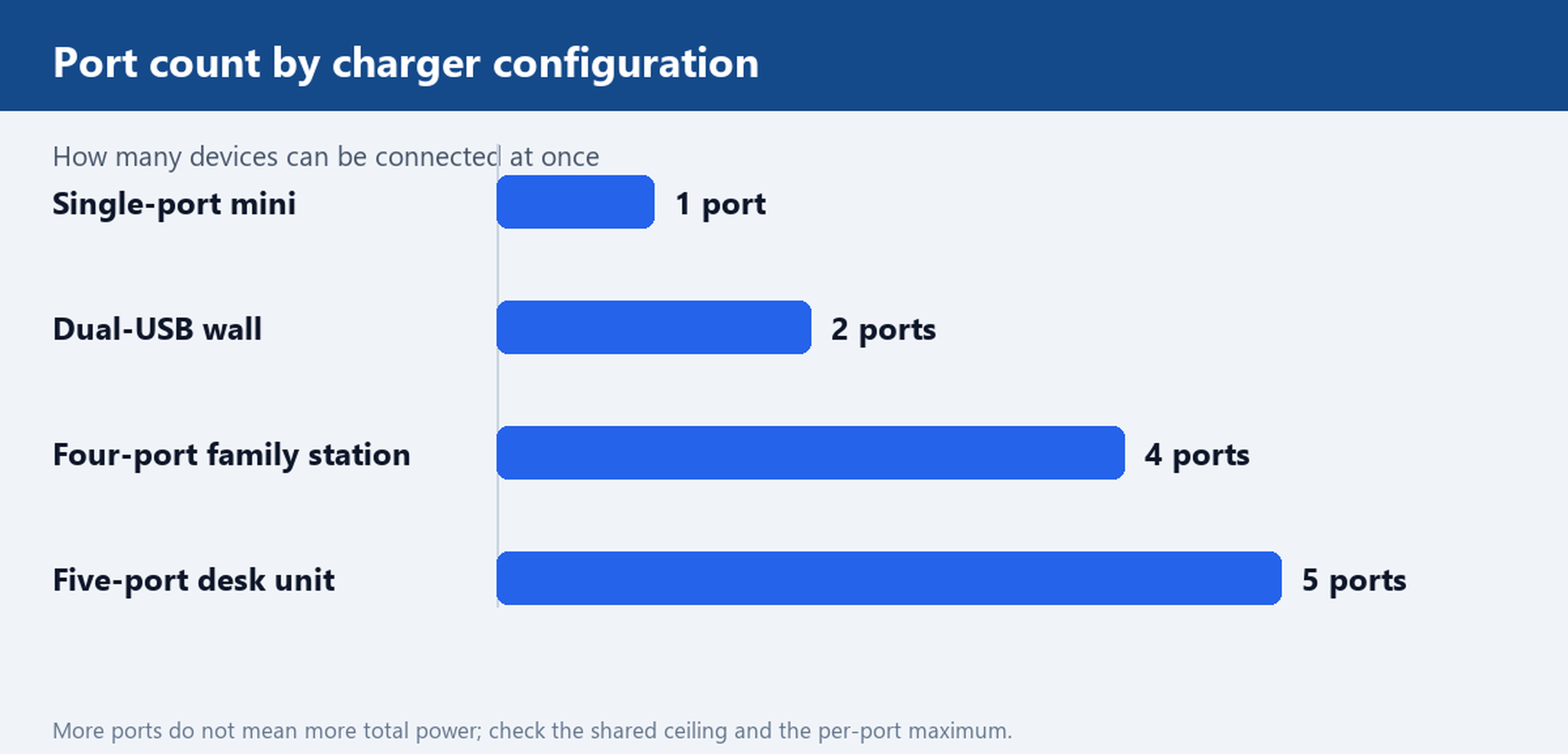
Why Desk Charging Is a Port-Count Decision, Not a Wattage Race
Start with the number of things that will be plugged in at the same time. A shared desk typically holds a laptop, a phone, a tablet and a pair of wireless headphones, while a guest room may only ever need one bedside point. A usb charger for office projects is therefore specified by occupied ports first and peak wattage second. Two chargers with the same printed total can behave differently at a full desk: one keeps a measured budget across every port, while another assumes that only one or two devices will draw hard at any moment. Before you compare totals, list the devices per desk and mark which of them need a higher-voltage input and which simply take 5 V. That list tells you whether five modest ports serve the room better than two strong ones. It also tells you how many wall sockets you need behind the furniture, which is often the real constraint in an older office fit-out. A unit with more ports reduces the number of adapters and extension strips on the desk, but only if the shared budget is stated honestly. The chargers and accessories range is the starting point for that comparison, since it groups wall units separately from power banks.
Five Ports at 50 W Total vs Four Ports Sharing 3.1 A
Two common configurations show the difference clearly. A five-port 50 W desk unit states a total power budget of 50 W across five outputs, which averages 10 W per port when all five are in use. A four-port family station states 3.1 A shared across four USB-A outputs; at 5 V that is a 15.5 W ceiling for the whole box, or roughly 3.9 W per port if all four are occupied. Both numbers are totals, not per-port guarantees, and neither tells you how the box splits current when a tablet and three phones are connected together. The 50 W unit has headroom for one higher-power device alongside light loads; the 3.1 A station is sized for four phones charging slowly overnight, not for four fast-charge sessions at once. Ask the supplier for the per-port maximum and the total ceiling in the same sentence, then check both against the device list you made. The four-port 3.1 A family charging station is the clearest example of the shared-current class, and it belongs on desks where nobody is in a hurry. 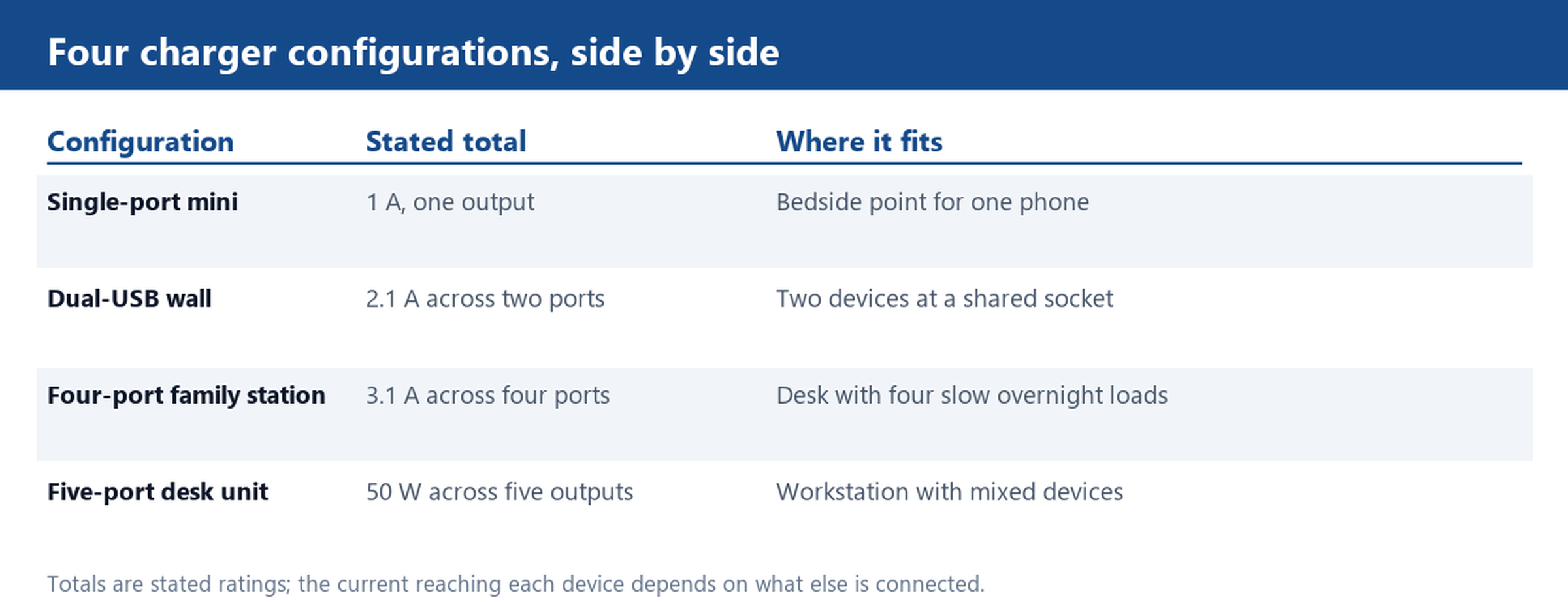
8 A Across Five Ports: What Each Device Actually Gets
An eight-amp rating is an aggregate ceiling, not a per-port promise. Spread across five ports, 8 A works out to an average of 1.6 A per port, before you account for conversion losses and the way the controller assigns current. In practice one port may deliver far more while the others settle at a trickle, which is fine for a desk with one phone and four low-power accessories and poor for a row of five identical phones all expected to be ready at the same time. The failure mode is quiet: every device shows a charging icon, so nobody complains, yet the phones are still near empty at the end of a shift. To specify this class properly, ask for the maximum current of a single port with the other four loaded, and ask whether that figure was measured on a sample or on a production lot. A five-port 8 A travel unit often ships with EU, US and UK plug options on the same body, so confirm which plug standard is in the carton you are quoted. Current sharing cannot be fixed by a longer cable or a different wall socket; it is decided inside the charger, and it has to be agreed before the order is placed.
One Plug Standard or Three: Travel Units for Mixed Regions
Plug standard is the other half of an office or hotel order. For a fixed desk in one country, a single molded plug is simpler and cheaper to stock. For a property that hosts visitors from several regions, or a distributor that sells across borders, a travel unit with interchangeable EU, US and UK plugs avoids a three-SKU inventory. Check the input range as well: AC 100-240 V is the stated input on this class of wall charger, which is what makes one electronics platform usable in several markets. The dual USB travel charger is a compact example for two devices in a guest room, while a wireless charging station suits a shared table where people set a phone down rather than plug it in. Do not treat the plug as a cosmetic choice. The plug determines which socket the unit fits, which test report an installer will ask for, and which spare parts you need when the room is refitted. Write the plug standard into the purchase order next to the port count, so the quotation and the carton agree.
Provisioning by Room Count: Sampling, Certificates and Lead Time
Provisioning starts with a count, not a catalog. Multiply desks by the number of occupied ports you listed earlier, add a small allowance for a spare at each bank, and then decide how many of those points need the 50 W desk unit versus the 3.1 A shared station. For a hotel, count bedside points per room and decide whether a single-port 1 A charger is enough for that location. Ask the factory for a sample set that covers every plug variant you plan to order, and confirm the sample window in writing before you promise a fit-out date. The same documents should state CE, RoHS and FCC status once, with the report traceable to the exact model; a certificate for a similar shell does not cover a different output circuit. Check delivery information for the shipping assumptions, and use the contact page to send the configuration list. Send the number of desks or rooms and the plug standard you ship to and we will quote a mixed sample set.