

A winter jump starter fails in a way that is easy to predict and hard to explain to a customer: it works perfectly in the shop in October and refuses to crank an engine in January. The pack itself has not degraded. What changed is the temperature, and a lithium-polymer cell that is happy to deliver 300 A at room temperature will deliver substantially less when the whole vehicle is sitting at minus twenty. The numbers that decide whether a winter pack is honest are therefore not only the 11,400 mAh capacity, but the 300 A start rating, the 600 A peak burst and the temperature at which those two figures were measured. This guide turns those figures into a purchase order a buyer can defend when the first cold snap produces complaints.
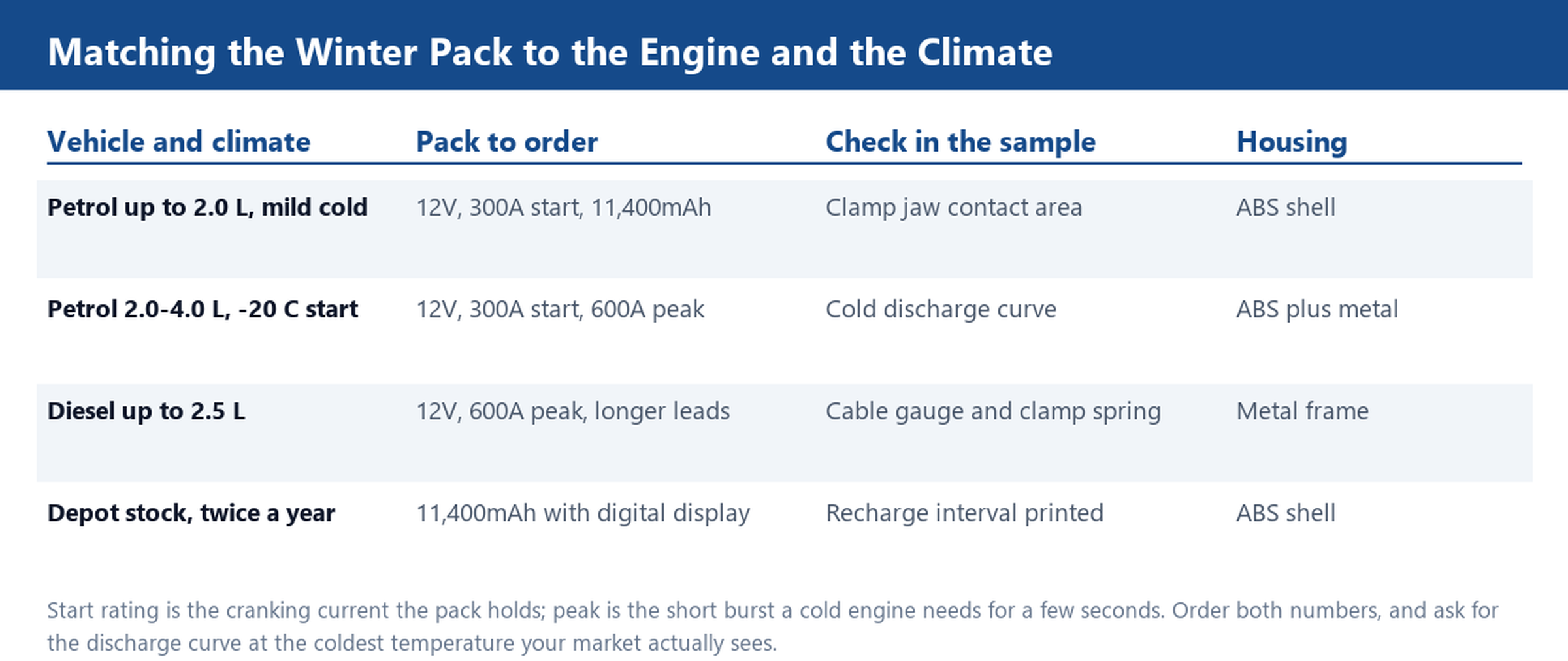
What Cold Does to a Li-Polymer Pack and Why Low-Temperature Cells Matter
Cold raises the internal resistance of every lithium cell, and internal resistance is what stands between the stored charge and the current a starter motor wants. At normal temperatures the voltage sags only a little under a 300 A load; at low temperature the same load pulls the terminal voltage down far enough that the vehicle control unit decides the battery is too weak to crank. The stored energy has not disappeared, but a meaningful part of it is no longer available at the current the application needs, which is why a pack that starts a car in autumn can fail in a cold snap without any component being faulty.
That is the reason a cold-climate programme should be built around cells specified for low-temperature discharge rather than around a bigger capacity number. Two packs with the same 11,400 mAh label can behave very differently at minus twenty, because the label describes energy at a nominal temperature and says nothing about the impedance curve. The document to ask for is the discharge curve at the coldest temperature the market actually sees, plotted at the cranking current, and the question to ask is whether the pack holds its start rating at that temperature or only at 25 C.
For the buyer there is a second, more practical consequence. A cold pack has to be kept somewhere it does not soak at the ambient temperature overnight, which is why the storage case and the cable length matter as much as the cell. A pack that lives in a warm cab and reaches the dead car on a one metre lead is in a different thermal state from the same pack left in the boot for a week.
300A Start and 600A Peak: Matching the Pack to Engine Size
The two current figures describe two different events. The start rating is the current the pack can hold while the starter turns the engine over for several seconds, and it is the number that decides whether the engine catches. The peak rating is the short burst a cold engine demands in the first fraction of a second, when the oil is thick and the compression is highest. A pack with a 300 A start and a 600 A peak covers the ordinary case: a petrol engine up to roughly two litres cranks comfortably, and petrol engines up to about four litres usually start on the peak burst.
Diesel changes the arithmetic. Higher compression means a higher cranking current for longer, so a 2.5 litre diesel at low temperature belongs with a pack that can hold 600 A as a peak and still deliver a start rating well above the petrol equivalent. The mistake buyers make is ordering one SKU for a mixed fleet and assuming the largest engine will be fine because the capacity looks generous. Capacity measured in milliamp hours is a poor guide here: it describes how long the pack can supply a modest load, not how hard it can push for three seconds.
Clamp quality decides whether the rating can be delivered at all. A pack rated at 300 A through thin cable and a small jaw will not pass 300 A to the battery post, because the resistance sits in the connection rather than the cell. Ask for the cable gauge and the jaw contact area with the sample, and check the spring force by hand: a clamp that needs two hands to open is a clamp that will hold under load. Our heavy-duty unit CPB496 pairs the higher current rating with a metal-reinforced housing for exactly this reason, while the compact CPB247 with its built-in torch covers the smaller petrol case.
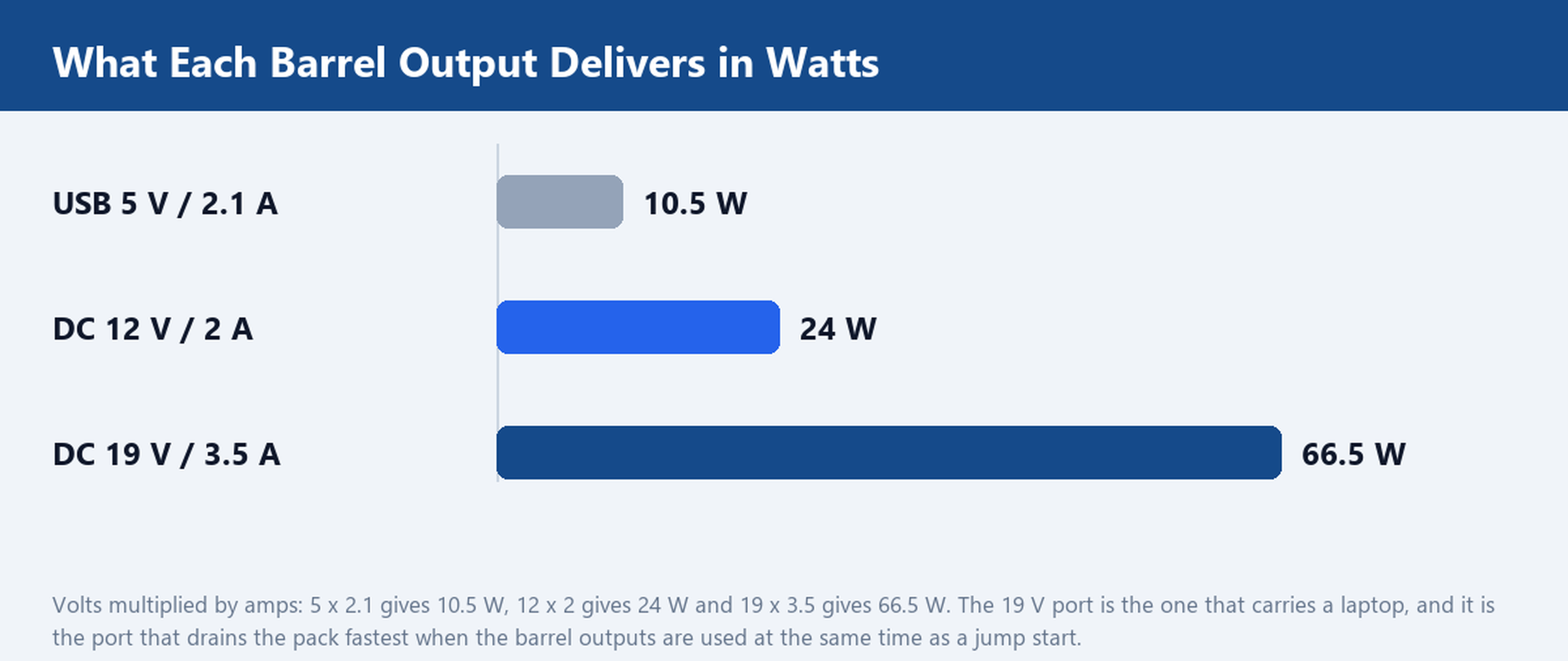
The Rest of the Barrel: 5V/2.1A USB, 12V/2A and 19V/3.5A Outputs
A jump starter spends most of its life as a power bank, and the output set decides how useful those months are. The USB port at 5 V and 2.1 A gives 10.5 W, which is a phone charge at a normal rate and a tablet charge at a slow one. The 12 V barrel at 2 A gives 24 W, enough for a tyre inflator, a dash camera or a 12 V spotlight. The 19 V barrel at 3.5 A gives 66.5 W, which is a laptop class output and the one that makes the unit worth carrying on a service call.
Those wattages are the arithmetic of volts times amps, and they are also a warning about how the pack gets drained. A 19 V laptop pull at 66.5 W empties a pack far faster than a phone at 10.5 W, and using the barrel outputs at the same time as a jump start divides the available current between two very different loads. If the unit is sold into field service, the honest specification states which outputs can be used together and which are exclusive, because the customer will otherwise find out at the roadside.
The connector kit is part of the output specification, not an accessory afterthought. A 19 V output without the right barrel tips for the laptops in the market is a 66.5 W port nobody can use, and the tips are what get lost first. Order the kit contents per market, label each tip on the bag, and include a short cable for the 12 V output so a tyre inflator does not hang from the pack by its own plug. Digital display versions such as CPB493 earn their extra cost here, because a percentage readout tells the user whether the pack can still take a laptop load before the attempt rather than after it.
Storage Between Winters: Recharge Interval and Self-Discharge
A winter pack is used twice a year and stored the rest of the time, which is the hardest duty cycle a lithium pack can have. Self-discharge continues while the unit sits in a boot, and a pack left at a low state of charge for months loses capacity permanently. The maintenance rule to print on the label is simple: recharge every three months, to a mid state of charge rather than full, and do it on a calendar reminder rather than when the driver remembers.
Shipping state of charge follows the same logic and is where a returned unit usually originates. A pack shipped at full charge ages faster during a long sea transit, and one shipped empty arrives dead and gets reviewed as a faulty product. Agree the shipping state of charge with the factory in writing, and add a battery contact insulator so the unit cannot self-discharge through a sleeping circuit in the carton.
Storage temperature is the third variable and the one buyers cannot control. A glovebox in summer and a garage in winter are both outside the comfortable window for a lithium cell, so the manual should say plainly where the pack should live between uses. This is also the argument for a hard case: a pack that lives in a case survives the boot, and a pack that lives loose beside a jack and a wheel brace does not.
Ordering for a Cold-Climate Market: Housing, Clamps and Paperwork
The housing decision is a climate decision. An ABS shell is adequate for a pack that lives in a cab and is used in mild cold, and it keeps the unit light. A housing with a metal frame or metal reinforcement is the right choice for a pack that stays in the vehicle, because the case has to survive the same temperatures as the cell and the impact of a boot full of tools. Colour matters more than usual: a black housing that sits in a windscreen will be the hottest object in the car in summer and the coldest in winter, and a lighter moulding reduces both extremes.
Paperwork carries the credibility of the product in this category. The pack needs the shipping documents for lithium cells, which means UN38.3 test summary and the transport paperwork that goes with it, plus the market access marking your channel requires, such as CE and RoHS for Europe. None of that is a marketing claim; it is the file the importer will be asked for at the port, and it is why the factory has to be chosen on documentation as well as on price.
Finally, write the winter specification into the order as numbers rather than adjectives: 12 V nominal, 300 A start, 600 A peak, 11,400 mAh, the outputs listed above, the coldest test temperature, and the recharge interval printed on the housing. Two packs that match those figures are comparable, and a pack that cannot quote them is being sold on capacity alone. The car jump starter power bank range covers the housing and clamp combinations described here, the field-service versions sit with the outdoor power banks, and the barrel leads and tips are listed under chargers and accessories.
Tell us the engine sizes your market serves and the lowest temperature you expect, and we will send an 11,400 mAh sample with its discharge data for a cold-start test.