

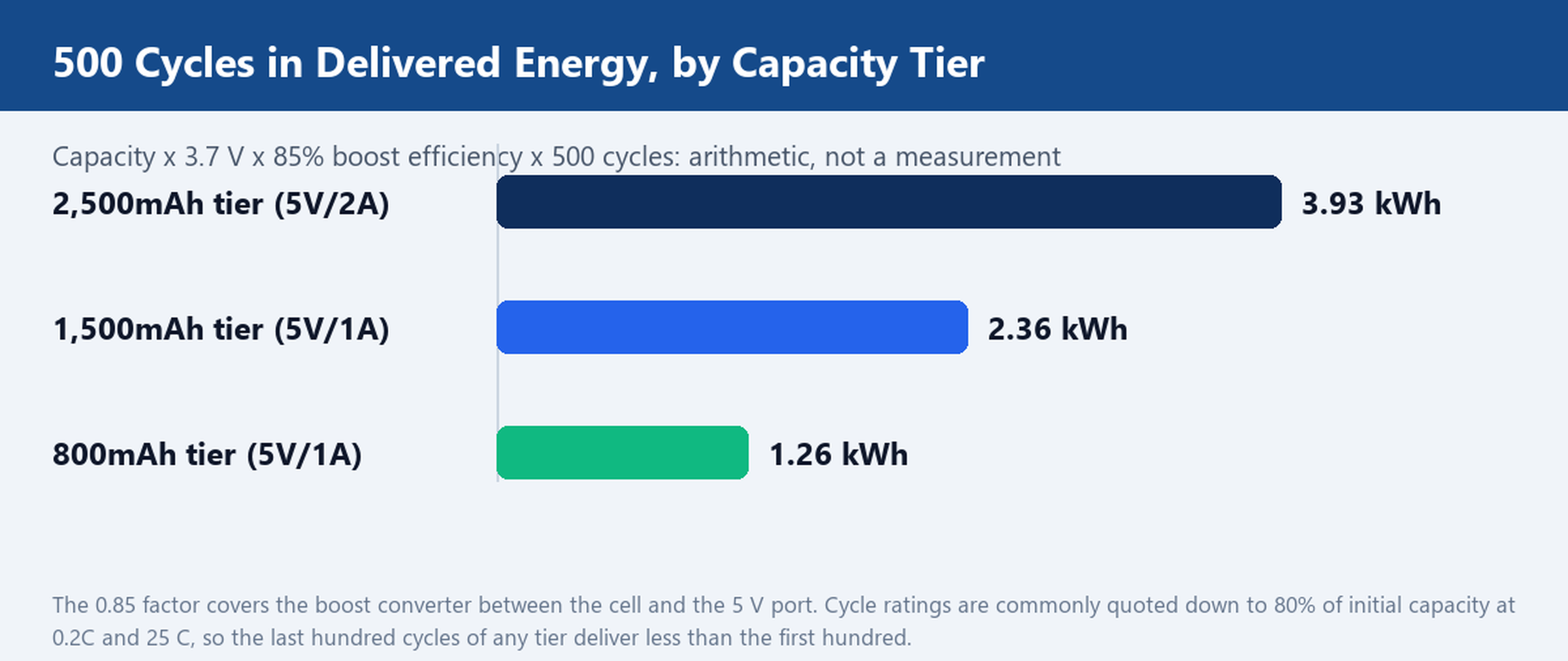
A 500-cycle rating on a mini power bank is a budget, not a countdown clock. It means 500 full-capacity equivalents of charge can leave the cell before capacity reaches the 80% line that most suppliers treat as end of life. What that budget is worth depends on the capacity tier you stock and on three habits that spend it faster than daily use does. Read the number as energy delivered rather than as days of service, and the same rating stretches from 1.26 kWh at 800mAh to 3.93 kWh at 2,500mAh.
What counts as one cycle on a Grade-A Li-polymer cell
One cycle is not one plug-in. It is a cumulative 100% of capacity taken out and put back. Five top-ups of 20% each add up to one cycle. A keyring pack that hands a phone 15% on the walk to a meeting, twice a week, is spending a fraction of a cycle each time — cheap in cycles, and expensive only if the habit ends in a pack left flat for a month.
Cycle ratings are normally measured at 0.2C discharge and 25 C ambient, with end of life set at 80% of initial capacity. Those three conditions belong on the datasheet beside the number, because a 500 printed without them can mean 500 cycles at a heavier discharge rate in a warm room, which is a different product. The 500+ figure on our 2,500mAh pocket-clip model is quoted for Grade-A Li-polymer under those conditions. The same 500 printed on a salvaged cell describes a cell that was already cycled inside a laptop pack before it reached the shell.
The 80% end point is the part buyers miss. The pack does not stop at cycle 500; it keeps working with about a fifth of its range gone, and the fade steepens after that. A buyer planning a two-year retail life for a promotional pack is working inside the budget. A buyer treating 500 as a warranty term is not.
800, 1,500 and 2,500mAh: how capacity sets top-ups per cycle
Convert capacity to energy before comparing tiers: milliamp-hours multiplied by nominal cell voltage. A 2,500mAh Li-polymer cell holds about 9.25Wh, a 1,500mAh cell holds 5.55Wh, and an 800mAh cell holds 2.96Wh. The boost converter between cell and 5V port returns roughly 85% of that, which leaves 7.9Wh, 4.7Wh and 2.5Wh usable at the port.
Against a phone that needs about 15Wh for a full charge — a 4,000mAh cell at 3.85V — one full discharge of the bank covers roughly half a charge at 2,500mAh, a third at 1,500mAh and a sixth at 800mAh. Multiply by 500 cycles and the tiers separate the way the first figure shows. This is why mini power bank lifespan is better argued as top-ups per session than as a promise about time: the number that decides a repeat order is how far one top-up goes, and the cycle budget only decides how many of those sessions the pack survives.
The practical consequence for a range: an 800mAh keyring unit and a 2,500mAh clip unit are not the same product at different prices. The first is a seatbelt, the second is a daily carry. Stocking both is sensible. Describing them with one lifespan line is what turns the second into a return.
5V/1A on the keyring model against 5V/2A on the 2,500mAh shell
Output current sets the time the buyer spends waiting, and waiting time is a lifespan variable because of what happens during it. At 5V/1A the port delivers 5W, so a 15Wh phone charge takes about three hours if the phone accepts the full 5W throughout. At 5V/2A it delivers 10W and the same charge takes about an hour and a half. Taper at the top of the phone charge adds 20 to 30 minutes to both.
The keyring format in our USB-stick emergency model is rated 5V/1A in and out, with 800mAh, 1,500mAh and 2,500mAh tiers available on request. At 1A input an 800mAh cell refills in about an hour including taper, short enough that the pack rarely sits plugged in. A 2,500mAh pack on a 1A input needs closer to three hours, long enough that most owners leave it on the charger overnight — and a cell held at full charge in a warm room loses calendar life rather than cycle life. Put the input current on the quotation so the buyer chooses the overnight habit with the number in front of them.
Do not read the 2A port as a larger bank. It is a faster phone charge drawn from a small energy pool: 10W out of 7.9Wh usable is under an hour of full-rate output before the pack is spent.
Charging while discharging, storage heat and the cycles they cost
Pass-through charging — phone on the output while the bank sits on its own charger — runs the boost stage and the charge path at the same time inside a shell the size of a card case. The energy is not lost, it is converted twice, and the waste leaves as heat in the one place the cell cannot shed it. Some boards handle this cleanly and stay lukewarm. Others push the cell above the 25 C that the cycle rating assumes for the whole session, and every hour spent there is paid out of the same budget.
Heat is the cheapest fault to design out and the most expensive one to ignore. A pack left on a car dashboard through a summer afternoon sits far above rated ambient, and the capacity lost that way does not return with a cool evening. Storage at 40 to 60% state of charge costs nothing and sidesteps the two failures that look like cycle wear without being it: a cell held at full charge for months, and a cell drained flat on a shelf until the protection board declines to wake.
Cold is the mirror case. Charging a Li-polymer cell below 0 C plates lithium on the anode instead of intercalating it, and that capacity is gone for good. For a winter market that is a return with nothing to do with the 500 figure, and no cycle count prevents it.
The spec sheet lines that decide a warranty claim upfront
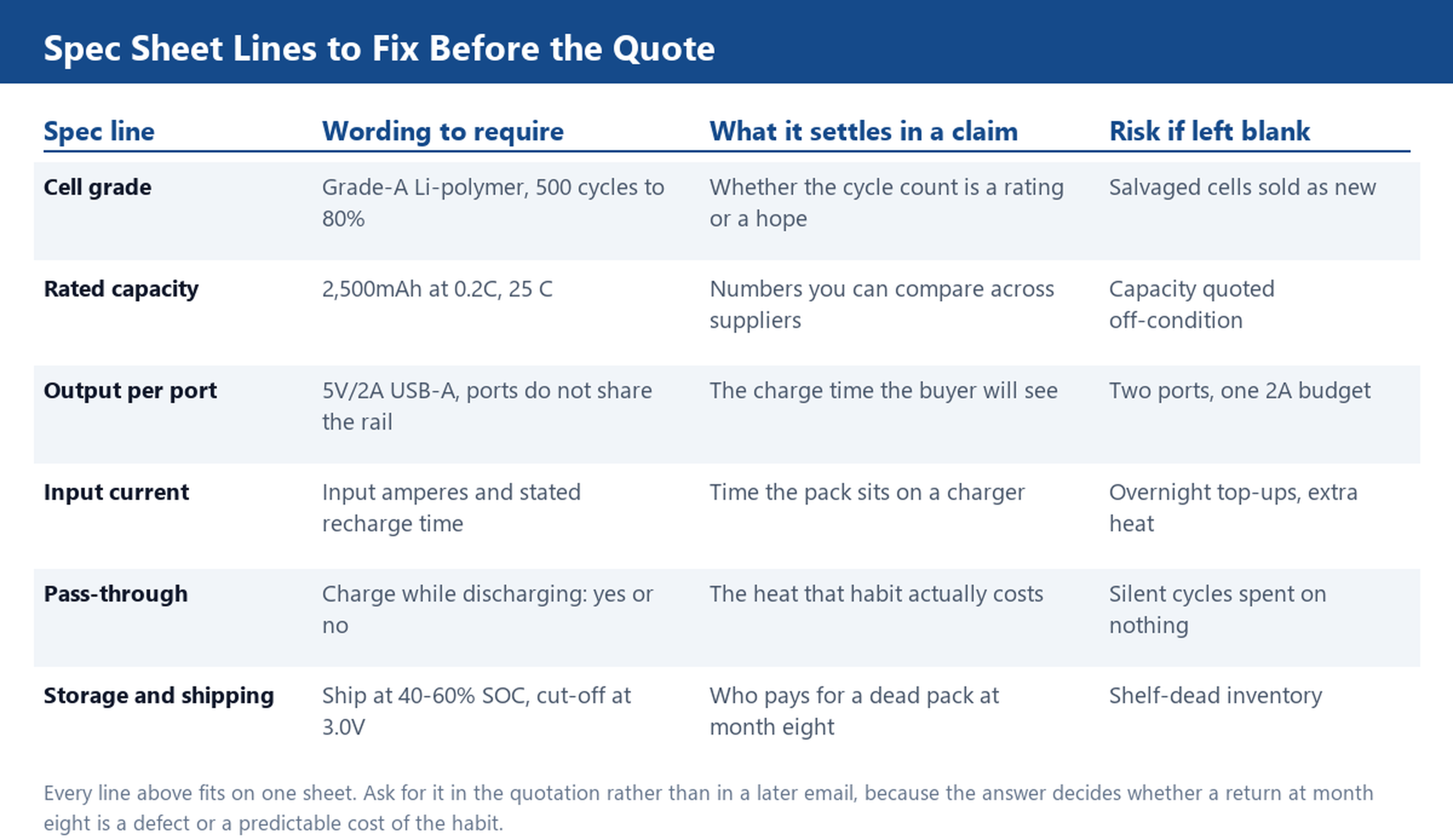
Most returns on small packs are argued rather than measured, because the quotation never fixed the terms. The second figure lists six lines that fit on a single sheet. The two that matter most in practice are cell grade and per-port output: a quote reading 2,500mAh and 2A without naming the cell, or without saying whether the ports share one rail, leaves the buyer no ground when the pack is flat at month eight.
Two further lines look like factory detail and are not. Pass-through support, stated yes or no, decides whether that habit costs heat or nothing. Storage and shipping state of charge decides whether stock that spends a season in a warehouse arrives alive. Our under-1,000mAh tier and the 1,000-5,000mAh tier are quoted with those lines filled in rather than left to the sample stage, because a specification settled after tooling is a specification settled by whoever is least willing to walk away.
Before you pick a tier
Work backwards from the session, not from the cycle number. Decide how much of a phone charge one top-up has to deliver, convert that to watt-hours, and choose the smallest tier that clears it at 85% boost efficiency. Then check that the cycle budget covers the retail life you plan, with the 80% end point counted as the end rather than a rounding error. A 2,500mAh pack giving half a charge is a daily-carry product. An 800mAh keyring pack giving a sixth is an emergency item. Neither should be sold as the other, and the mini power bank range carries both for exactly that reason.
Once the tier is fixed, settle the sheet: cell grade, rated capacity with its test conditions, per-port output, input current, pass-through support, storage state of charge. Those six lines are what a return argument is actually made of, and they cost nothing to write down before the order instead of after it.
Send us the capacity tier and output current you plan to stock, and we will quote a 2,500mAh sample with the cell grade and cycle count written on the spec sheet. The customisation page covers the logo and packaging options that ship with it.