

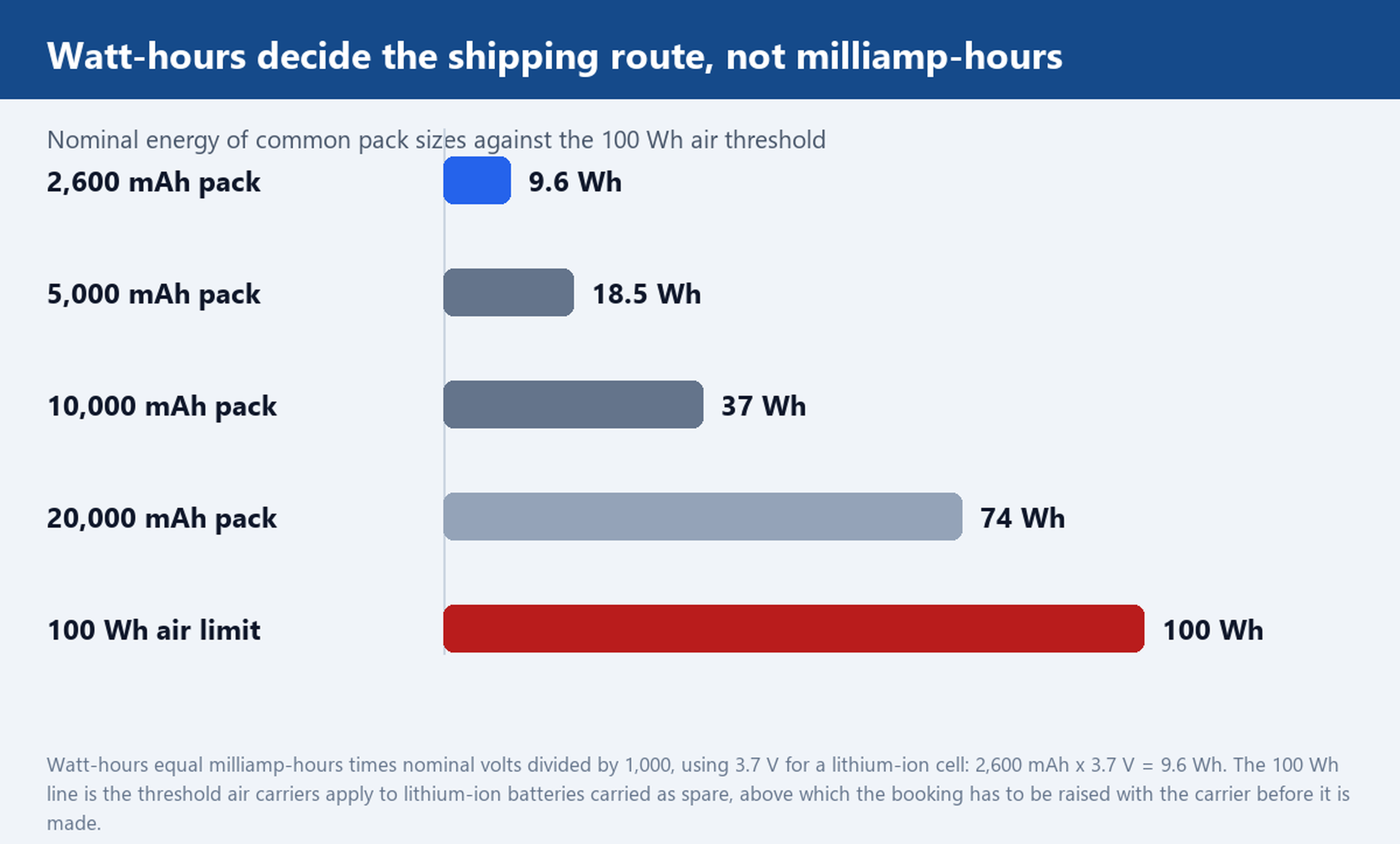
A 2,600 mAh mini power bank is a 9.6 Wh battery, which puts it far below the 100 Wh line that air carriers apply to spare lithium-ion packs. That does not mean it travels without paperwork. Small units are the ones that move as giveaway stock inside a carton of other goods, and that is exactly where a forwarder stops the shipment and asks for a UN38.3 test summary and an MSDS that match the model in the box. What comes back is often a set of reports for a different capacity, a different cell or a different enclosure. Mini power bank certification is therefore a stack of six files answering six different questions, and knowing which question belongs to which file is what keeps a booking from stalling at the counter.
The Documents a Lithium Battery Shipment Cannot Leave Without
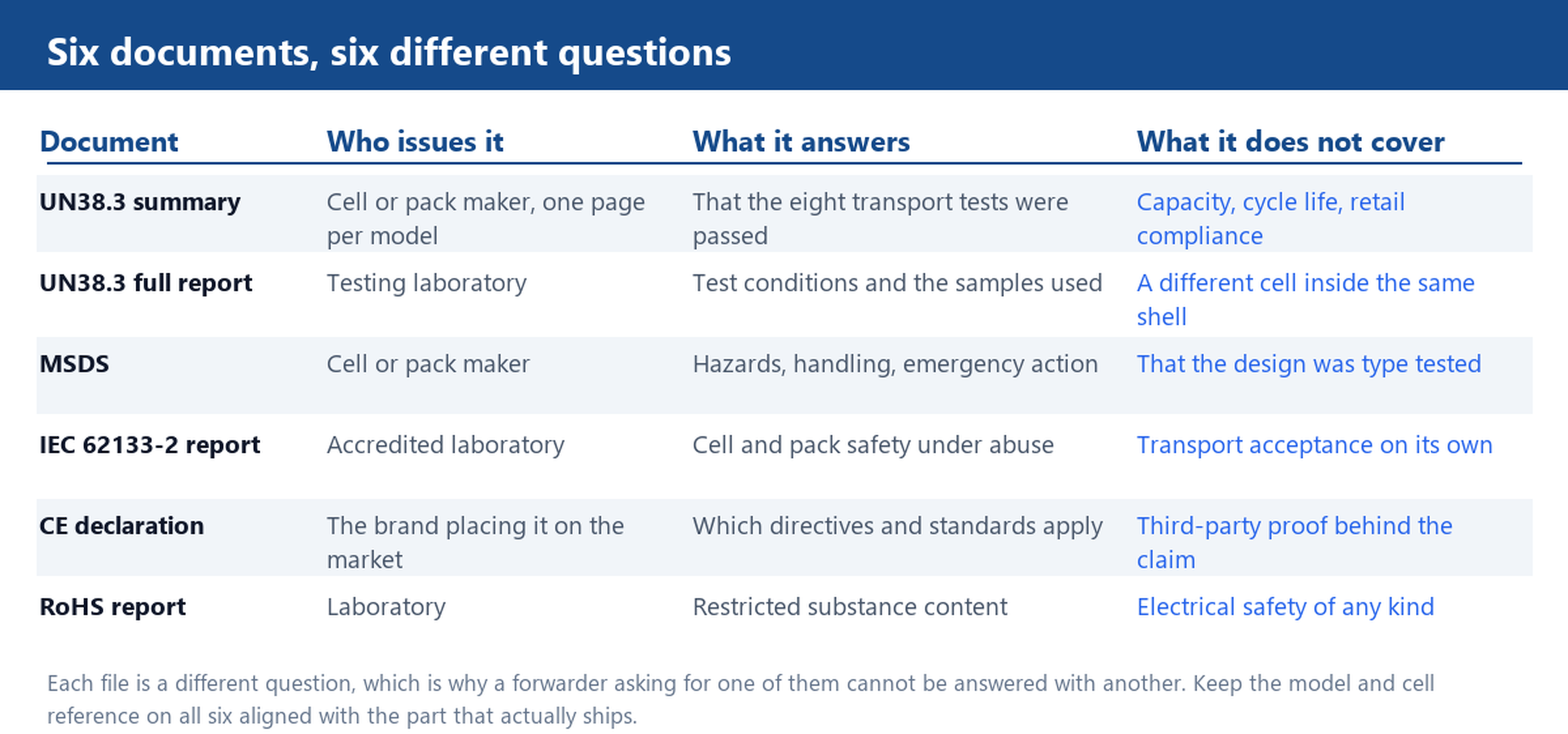
Three files travel with the goods. The UN38.3 test summary is a one-page statement that the model passed the eight tests in the UN Manual of Tests and Criteria: altitude simulation, thermal, vibration, shock, external short circuit, impact and crush, overcharge, and forced discharge. The MSDS, normally written as an SDS with sixteen sections, describes the hazards of the chemistry, how to handle a damaged unit and what to do in a fire. The third is the full test report behind the summary, which a carrier or a broker may ask for when a page of results is not enough.
Two more files belong to the destination market rather than to the aircraft. IEC 62133-2 is the safety standard for lithium-ion cells and packs, and a report against it is what a European retailer or a marketplace compliance team usually requests. The CE declaration and the RoHS test report are separate again: one is the statement that the applicable directives were applied, the other is a laboratory result on restricted substances.
Sorting them this way prevents the most frequent delay. A supplier sends whichever file is at hand, the forwarder reads it, finds a model designation that does not match the carton, and holds the booking. The shipment is not stopped because it is unsafe. It is stopped because it is undocumented, and that takes longer to fix, since the replacement comes from a laboratory rather than from a desk.
UN38.3 Test Summary Against the Full Report: What a Forwarder Accepts
Forwarders accept the summary for routine bookings. It carries the model designation, the cell manufacturer and type, the watt-hour rating and one line per test. What it does not carry is the test conditions, the number of samples, or the state of charge used. Those sit in the full report, which is what gets requested when a shipment is audited, when the battery attracts extra attention, or when the model has been re-tested after a change.
Read the summary for three things before sending it anywhere. The model designation has to match the carton and the invoice exactly, including any suffix for colour or capacity. The cell type has to match what is inside, because a summary naming a 2,000 mAh cell does not cover a unit built around a 2,600 mAh cell even when the shell is identical. The watt-hour figure should agree with the capacity printed on the product: 2,600 mAh at 3.7 V is 9.6 Wh.
A summary that passes those three checks is worth keeping as a PDF with the model name in the filename. The version that arrives as a photograph of a printed page with the model handwritten in is the version that gets questioned at the counter, and rightly so.
MSDS and the 2,600mAh Cell: Which Line Must Match the Real Part
An MSDS describes a chemistry, not a product. That is why the same document can stay on file for years while the product underneath changes. The lines that must match the shipment are the cell chemistry, the nominal voltage, the capacity or watt-hour rating, and the manufacturer name and address on the first page.
Section 3, the composition table, is where a mismatch usually shows up. If the table lists a cell of a different capacity, the document is describing a different battery. Section 9 carries the electrical properties. Section 14 carries the transport information, including the UN number and the packing instruction. A file with the right chemistry and a stale Section 14 is a file that comes back.
There is a limit to what an MSDS can prove. It does not show that the design was type tested, it does not replace a UN38.3 summary, and it does not establish that the product meets a safety standard. Treating it as a general compliance document is the second most frequent reason a shipment stalls.
IEC 62133, CE and RoHS: Different Questions, Different Files
IEC 62133-2 addresses what happens to a cell or pack under abuse: overcharge, forced discharge, external short, crush, impact and thermal abuse, plus the behaviour of the protection circuit in the pack case. A report against it is evidence about design safety. It is not a transport document, so a pack with a current IEC report still needs UN38.3 before it boards an aircraft.
The CE declaration is a statement by the party placing the product on the European market, naming the directives and standards that were applied. Two practical points follow. The declaration has to name the model that ships, and the party signing it has to be the one carrying the obligation, which for an own-brand order is the buyer rather than the factory. RoHS is narrower again: ten restricted substances tested on homogeneous materials, with a report that says nothing about whether the product is electrically safe.
For a battery product sold into Europe, the EU Batteries Regulation adds obligations on labelling, documentation and, over time, carbon footprint and recycled content. Those duties attach to the producer, which is why the entity named as producer should be settled before artwork is finalised rather than after the first shipment is refused.
Why a Re-Celled or Re-Housed Version Retires the Old Paperwork
A test report is tied to the samples that were tested. Change the cell and the sample is no longer the one in the report, whatever the outside looks like. Change the protection circuit, the cell arrangement, or the enclosure in a way that alters thermal behaviour, and the same applies. The summary that was valid for the earlier build then describes a product that is not being shipped.
This matters most for mini units, because the tempting change is exactly the one that invalidates the file. A customer asks for a slightly larger cell to reach a rounder capacity figure, the factory swaps it without re-testing, the number on the label goes up and the paperwork stays the same. The mismatch surfaces at the airport or in a retailer audit, long after the tooling was paid for.
The fix is procedural rather than technical. Put the cell reference into the purchase order, require written notice before any substitution, and ask for the summary and the MSDS again whenever that reference changes. One page of paperwork control costs less than a re-test, and far less than a container sitting on a tarmac.
Our mini power bank range is where the 2,600 mAh class sits, and the 1,000 to 5,000 mAh section covers the neighbouring capacities that share the same cell family. Card-format units are collected under card power banks. For a private-label programme, the customisation page lists what can change without a new tool, and the factory tour shows where incoming cells are checked against the reference on the order.
Send us the destination country and the shipping mode, and we will list which reports the 2,600 mAh mini unit ships with and forward a sample dossier for your forwarder to check before you book.