

Working out how to choose card power bank for a giveaway programme or a retail shelf comes down to one question asked in the right order: how many recharges does the recipient need, and what does that cost in thickness. The card format is a footprint decision, not a capacity decision. Once the footprint is fixed at wallet or badge-holder size, the capacity tiers inside it are a trade between cell volume and shell material, and the difference between 2,500mAh and 10,000mAh is roughly the difference between topping a phone up once and carrying a weekend of power.
What Card Format Costs You in Millimetres and Grams
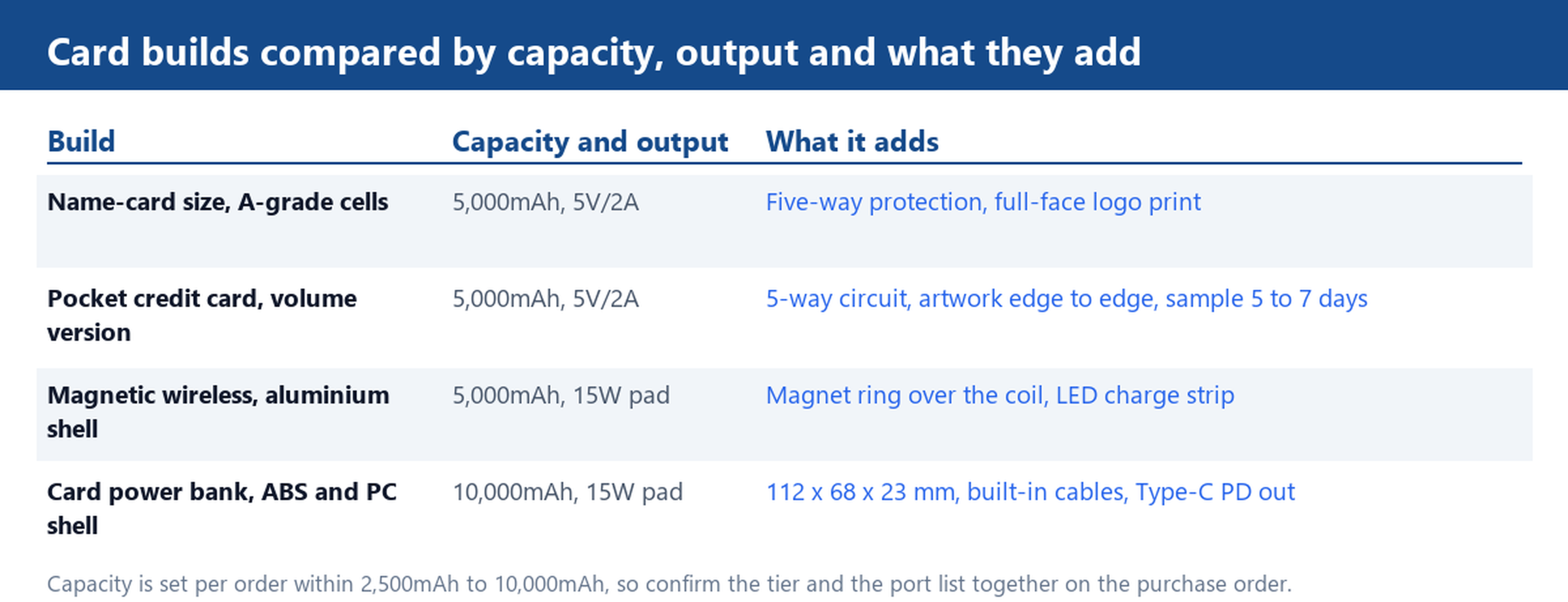
The category name describes a footprint, not a thickness. A card bank is built to sit beside a credit card in a wallet or inside a badge holder, so the face dimensions are locked to that envelope and the depth is the one variable a buyer is really negotiating. The volume version of the credit card build uses the wallet-thin profile with a 5,000mAh cell; the card power bank with an ABS and PC shell stacks a 10,000mAh Li-Po cell into a 112 x 68 x 23 mm body, which is a card footprint with a much deeper body and a 15W wireless pad on one face.
Two mechanical details decide whether the format works in the hand. The first is the seam: a shell that closes around the cell with no open face reads as one solid object rather than two halves clipped together, and it stops the pocket lint that collects in a groove. The second is the base edge. A wide, flat bottom edge lets the unit stand on a desk without tipping forward when a phone is laid on the wireless pad, which is the failure people notice first in a demo.
Capacity Tiers in One Footprint: 2,500mAh, 5,000mAh and 10,000mAh
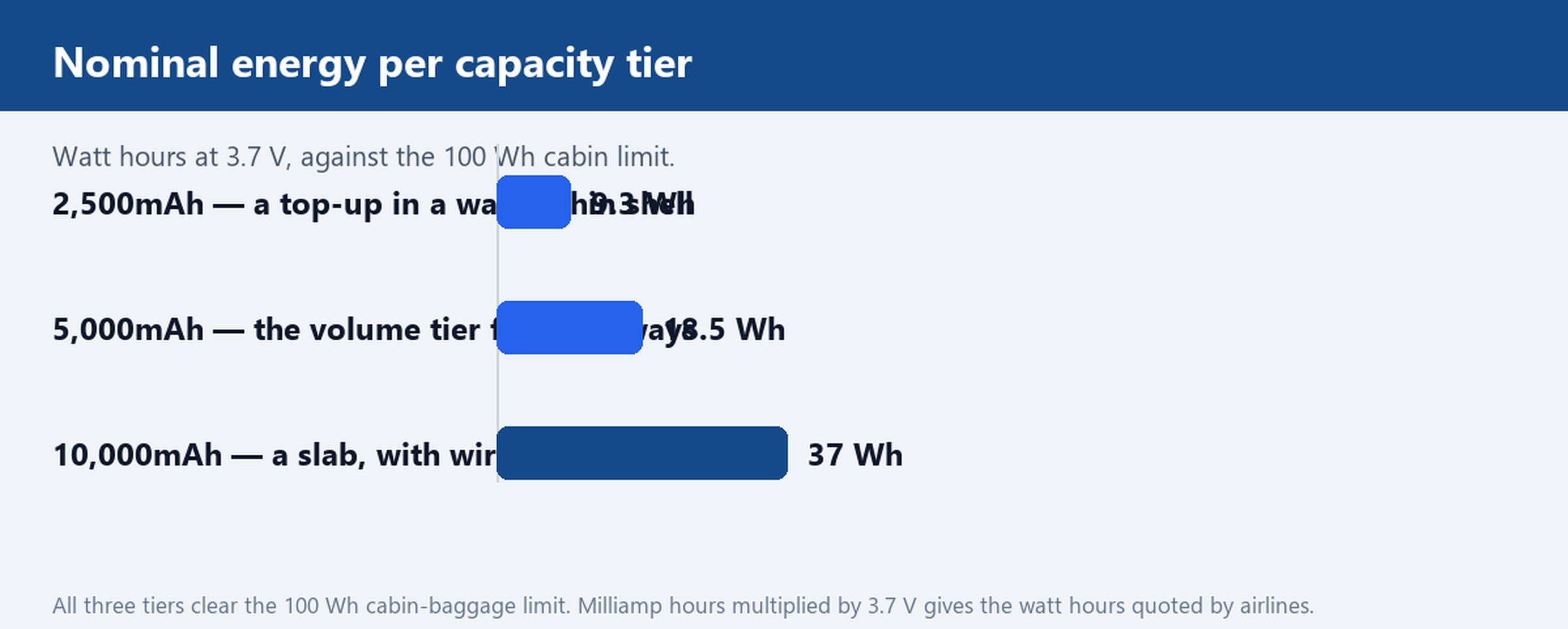
The card range is normally quoted at 5,000mAh, with 2,500mAh and 10,000mAh available on request at order confirmation. Those three tiers are the whole decision, and the arithmetic that makes them comparable is nominal energy: milliamp hours multiplied by the 3.7 V nominal cell voltage. That gives roughly 9.3Wh at 2,500mAh, 18.5Wh at 5,000mAh and 37Wh at 10,000mAh. The number worth remembering is 100Wh, the common cabin-baggage limit for lithium cells, which every tier in this range clears with room to spare.
In practice, 2,500mAh is a top-up: enough to take a phone from a low battery to the end of an evening, and the tier that keeps the unit genuinely wallet-thin. 5,000mAh is the volume tier and the one to quote for a giveaway, because it covers a full recharge plus a partial second one. 10,000mAh is the tier that stops being a card in the pocket sense and becomes a small slab, which is why it pairs with the wireless pad and the built-in cables rather than with a wallet.
5V/2A Output and Where It Stops
The standard configuration across the card builds is 5V/2A output and 5V/2A input, and that rating sets a clear boundary. A phone that draws 10W charges at a normal rate; earbuds, a watch and a small camera battery charge fine; a tablet charges slowly and a laptop does not charge at all, because a laptop wants 20V negotiation over USB-C PD and a 5V/2A port cannot offer it. Buying a card bank for a laptop is the most common mismatch in this category, and no amount of capacity fixes it.
The deeper build in the range shows what the next step up looks like: Type-C output at 5V/3A, 9V/2.2A and 12V/1.6A, Type-C input at 5V/3A and 9V/2A, Micro input at 5V/2A, and a 15W wireless output. That is a fast-charge tier rather than a 5V tier, and it belongs in a different price band. Decide which one the programme needs before comparing quotes, because a 5V/2A unit priced against a PD unit is not a like-for-like comparison.
Cells and Protection: A-Grade Polymer and the Five-Way Circuit
Cells are where the category has a reputation problem, and the specification language that matters is short: A-grade Li-polymer, capacity tier confirmed at order. A-grade means the cell meets its marked capacity when tested, rather than being a lower bin sold with a printed number that the cell cannot deliver. The name-card size build and the volume version both quote A-grade cells and both state the tier is set per order, which is the sentence to get in writing.
The protection circuit is quoted as five-way: short-circuit, over-charge, over-current, discharge and explosion guarded. Read that list as the minimum rather than a feature, then ask which parts of it are a discrete IC and which are handled inside a protection board, because a discrete IC is what a safety test will look for. Certification on these builds is CE, RoHS and FCC, and the universal 5V output is described on the page as covering 98 percent of the devices the audience carries, which is the claim to test against your own device mix rather than accept as a number.
Ports, Print and the Order Details to Fix Before the Bulk Run
Ports are the part of the specification that changes without changing the model name, so confirm them line by line: Micro input, Type-C input, Type-C output, a USB-A output, built-in cables, or a flat wireless pad on the face. The magnetic wireless build is the clearest example of how far the configurations diverge inside one footprint: a brushed aluminium-alloy shell, a ring of neodymium magnets over the coil, an LED strip for charge level, and a bottom-edge inlet that routes the cable along the phone rather than sideways.
Print area follows the same logic. A full-face print with artwork edge to edge is the reason the card format sells as a giveaway at all, and it needs to be agreed alongside the shell finish, because black and white matte finishes take artwork differently and a coloured shell changes the ink layering. Sampling on these builds is quoted at 5 to 7 days.
For the category view, the right starting points are the 1,000-5,000mAh range for the thin tiers and mini power banks for the sub-card formats, with the broader power banks by type index for everything outside this shape. Tell us the capacity tier and shell finish you need for a free sample and a quote.