

A keychain power bank is not a tiny version of a 20,000mAh travel brick. It is a deliberate trade: you accept a limited number of top-up watt-hours in exchange for something that disappears onto a keyring. If you are working out how to choose keychain power bank units for retail, a promotion or an OEM program, the decision rests on four checks that matter far more than a peak output number on a box. This guide walks through the capacity tiers, the cell format, the realistic power ceiling, the grams on your keys and the paperwork that gets a lithium battery onto a plane. 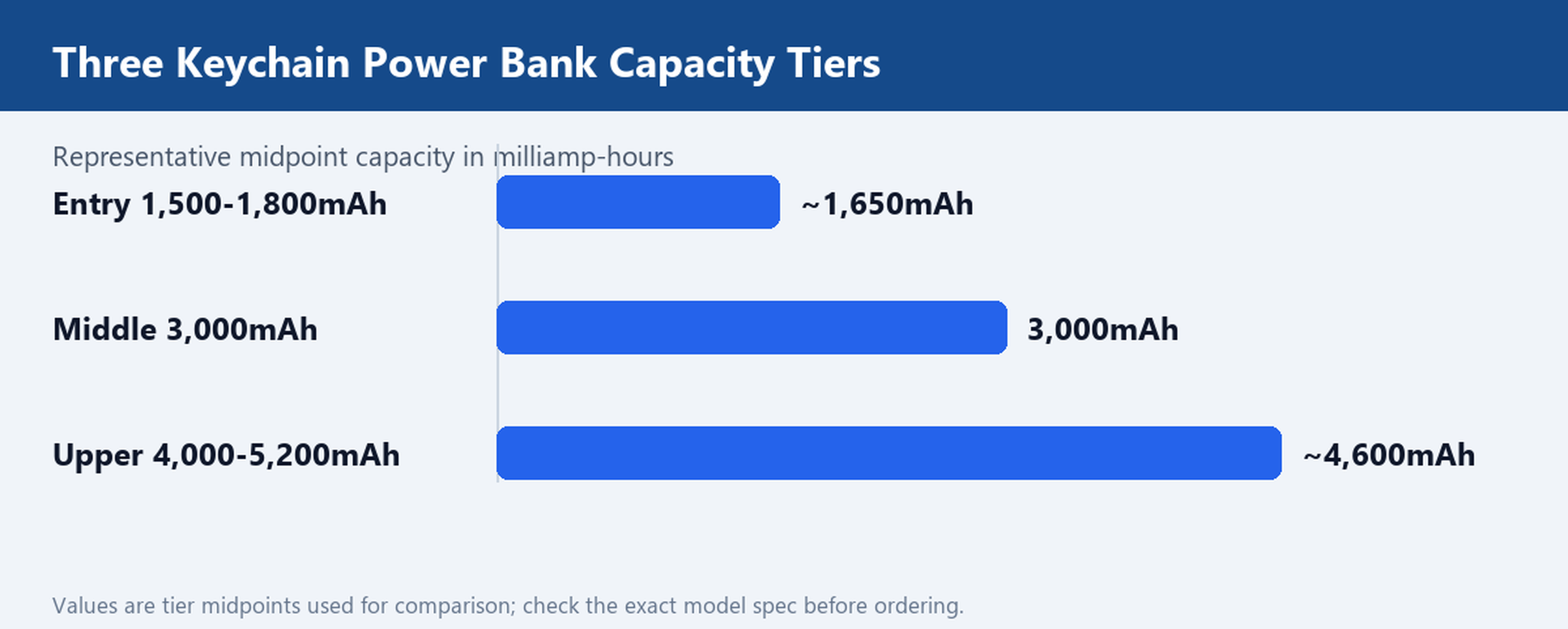
Three capacity tiers, and what each one actually buys
Keyring units cluster into three bands, and the band you pick decides the use case before any other specification does. The entry band runs from 1,500 to 1,800mAh. At 3.7V nominal, 1,800mAh holds roughly 6.7Wh; after a boost converter and cable losses, that is enough to add a partial charge to a phone, not to fill one from empty. Buyers choose this band when the promise is emergency top-up, not daily charging, and when the unit should weigh almost nothing in a pocket. Our USB-stick size keyring model sits at the bottom of this range and is the shape most often requested for giveaways.
The middle band centers on 3,000mAh, around 11Wh. This is the point where a keyring unit can realistically take a phone from a low battery to a usable level once, and where the body has to grow a few millimetres to hold the extra cell area. It is a common compromise for staff gifts and retail impulse buys. The upper band, 4,000 to 5,200mAh, is where a keychain power bank starts to behave like a real backup battery; a 5,200mAh leather-effect shell is about as far as the form factor comfortably goes before it stops feeling like a keyring and starts feeling like a purse item. Browse the 1,000-5,000mAh category to see how the tiers are stocked in practice.
Flat Li-polymer or an 18650 cylinder: thickness, weight and cycle life
The cell format underneath the shell drives three things a buyer feels immediately: how flat the unit sits against a key, how heavy it is, and how it ages. A flat lithium-polymer cell can be pressed into a slim rectangle. Our 9mm ultra-thin keychain model shows the extreme of that approach: the body is thin enough to slide under a stack of keys without printing a bulge in a pocket. A cylindrical 18650 cell is cheaper per watt-hour and tolerates more abuse, but it forces a rounded, thicker housing and puts the weight in a small, noticeable lump.
Cycle life is the quieter criterion. A Grade-A Li-polymer cell is typically rated for 500 charge cycles before its usable capacity falls to a defined fraction of the original. That figure belongs in a spec sheet as a supplier rating, not as a promise about a particular customer usage pattern, so ask for the test conditions alongside the number. For a giveaway that will sit in a drawer for a year, cell age and storage charge matter more than a small difference in rated cycles. For a retail product that is charged weekly, the 500-cycle floor is the more useful benchmark. The mini power banks category is a good place to compare how the same capacity is packaged in each format.
Why 5V/2A is the practical ceiling on a keyring unit
A keyring body has almost no surface area to shed heat. That single physical fact sets the power ceiling. Pushing 9V/2A or a 20W USB-C Power Delivery profile through a shell the size of a matchbox raises the cell and the connector temperature quickly, and the protection circuit will throttle the output long before a phone accepts the full rate. In practice, 5V/2A in and out is the honest ceiling for this form factor: it is enough for a steady top-up, it keeps the connector within a modest temperature rise, and it lets the protection board stay small enough to fit. 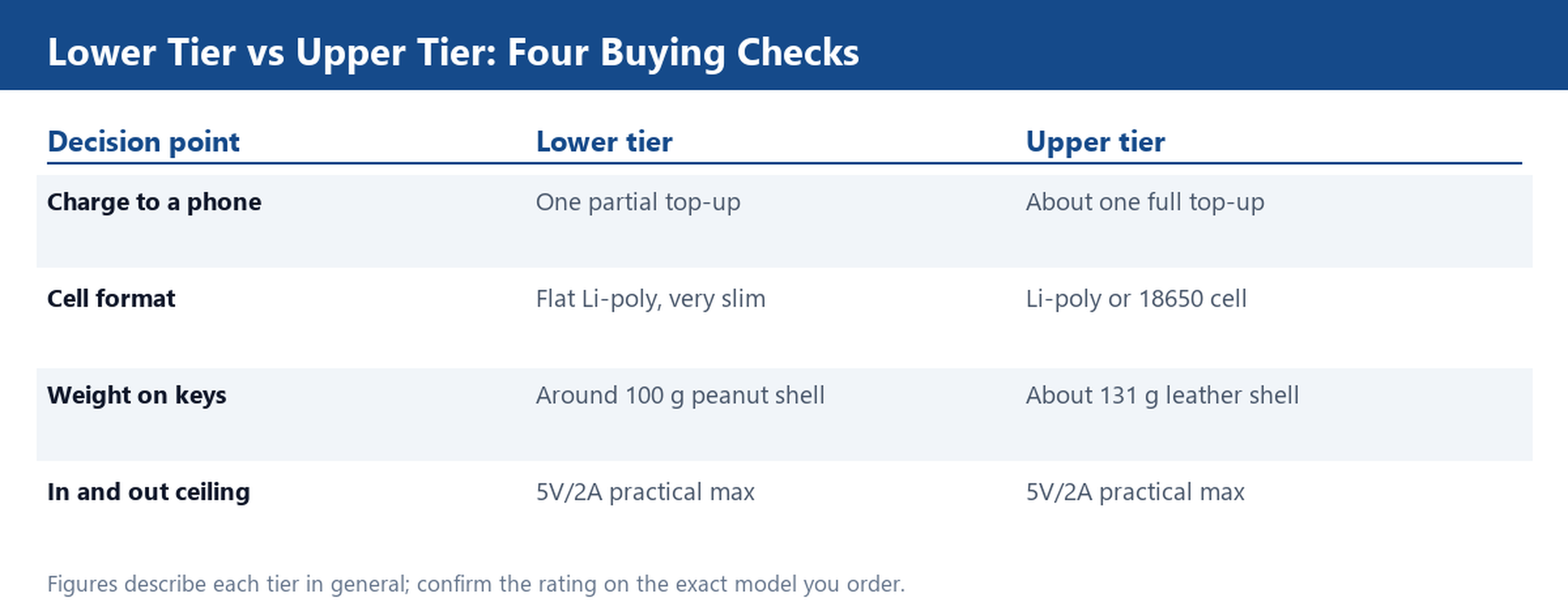
Treat any higher headline figure on a keyring unit as a question to ask, not a feature to bank on. Ask what input the cell actually accepts, what the continuous output is after thermal throttling, and whether the rating applies to a single port or to a shared total. A vendor who answers with a single peak number is describing a laboratory moment; a vendor who gives a continuous rating is describing a charge. For procurement, the continuous figure is the one that belongs in your comparison sheet.
The grams on the keyring: 100 g against 131 g
Weight is the specification people notice after a week, not on a product page. A compact peanut-shell body around 100 g disappears into a pocket and stays there. A leather-effect shell at about 131 g looks better on a desk and carries a perceived value that suits a corporate gift, but it pulls noticeably on a keyring and is the shape most likely to be left at home. The right choice depends on where the unit is meant to live: on the keys every day, or in a bag for occasional use.
Do not fill the gap by guessing. Weigh the finished sample with its keyring attachment fitted, because the split ring and the shell trim can add a surprising amount. Then hand it to three people and ask them to shake a key set with it attached. That informal test catches a bulky housing faster than any dimensional drawing. If the program is a giveaway, the lighter body usually wins on actual carry rate; if it is a premium gift, the heavier shell earns its keep through finish and print area. Our about us page explains how we handle sample approval for both cases.
Air freight, giveaway paperwork and the sample step
Lithium batteries travel under rules that are unrelated to the charger specification. A keychain power bank shipping by air typically needs a UN38.3 test summary for the cell and the assembled pack, plus an MSDS for the pack. On the commercial side, the usual conformity marks for the EU and US markets are CE, FCC and RoHS; keep each report tied to the exact model number, because a certificate for a sibling model does not automatically cover yours. Recheck the documentation set each time the cell supplier changes, even when the outer shell is unchanged.
That paperwork is part of the selection, not an afterthought. Ask for the test summary before you approve artwork, and confirm that the model number on the report matches the number that will be printed on the shell. When the documents line up, the last step is a physical sample: hold it, charge a phone once, and check that the print area survives a keyring. Tell us the capacity tier and artwork area and we will send a keychain sample for approval.