

Almost every warranty claim on a built-in cable power bank ends at the same place: the point where the cable leaves the shell. The cell is usually fine, the board is usually fine, and the unit still goes in the returns bin because the conductor broke inside the moulding after a few months of being bent against a bag. That single failure mode should drive the specification, the sample test and the price conversation, and it is the one line most quotations leave out. This guide works through how to choose built-in cable power bank specifications in the order the product actually fails: the exit first, then the connector set, then the cell.
Why a Built-In Cable Fails at the Exit, Not in the Cell
A built-in cable turns a fixed connection into a moving one. On a conventional power bank, the cable is a separate part: it bends, it wears, and when it finally breaks the user replaces it for the price of a cable. On a built-in design, the same bending happens at a joint that cannot be replaced, inside a shell that also has to hold the cell, the board and the connector. The mechanical load moves from a consumable part to the product itself.
The load concentrates in a very short length. Every time the unit is dropped into a pocket, the cable is folded flat against the body; every time it is pulled out by the cord rather than the shell, the exit takes a peel force it was never designed for. Inside the moulding, the conductors are stranded copper a fraction of a millimetre thick, and repeated bending work-hardens them until one strand after another snaps. The resistance rises slowly at first, which is why the unit still charges and the user does not complain, and then the last strand goes and the cable is dead.
Two design answers exist, and they are not equal. A moulded strain relief that tapers gradually from the shell spreads the bend over a longer length, so the copper sees a gentler radius. A metal or hard-plastic collar does the opposite: it holds the cable rigid up to a sharp edge and moves the failure point a few millimetres outward, where it is even harder to see. Buyers who compare samples by looks alone tend to prefer the metal collar, because it feels more expensive. Buyers who compare them by return rate learn to prefer the taper.
One Connector or Three: What Each Plug Adds to the Unit Cost
The connector set is the second decision, and it is usually framed as a marketing question when it is really a cost and failure-rate question. A single USB-C tail is the simplest build: one set of conductors, one moulding, one crimp, and the shortest possible exit. It also narrows the addressable market, because a buyer whose customers still carry older handsets will not place the order.
Adding a second plug, typically a Lightning-compatible tail alongside USB-C, doubles the conductor count inside the same shell and adds a second crimp at the exit. The shell has to grow or the cable bundle has to thin, and thinning the bundle is the cheaper option that costs reliability later. A three-plug version, usually USB-C, Lightning-compatible and Micro-USB, adds a third tail and often a small selector or a permanently live set of three, which is the worst case for the exit: three cables leaving one hole, each able to pull on the others.
The commercial rule that follows is simple. Price the extra plugs against the returns they prevent, not against the retail price they justify. A two-plug unit that sells into a mixed-device market is usually worth the extra crimp. A three-plug unit sold on connector count alone usually is not, unless the shell is redesigned around the bundle rather than the bundle squeezed into an existing shell. Our built-in cable power banks are listed with the connector set stated per model so the trade-off is visible before quoting.
Strain Relief, Overmold and the Bend Test to Run Before Sign-Off
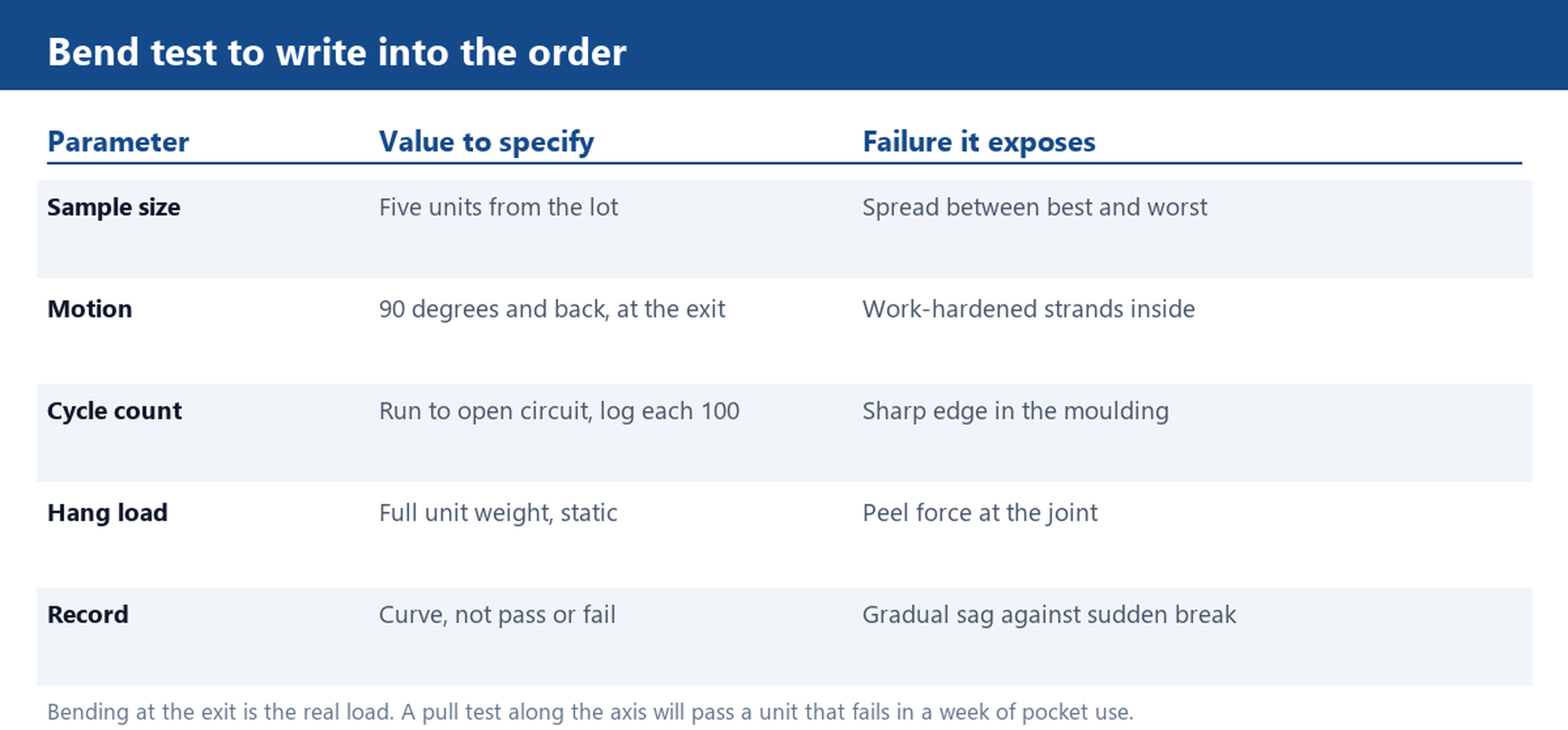
A bend test is the practical way to know whether the exit will survive, and it is cheap enough that there is no reason to skip it. Clamp the body, hold the cable straight out, bend it to ninety degrees and back to straight, and count the cycles until the conductor goes open. Run it on five units from the sample lot, not one, because the spread between the highest and lowest unit is the number that predicts field returns.
What matters is that the test matches the abuse. Bending at the exit is the real load; pulling along the axis is not, and a pull test on its own will pass a unit that fails in a week. If the design includes a hanging loop or a lanyard, add a static hang test with the unit at full weight, because that load is constant rather than cyclic and it attacks the same joint from a different direction.
Record the results as a curve rather than a pass or fail. A design that survives a few hundred cycles and then fails abruptly is different from one that degrades gradually and still conducts at the end, and the two point at different fixes: the first is usually a sharp edge inside the moulding, the second is a bundle that is too thin for the bend radius. Both are correctable at the tool, and both are invisible on a quotation.
5000mAh Bedside vs 10000mAh Travel: Matching Capacity to the Room
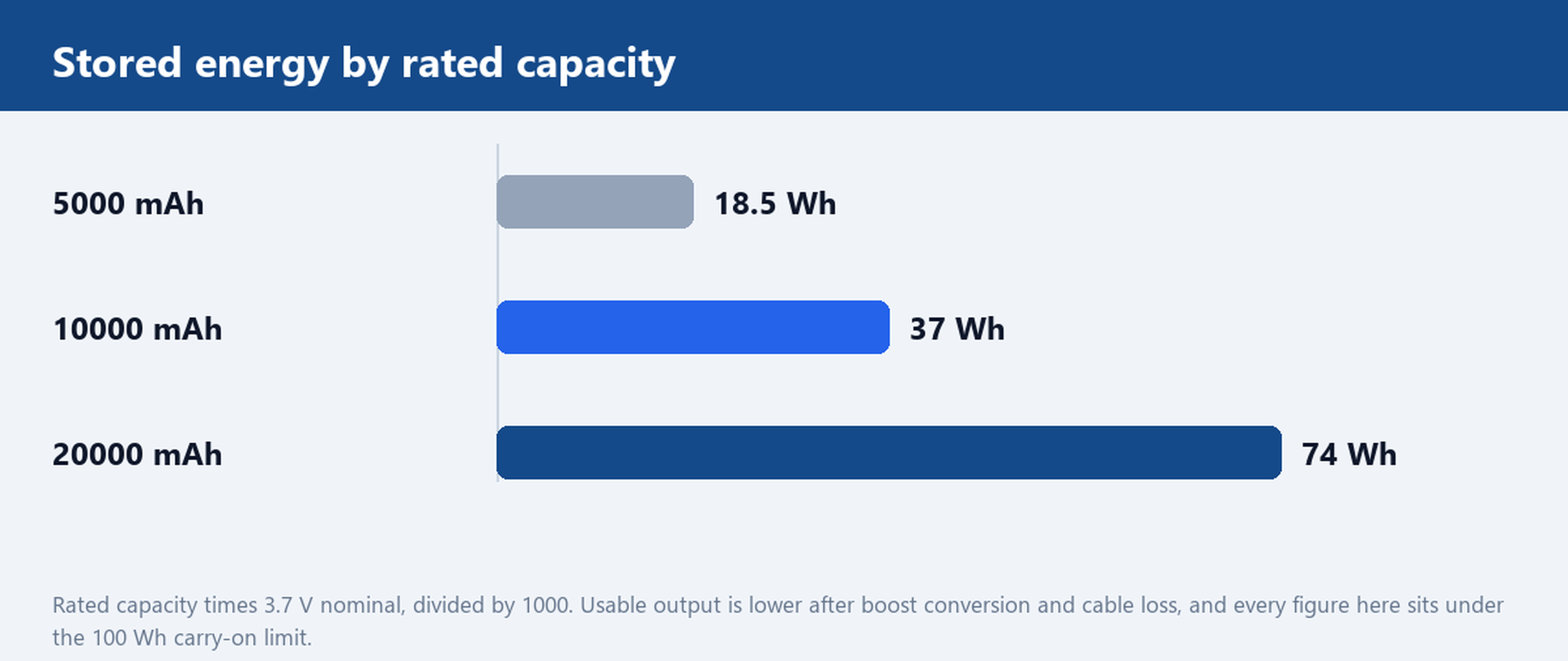
Capacity should follow the place the unit lives, not the largest number the cell supplier can offer. A 5000 mAh pack at a nominal 3.7 V holds about 18.5 Wh of energy. After the boost conversion and the cable, less than that reaches the phone, so a pack in this class tops up a modern handset about once. That is exactly the right amount for a bedside unit, where the job is to get a phone through the night on a socket that is out of reach, and where a heavier pack is simply a thing that falls off the table.
A 10000 mAh pack doubles that to roughly 37 Wh and earns its weight when it travels: two or three top-ups across a long day, a tablet included, and enough margin for a delayed connection. Both figures stay far below the 100 Wh carry-on limit that applies to lithium packs on most airlines, which is worth stating on the packaging because it is a question buyers ask at the airport rather than at the shelf.
The mistake to avoid is treating capacity as the differentiator that matters. A 5000 mAh bedside unit with a good exit and a sensible cable length will outperform a 10000 mAh unit whose cable dies in three months, because the customer experience is defined by the connector, not the cell. Our 1000 to 5000 mAh and 5001 to 10000 mAh ranges are grouped this way so a room-based assortment is easy to build, and the 5000 mAh bedside built-in cable model is the shape most care and hospitality buyers settle on.
A Spec Sheet That Makes Two Quotes Comparable Line by Line
Two quotations for the same nominal product are rarely comparable, because each hides a different decision. The fix is to send a specification sheet with the enquiry and require it back, filled in, with the quotation. Six lines carry almost all of the risk: the connector set and its exact count, the conductor gauge per tail, the strain relief type and its length, the rated output per port, the cell type and capacity, and the bend test result from the sample lot.
Add a seventh line for the certification files the unit will ship with, since a pack with a built-in cable is still a lithium battery product and the paperwork has to match the cell actually used. And add an eighth for the idle behaviour: whether the unit shuts down when nothing is connected, because a board that keeps a boost converter alive will drain a pack sitting in a drawer and generate a complaint that looks like a cell fault.
With those lines filled in, the comparison stops being about price per unit and becomes about price per surviving unit. That is the number a buyer can defend internally, and it is the number a supplier can actually be held to.
Send your target capacity and the connector mix you need, and we will quote the built-in cable line with the exit strain relief detailed on a physical sample. The mini power bank range covers the smaller shells where the exit geometry is tightest, and the power banks by use index is the quickest way to shortlist by room or by trip.