

A mini power bank for power outage duty is a sizing decision disguised as a spec sheet. The drawer bank people reach for when the lights go out is usually a 2,500 to 10,000 mAh unit, and the useful question is never how large the number on the casing looks. It is whether that number covers one phone call, a whole evening of messages, or a phone plus a second device, and whether the bank can be brought back to life while the mains is still down. This guide reads the capacity tiers, the recharge path, the LED fuel gauge and the storage habit in plain terms, using only stated nameplate ratings and common electrical behaviour. Every figure below is a printed capacity or a widely accepted rule of thumb, never a promise about a particular device. 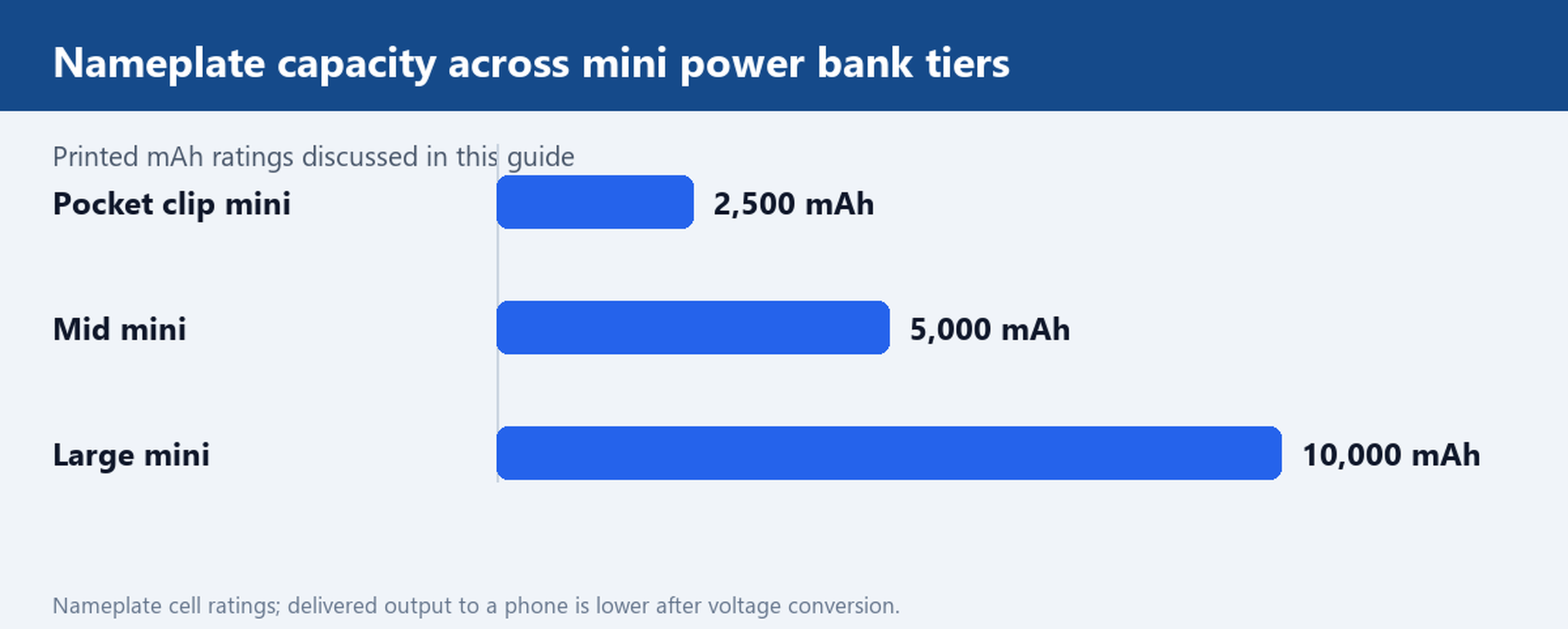
Sizing the Bank to the Outage, Not to the Spec Sheet
Begin with the job, not the number on the box. A power cut has two very different shapes. One is the short interruption where a household wants a single phone to stay reachable for a call or two. The other is an evening or a full day without mains, where a phone may be topped up more than once and a second device enters the picture. A mini power bank for power outage planning is chosen differently for each. Write down the devices that must stay alive, note which of them take a standard 5 V input and which expect a higher-voltage fast-charge input, and decide whether the bank is for one person or a room. That short list does more to pick a capacity tier than any comparison chart. It also exposes a common mistake: buying a large bank that stays in the drawer because it is bulky to carry, when a smaller unit that is always in a bag would have been used. Browse the mini power banks range with that list in hand, and treat capacity as a response to a defined outage rather than a status symbol.
Rescue Tier and Full-Charge Tier: Reading mAh Honestly
Nameplate capacity is the starting point, not the finish line. A 2,500 mAh pocket clip bank sits in the rescue tier: it is built to add a modest top-up, enough to place a call or keep a phone alive through a short interruption. A 5,000 mAh unit is the mid tier and can take a typical phone through a single short outage. A 10,000 mAh mini sits at the top of the range discussed here and can cover a phone plus a small second device. These are roles, not guarantees, because the figure printed on the casing is the cell rating before voltage conversion and overhead. Delivered output to a phone is lower than nameplate, so a buyer who budgets around the printed number should leave a margin. Read the 1,000 to 5,000 mAh and 5,001 to 10,000 mAh bands as a ladder of roles rather than a contest of size. 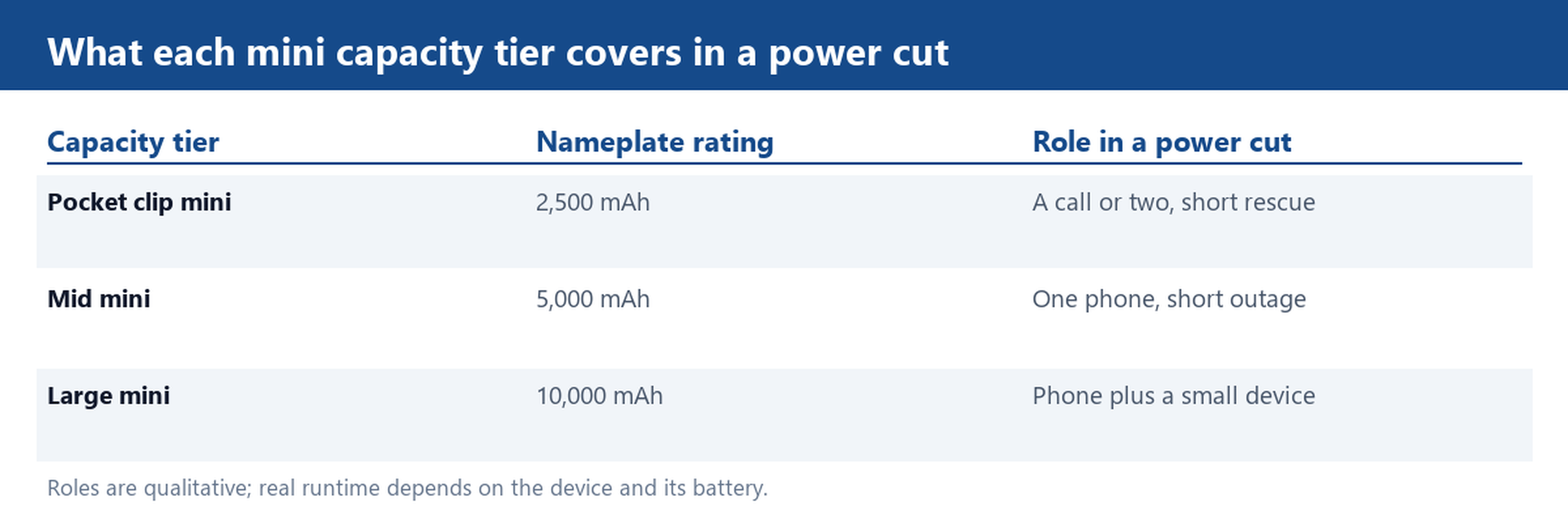
Recharging the Bank Itself When the Mains Is Down
A power bank is stored energy, and an empty bank is a paperweight until a source appears. This is the point most outage guides skip. Decide in advance how the bank will be refilled when the socket is dead. Options include a wall charge done before a forecast storm, a car USB outlet, a small solar panel, or a larger bank held back as a reserve. A plug-in two-in-one unit that folds into a wall socket collapses the charger and the stored battery into one object, which reduces the number of separate pieces to keep track of. See the multi-function power banks category for that form factor, and the two-in-one wall charger bank for a concrete build. The practical rule is simple: the bank relied on during an outage should be charged on a routine, not only after it is already empty, because there may be no chance to refill it mid-event.
LED Readout, Pass-Through Charging and Standby Drain
Three small features decide how a mini bank behaves in the dark. First, the LED fuel gauge: four bars or a percentage display tells a buyer how much is left, which matters when there is no way to know when power returns. A bank with no readout turns every decision into a guess. Second, pass-through charging, where the bank charges a phone while it is itself being fed from a source; useful when a car outlet or a solar panel is available for a limited window. Third, standby drain. A bank left charged in a drawer slowly loses energy, so a unit with low idle consumption is the one that still works months later. Look at the Power Bank Mini for a compact example of the category. None of these features change the nameplate capacity, but together they decide whether the stored energy is actually there at the moment it is needed, and a buyer who checks them before ordering avoids a bank that looks adequate on paper and disappoints on the night.
Cycle Life and How to Store It Between Seasons
Lithium cells age whether or not they are used, and heat speeds that up. An outage bank that lives in a hot car or beside a radiator will be in worse shape than one kept at room temperature. Storage practice matters more than most buyers expect: leave the bank around a partial charge rather than full or flat, top it up on a calm schedule through the year, and keep it away from direct sun. Avoid treating the printed cycle figure as a countdown, because real life depends on depth of discharge and temperature. The goal is not to maximise a number on a datasheet but to have a bank that still holds a useful charge when the lights go out without warning. If the kit is for a household, a small bank per person often works better than one large shared unit that nobody can find at the critical moment. Tell us the phone models in the kit and we will quote two capacity tiers with samples; reach us through the contact page and we will size the rescue tier and the full-charge tier against the devices you actually carry.