

Learning how to choose slim power bank models is a thickness question before it is a capacity question. A slim unit is bought to disappear into a shirt pocket, a gift box or a card slot, and every millimetre shaved off the body changes which cell can fit inside. The buyer who compares only milliamp hours ends up with a thick unit that never leaves the drawer, or a thin one that cannot get a phone through a commute. Four figures settle the choice: body thickness, cell format, capacity tier and the charge and output rates.
Short version: an 11 mm body is the practical floor for a useful pocket unit; below roughly 2,500 mAh the capacity stops being worth carrying; a 10,000 mAh slim model is a two-day or shared-device proposition, not a jacket-pocket one; and a 5V/1A input means the largest tier is an overnight charge. The arithmetic behind each of those statements is below.
Thickness First: What 11 mm Buys and What It Costs in Capacity
Thickness sets the cell format, and the cell format sets everything else. A body around 11 mm can hold a single layer of pouch cells with a thin PCB on top and still flex enough to survive a pocket. Push toward 8 mm and the cell layer has to get thinner or the capacity drops sharply; the housing also loses the stiffness that protects the cell. For a retail or gift line, 11 mm is the point where the unit still feels solid and still fits a card pocket.
The cost is capacity per square centimetre. A thin body can only grow in length and width once it can no longer grow in depth, which is why slim models are visibly longer than a chunky unit of the same mAh. When a supplier quotes a high capacity in a very small, very thin shell, ask for the physical dimensions alongside the number. If the footprint and the thickness cannot hold the cell volume, the figure belongs to a different model. Our power bank types are grouped by exactly this trade-off.
Pouch Cells, Not Cylindrical: Why Slim Bodies Run Li-Polymer
A cylindrical 18650 cell is about 18 mm across, so a body thinner than that cannot stack one without a visible bulge. Slim units therefore use lithium-polymer pouch cells, which are sealed in a soft foil bag and can be made long and flat. The format is not a premium feature; it is the geometry that fits the case. It also means the pack is less tolerant of a sharp edge or a point load inside the housing, so the internal layout and the wall thickness matter as much as the cell rating.
For a buyer, the practical consequence is that a slim power bank should be checked for how it carries, not just how it charges. A pouch pack pressed against a key or bent in a tight jeans pocket is being asked to do something a cylinder would shrug off. A rigid back plate, radiused corners and a snug cell cavity are the details to specify in the sample brief, because they decide whether the unit survives a season of pocket use.
2,500, 4,000 or 10,000 mAh: Sizing by Trip Length, Not by the Biggest Number
Convert mAh to watt hours before comparing tiers. Multiply by 3.7 V and divide by 1,000: 2,500 mAh is 9.25 Wh, 4,000 mAh is 14.8 Wh and 10,000 mAh is 37 Wh. At the 5 V output, with a conversion stage near 85 percent, those become roughly 7.9 Wh, 12.6 Wh and 31.5 Wh at the port. A modern phone battery holds around 14 to 18 Wh, so the tiers answer different questions.
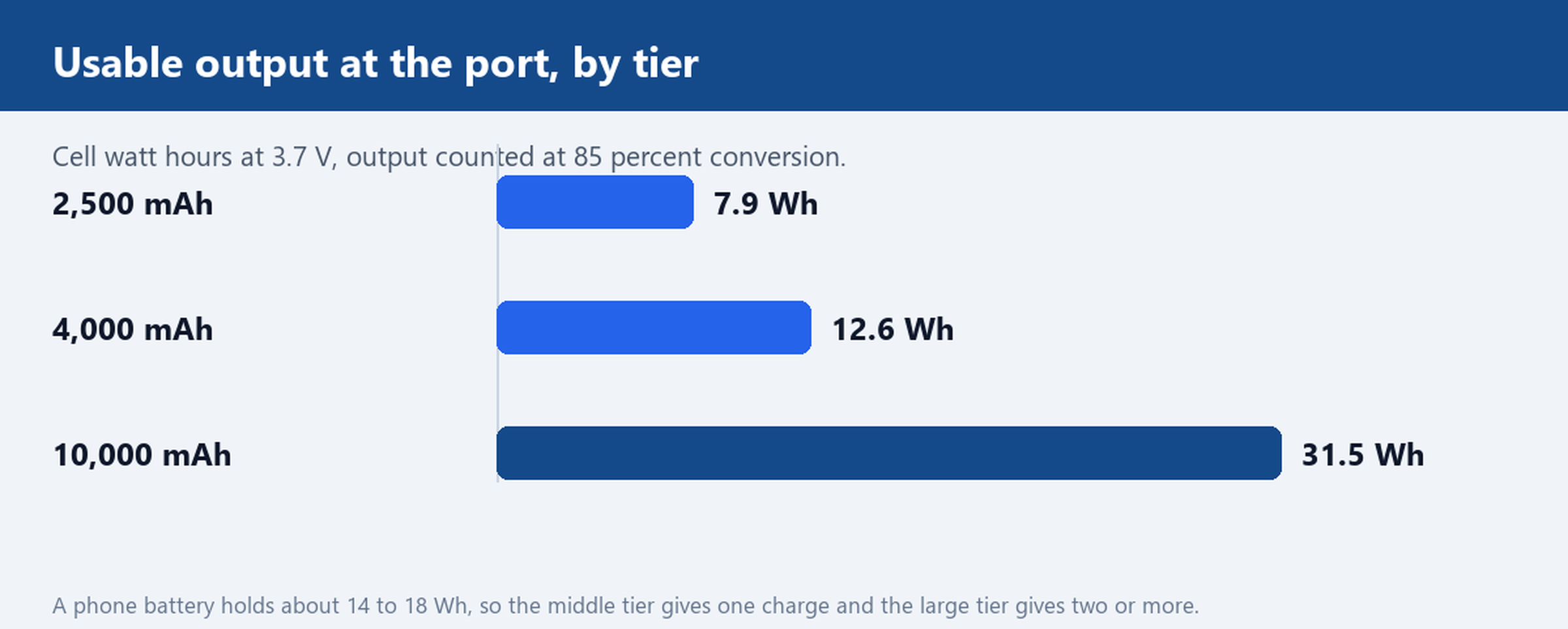
The 2,500 mAh tier gives a partial top-up, enough to add a few hours to a phone rather than a full charge. The 4,000 mAh tier lands near one full phone charge and is the natural pocket size. The 10,000 mAh tier covers two or more charges or a phone plus a pair of earbuds, but at 37 Wh it is heavier and takes longer to refill. Match the tier to the trip: a commute or an evening out needs the middle tier; a travel day or a shared desk needs the large one. The small-capacity range and the larger tier are separate buying decisions, not a ladder to climb.
5V/2A Out and 5V/1A In: Setting Charge-Time Expectations Before the PO
Output and input rates are often printed at the same size on a package, but they describe opposite directions and very different times. A 5V/2A output is a 10 W port, which is a normal charging rate for a phone and fine for a pair of earbuds. A 5V/1A input is a 5 W refill rate, and that is where expectation setting matters. Divide the cell watt hours by the input watts after allowing for conversion loss: 9.25 Wh at about 4.25 W of useful input is just over two hours for the small tier, 14.8 Wh is around three and a half hours, and 37 Wh is close to nine hours.
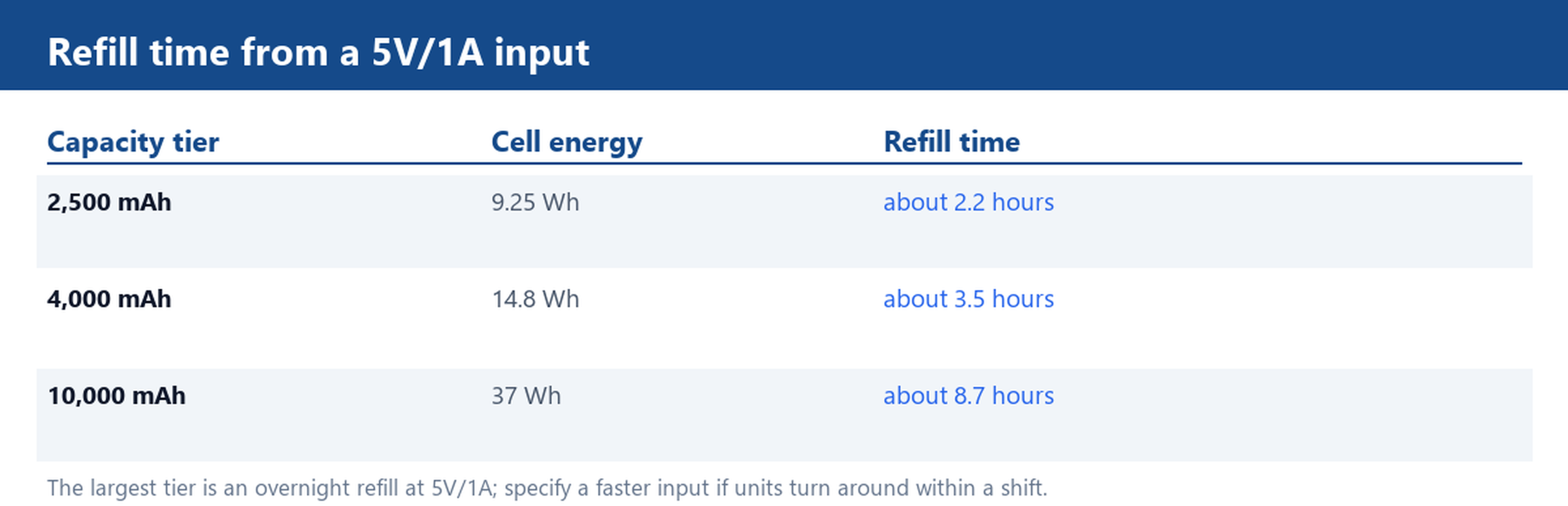
Nine hours is an overnight charge, not a quick turnaround. If the large tier will be used in a retail setting where units are recharged between shifts, the 5V/1A input will be a complaint. Either specify a faster input in the sample brief or plan the stocking around a full night. Write the input figure into the purchase order alongside the capacity, because two listings with the same mAh and different inputs behave like different products in the field. A faster-output variant is shown in our 10,000 mAh slim model for comparison.
Clip, Suction or Built-In Lead: The Carry Detail That Decides Returns
The last decision is mechanical, and it is the one that shows up in returns. A pocket clip holds the unit to a bag strap or a belt and suits the 2,500 and 4,000 mAh tiers, where the weight is low enough that a clip can carry it. A suction back sticks the bank to a phone for a hands-free charge, which works on a smooth case and fails on a textured one. A built-in lead removes the loose cable but fixes its length and connector, so it serves one device family well and others badly.
None of these is better in the abstract; each fits a route to market. A gift box favours a clean face and a short lead. A retail clip-on favours a light body and a secure clip. A travel accessory favours a longer lead and a larger tier. State the carry method in the sample brief and test it with the actual phone case and pocket used by the customer, because that is where a slim unit either becomes routine or gets left at home.
Send your pocket or gift-box size limit for a sample unit and a quote, and we will match the cell format, tier and carry detail to the route it will actually take. See our contact page to send the dimensions.